
Why a century later, the General Strike must not be forgotten - Jayne Dowle
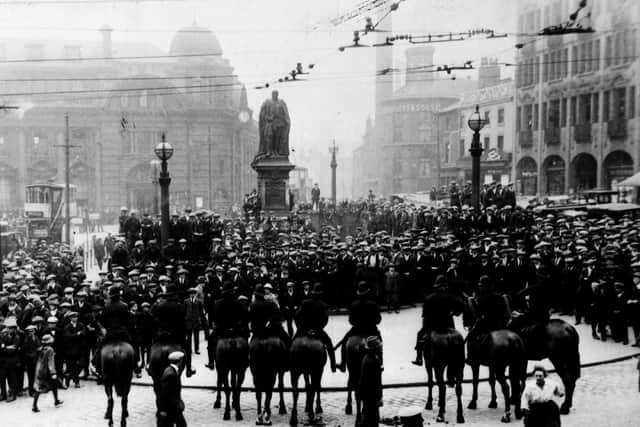
A century ago today the country had been brought to a halt by the General Strike. But the tragedy is that without the exhibitions and the brass bands and the marches and the rallies, the gigs and the university debates to commemorate, this event, so pivotal it’s described by many historians as the biggest ‘rupture’ in British society since the 1640s civil war, had been remembered by so few.

I did a quick straw poll of friends and family. Some friends here in Barnsley did know the basics, several confessed absolutely no knowledge at all.
My daughter knew an outline, but she did history at A Level and has had to live with me banging on about local history for all her two decades on earth.
My son knows, but that’s because the folklore of coal-mining has seeped into his bones.

He and his close pals – after a pint or two in the pub that was built next to the old canal basin where the coal barges worked - talk wistfully of the times when the pits employed thousands of people in our town, and how they would go down in a heartbeat if they ever opened up again.
A very romantic, rose-tinted notion perhaps, that over-rides the immense danger of working underground, the emphysema, and the severe disabilities so many miners suffered, but one of the reasons why the General Strike can’t be forgotten.
It’s not dusty ancient history however. We might not talk about it much but the General Strike had a profound effect on society.
The General Strike still colours how people view trade unions, as fighters for workers’ rights, or the enemy within, depending on your political point of view.
Indelibly, it solidified British class divisions and also shaped the way that governments – particularly Conservative governments, in 1926 led by Stanley Baldwin – regard workers. Especially the miners, who had the power to cut off coal supplies and bring the nation to a standstill and their formidable organisation.
Margaret Thatcher, not yet one year old when the General Strike happened, would have grown up knowing what unions were capable of.
This was brought into sharp focus when she served as the Secretary of State for Education and Science in Edward Heath’s Cabinet during the miners’ strikes of 1972 and 1974, which saw power cuts, a three-day working week and violent clashes between strikers and police. And she got her revenge, in the 1980s, when she remained intransigent in the face of strikes in the coal and steel industry and brought them to their knees.
My grandad – all the men in my family were coal-miners then – certainly never forgot, nor let me forget. Before I started school he would walk me all over the village, where the clamouring pit still stood working on the valley-side, the noise and the smell of the adjacent coke works always in the background.
He was born in 1901, so a young man in the strike. This was almost half a century later, but he still spoke of those who ‘came out’ and those who ‘went back’. After the General Strike ended many miners stuck it out alone for months, fuelling the exceptionalism that ran deep through future industrial disputes.
My grandad was a mild man, football was the only time he got passionate about anything, but the strike, or the ‘lock out’ as he often called it, was a pivotal experience of his life.
It shaped his quietly-held Labour politics, but it galvanised my grandma. She was 15 during the strike; her family were dirt poor, she remembered being sent to ‘pick’ coal off moving railway trucks and running to escape the local bobby.
The General Strike started on May 3-4 when millions of workers, in transport, factories, printing, and heavy industry walked out to support the coal miners, locked-out by mine owners in a bitter dispute.
The coal industry was in crisis; after the boom years of the First World War, in the face of intense international competition – countries such as the USA were rapidly mechanising – exports were suffering.
Meanwhile, the ownership and management of the British coal industry was hopelessly fragmented, our own technology was outdated, the pressure was on the men with the picks and shovels.
Rather than negotiate, the bosses cut wages and made the working day longer.
In our region, and in many others, these miners were our grandparents, our children’s great-grandparents.
Only four generations might separate their world and ours. It is far, far too early to forget what they did. Or to assume that the battle for equality, respect, fair pay and decent working conditions is over.