
Why Britain needs to be careful with its posturing on Ukraine - Patrick Mercer
What on earth is Britain doing? I’d hoped that one of the big differences between our last government and the present one would be an end to the Tories’ hideous jingoism and empty posturing in Ukraine with a much more sober and realistic attitude marking our support for Kiev.
But no: on we stumble, way out in front of the US and the rest of NATO apparently hell bent on war with Moscow.
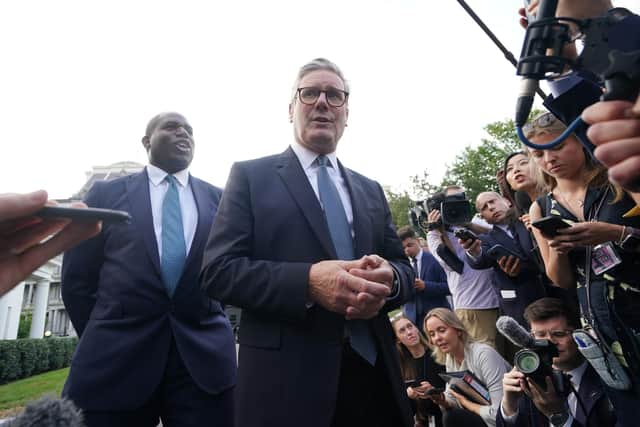
Central to British policy, of course, is the issue of deep strikes onto Russian land using the Storm Shadow missiles that we have already given, or earmarked, for Ukraine. Sir Keir and his less than impressive Foreign Secretary, David Lammy, have already made fools of themselves over this issue having first promised Ukraine that they could use British weapons and then, when the White House cavilled, saying that it would all be resolved when the PM met the President a few days ago.
Well, it wasn’t. The US clearly has no intention of allowing such strikes and, although it’s been bruited about that Britain might be allowed to act unilaterally, that’s just nonsense. But that didn’t stop five ex-Defence Secretaries insisting that Storm Shadow should be fired, echoing the idea that Britain should go it alone, but weren’t they listening when the MoD briefed them about these weapons?

They should know that the missiles’ navigational systems are US made and controlled, so any ‘British’ attack would also be partially American and that is not going to be permitted. Also, there are probably no more than 120 missiles available and most Russian airfields - the critical targets - are out of range. Add to that, Russia has world class air defences - as already demonstrated by the number of Western projectiles that have been intercepted. With this in mind, how many of these precious rockets would get through?
The thing that’s most confusing about all this, though, is why Britain is choosing to be the most aggressive country in NATO. Of course we have deep interests in Russia and Ukraine and need to behave as one of the leading members of the Alliance, but NATO’s most powerful shareholder, Uncle Sam, can normally be expected to lead in such confrontations. It’s US policy - backed by her wealth and military strength - which always leads, yet in this deeply dangerous situation, Britain’s trying to call the shots.
Why, for instance, was Boris Johnson so deeply involved with Ukraine and why did he start the pattern of our financial and physical contributions to this bloody war? It’s widely believed that it was he who persuaded Mr Zelensky to overturn the tentative peace agreement of April 2022 and to fight on. Even today he wields great influence in Ukraine and tries to speak for Britain like a sham Churchill. Now Labour’s copying him.
There may be some justification for seizing the lead if Britain had the military resources to back her words. Unlike France which has not just suggested sending troops to Ukraine and then held a force in readiness to deploy, Britain has talked tough whilst continuing to cut her forces. It absolutely beats me why Ukraine should take Britain’s strategies seriously; to my deep regret we have become nothing more than a paper tiger.
Just supposing that Joe Biden, in his dotage, agrees to Westminster’s demands that our missiles should be allowed to fly deep into Russia: what would Mr Putin do? Well, he’s already said that such attacks would change the nature of the conflict and provoke counter strikes on NATO countries.
Naturally, that’s designed to deter, but perhaps it might not mean that Russia would get into a shooting war with the whole of NATO - which she doesn’t want to do. Perhaps, for all the reasons mentioned above, a Storm Shadow strike would be ineffective and the Kremlin might hope to shrug it off, but that would excite a huge amount of internal criticism.
No, I think we’ve already seen how Russia might react.
A few days ago the Houthis fired what they claimed to be a new pattern of hypersonic missiles from Yemen towards Israel, flying many hundreds of miles through airspace which, certainly in the northern parts, is under Tel Aviv’s air defence. A Houthi media official said, “A Yemeni missile reached Israel after 20 missiles failed to intercept’ it,” which wasn’t entirely true, but the weapon did get through, although it didn’t cause much damage.
The point is, Russian expertise and equipment were certainly behind this attack coming, as it did, at a particularly sensitive time. And even the partial success of the attack will have been carefully noted by NATO.
It doesn’t take much imagination to see Russia retaliate not by counter strikes directly against Allied countries, but by attacks from Syria to the Arctic, anywhere where there is friction between the superpowers.
Now, it’s possible that America will suddenly change direction and allow both herself and Britain to use long range missiles - but I doubt it. The US’s joint chiefs of staff seem to be very clear about the risks that Russia poses and, so far, have kept America’s more reckless politicians in check.
If that holds true, Starmer, Lammy, various tame generals and even B Johnson can bluster and prose as much as they like about a handful of rockets that they’ll never be allowed to use. Their empty words help Ukraine not one jot and have absolutely no effect upon the Russians who know exactly what the true position is. Still, if such hollow posing keeps our betters happy, who are we to argue?