
Why North Yorkshire councillors rejected the Burniston gas drilling proposal - Andy Brown
Right now it isn’t hard to find examples of extreme political disagreements. So when effective cross party collaboration happens it tends to be for good strong reasons.
After local councillors in North Yorkshire read hundreds of pages of documents and listened to five hours of presentations and debate, not a single one of them voted in favour of a proposal to put a gas drilling test rig close to a delightful village on the outskirts of Scarborough.
All of those councillors are very experienced and have sat on many planning committees approving many developments whilst rejecting others and they are well used to judging applications fairly against hard evidence and national or local planning rules.
They weren’t convinced by suggestions that any industrialisation of a heritage landscape would be a small temporary inconvenience. The motion for rejection may have been put forward by myself as a Green Councillor but it was firmly supported by Conservatives, Liberal Democrats and Labour Councillors who all agreed that it didn’t comply with several of our policies and would be more likely to harm our local economy than help it.
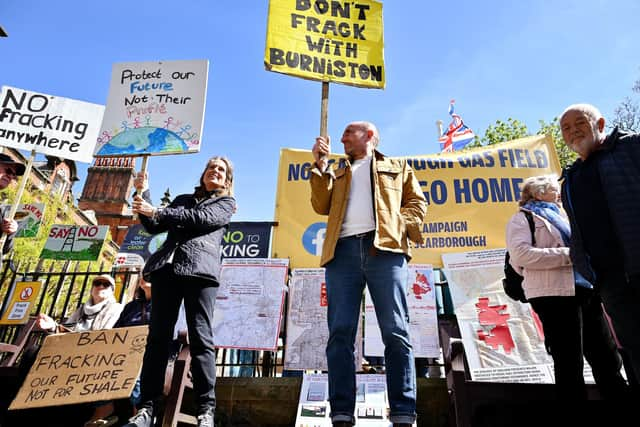

To understand why it is not necessary to study long and complicated arguments about whether what was proposed counted as a form of fracking or whether it was helping or harming our energy mix. It was only necessary to look at the impact on the local community and think logically about whether that was minor or significant.
The drilling rig that would be erected was going to be 38 metres high. That is higher than a ten story building. There was a shrouded gas flare burning day and night all throughout 15 weeks which was more modest in height. It was only 12 metres high or above the roof line of a three story house. On top of that there were other installations and machinery which were seriously out of place in a tourist location.
When it was proposed to put two wind turbines on this land it was considered inappropriate industrialisation and rejected both by North Yorkshire and on appeal. This proposal involved much more significant industrialisation on a heritage coastline.
The national cycle network includes a highly popular route that goes from Scarborough to Hayburn Wyke and passes within 200 metres of the proposed development outside Burniston. There is meant to be a 4km visual protection zone for such significant tourist routes. The last time I checked 200 metres was a lot less than 4km.
Another major tourist facility which is exceptionally close is the North York Moors National Park. This is such a special location for its night sky that Countryfile recently ran an entire episode describing its attractions. Elected representatives of the local community were not convinced that tourists would find the night sky quite so special if they arrived to find a 38 metres structure lit up all night right on the edge of the park.
Then there were concerns about the impact on local residents. North Yorkshire has longstanding plans which clearly say that any oil and gas development built within 500 metres of where people live needs to pass exceptionally robust policy tests. There were residents living within 320 metres of this one and one of the documents submitted by a local Parish Council claimed that there were 37 properties within the sensitivity zone.
Those residents were subject to risks of what was called fugitive gas releases. No I didn’t understand it either until I’d read it several times. It means accidents. There is no condition the planning committee could have implemented that would have completely avoided that risk. The committee had also received a report about air quality submitted by the developer which indicated that there would be some smells of sulphur and levels of nitrogen oxide would exceed recognised limits.
Councillors took the view that we are of little worth if we allow quite so many local residents to be subjected to the level of nuisance this development offered and that we could not guarantee every aspect of their protection when living in their own homes.
We did not take a view on the risk of triggering seismic activity on a coastline which is known for landslips. Not because we didn’t think that risk existed but because lawyers told us that regulating that is nothing to do with granting planning permission.
The long, thoughtful and careful deliberation that led so many councillors holding very different political views to agree that this was an inappropriate development resulted in relief in the local community.
For a short while. Because the decision of their elected councillors is not the end of the matter. If an application is approved local residents have no rights to appeal. That is that. Case over. If an application is rejected the potential developer does have a right to appeal and an appointed planning officer from national government will lead an enquiry and make a decision.
When people elect their local councillor they expect them to make decisions about what local developments are appropriate. Increasingly those powers of your local representatives are being weakened or removed and the current government is enthusiastically championing that approach. The residents of Scarborough and Burniston are entitled to think differently.
Andy Brown is the Green Party councillor for Aire Valley.