
Why Putin may not be losing any sleep over the downfall of Assad in Syria - Patrick Mercer
In the 19th Century they called the endless power struggles between Russia and the British Empire, ‘The Great Game’. Well, now it seems that the 21st Century’s equivalent has taken yet another twist. Mr Trump’s election victory is already having a profound effect and last week President Biden’s people and all those in NATO who support his policies decided to turn the heat up.
With fewer than two months left before power, attitudes and ambitions are changed irrevocably, a very great deal has already altered on the international stage.
From Russia’s perspective, a number of things have gone wrong. Georgia’s suddenly in uproar, Serbia’s restive and, most importantly - and apparently without any warning from Kremlin Intelligence, Syria’s imploded.
The situation is still far from clear, but here’s a simplistic explanation. For the last decade or so Russia’s been supporting the Assad regime in Syria with money, troops and weapons helping to control a number of opposing groups who have risen up against the regime.

The clearest manifestation of this is a major, Russian airfield and a small port on the western coast which gives the Kremlin access to the Mediterranean, a staging post for Africa and political prestige in terms of power projection.
On top of this, the grumbling insurgency that has beset Syria has always been seen to have the potential as a ‘second front’ for Russia in terms of the war in Ukraine. Indeed, it’s said that Kiev’s intelligence folk have been very active there.
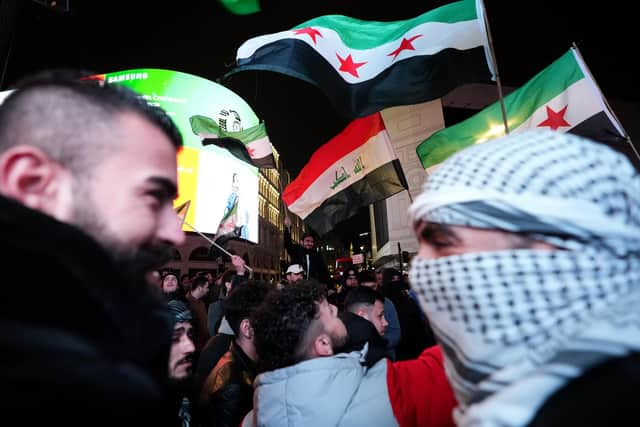
Then, just after Mr Trump triumphed, the quietly bubbling civil war erupted. President Assad’s Russian backed army collapsed, he fled to Moscow and now it seems as though Mr Putin may decide to order his ships, men and planes to evacuate the country.
There are at least three, competing elements in the forces that have risen up, though. The initiative belongs to Hay’at Tahrir al-Sham (HTS), the Ankara sponsored jihadists with links to Al Qaeda, who have swept over Damascus and as far as the Israeli border in the south.
To add to the jigsaw, despite treaty agreements, Israel simultaneously moved forward from her positions on the Golan Heights into Syria to create a buffer zone there. Now she’s engaging many significant targets with aircraft and artillery, has sunk Syria’s navy and, at the time of writing, is thought to be pushing armour all the way towards Damascus.
In short - and in a typically pragmatic way - Israel’s knocking out weapons, sites and materiel which could pose a threat to her in the future. The consequences of all this will be for Mr Trump to resolve.
In parallel, both the Syrian Democratic Forces - Kurds supported by America - and the Turkish-backed Syrian National Army have capitalized on the HTS-led offensive to expand their territory. They’re now clashing bloodily in the north east of the country.
Meanwhile, our underwhelming foreign secretary, David Lammy has said the downfall of ‘monster’ Bashar al-Assad was a ‘humiliation’ for Russia and Iran, but I wonder if it’s as simple as that?
Certainly, Iran will be deeply scarred by all these events, but Russia has very different priorities. In the short term the Kremlin needs to concentrate everything she has on making territorial gains in Ukraine before Mr Trump succeeds as president. None of the three, outline peace plans suggested by Team Trump makes much sense to Mr Putin, so there’s every incentive to push harder against Kiev’s increasingly fragile forces.
Now, I’m sure the Kremlin’s putting a good face on the chaos in Syria, but Russia’s main interest is what Turkey will do, rather than the fate of the unfortunate Syrians. The relationship between Mssrs Putin and Erdogan is complex, but Turkey is a crucial consumer of Russian natural gas and indirectly exports surpluses to parts of Europe. Similarly, Turkey defies any number of the sanctions placed on Russia: she still trades with Moscow whilst allowing substantial passenger transit.
Despite providing drones and other weapons to Ukraine, President Erdogan has, essentially, been neutral in the Russian/ Ukrainian war. He has followed his own agenda whilst playing host in Istanbul to the peace talks of early 2022 which we now know came close to success.
Cleverly, Erdogan also engineered a grain export corridor in the Black Sea for Ukraine which also allowed Russian grain and other exports to move freely. Now he’s positioning himself as a broker for any future negotiations with the 2022 deal probably going to be used as a blueprint.
So, as a reward for Turkey’s diplomatic and physical support, Russia has looked the other way when her lesser allies have been confronted by Turkish expansionism.
A few months ago, for example, Moscow’s peacekeeping force did not intervene when Azerbaijan - Turkey’s ally - slammed into and then ethnically cleansed the Armenian enclave of Nagorno-Karabakh.
I have no doubt that Russia has now quietly connived at the removal of Assad and a considerable expansion of Turkish influence.
Much of our press is celebrating the demise of Assad and the deep humiliation of Russia, but is that right? Certainly, Mr Putin has his hands full in Ukraine, but by accepting Syria’s self-destruction Moscow has helped Turkey (a NATO ally, remember) to confront her US backed enemies - the Kurds - whilst complicating things even further for Israel.
The Western alliance has certainly been weakened by Turkey’s and, perhaps, Israel’s actions and the whole mess will be NATO’s focus for the foreseeable future. That distraction, of course, will leave Russia free to get on with the further subjugation of gallant Ukraine and put more pressure on the incoming US president.
Obviously, things can still change drastically, but I bet President Putin’s sleeping much more soundly than when this uproar started just a few days ago.
Patrick Mercer is a former MP for Newark and Army colonel.