
Why the people of York are relieved that Prince Andrew is no longer associated with the city - Andrew Vine
There was a time when the people of York were proud that a prominent member of the royal family bore the name of their city as part of his titles.

No more. The city’s relief at Prince Andrew relinquishing his status as Duke of York speaks volumes about how far he has fallen in the public’s estimation following years of damaging allegations about his admitted friendship with the monstrous American sex offender Jeffrey Epstein, who killed himself in jail.
That nobody in York would wish to have the good name of their city associated with Andrew any longer can be seen as representative of the whole country’s view of him as tarnished by scandal.
Even his own mother, the late Queen Elizabeth, tacitly acknowledged as much when she removed his honorary military roles and patronages of charities a few months before her death in 2022. By then, Andrew had already resigned from public roles.
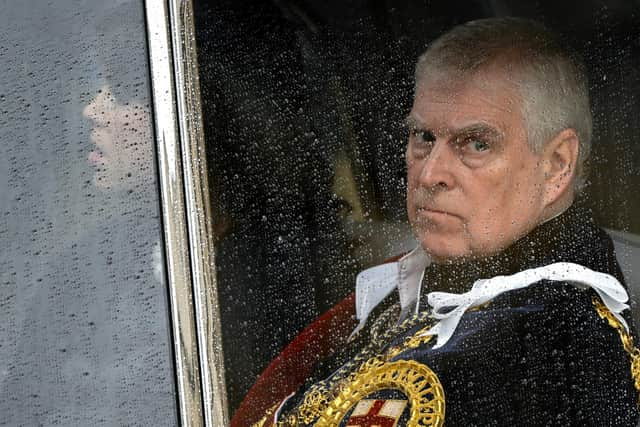

More than one opinion poll has found a clear majority of those questioned in favour of Andrew being formally stripped of his titles, even to the extent of him no longer being styled a prince.
Despite Andrew’s repeated denials of any wrongdoing in relation to Epstein, or to the late Virginia Guiffre, who sued him, alleging that she had been coerced into sex, accusations continue to dog the prince.
The publication of Ms Guiffre’s autobiography last week revived the allegations once more, as did an email suggesting Andrew’s association with Epstein continued after he stated it had ended.
That came only weeks after the publication of a book about Andrew and his ex-wife, Sarah Ferguson, Entitled, by Andrew Lownie, which painted a portrait of the couple that was unflattering to say the least.
Then there was his connection to a man accused of being a spy for China and barred by the Home Office from entering Britain. The allegation was denied by the individual concerned.
Attention has also turned to his living arrangements at the palatial Royal Lodge, in Windsor, with prominent Labour, Conservative and Liberal Democrat MPs calling for his tenure to be scrutinised.
There has not been a crisis as severe as this for the royal family since the Abdication in 1936. Even the public criticism it suffered for appearing to be unfeeling after the death of Princess Diana in 1997 doesn’t come close to rivalling the problem it currently has.
The monarchy has been damaged by the furore surrounding Andrew, the daily round of newspaper stories about him and his lifestyle.
He may be almost invisible to the public, except for snatched photographs of him out riding or driving around Windsor, but his presence nevertheless looms over everything the royal family does.
The King, still undergoing treatment for cancer, soldiers on carrying out engagements, as do the other senior members of the family, notably the Prince and Princess of Wales.
But the good work they do is currently being overshadowed and will continue to be until all the questions surrounding Andrew are addressed.
It remains to be seen if the efforts of individual MPs to secure an inquiry into Andrew’s finances – or those of the Crown Estate, which leased Royal Lodge to him – gain any traction, or even government support.
But something has to give if the problem Andrew represents to the royal family is not to rumble on for months longer – or even years, as it has since 2014, when Ms Guiffre first made her allegations.
Matters cannot continue as they are. The drip-drip of allegations and public criticism of Andrew is corrosive for the royal family. It would be the country’s loss if the monarchy was permanently harmed as a consequence.
If there was to be a proper look by MPs at the arrangements between Andrew and the Crown Estate, that would at least get one of the thornier issues surrounding him out into the open and enable the government to agree with the Palace what is in the best public interest.
There is, of course, a straightforward answer to it all. It is for Andrew to simply disappear, to move out of Royal Lodge and relocate somewhere far less prominent to live quietly, effectively as a private citizen with none of the trappings or status of a prince.
He could even follow the example of the Duke of Windsor, who after his abdication left the country and eventually made his home in France.
Doing so would be a service to his family, especially his older brother, and ultimately to the country.
And if Andrew will not step away of his own volition, nobody would bet against him being pressured by the King into such a course of action.