
Why we need more active travel infrastructure like cycle lanes in Yorkshire - Julian Pearce
Five years ago, I wrote for this newspaper about the importance of embracing active travel as a way of improving our town and city centres, protecting the environment and achieving better health outcomes.
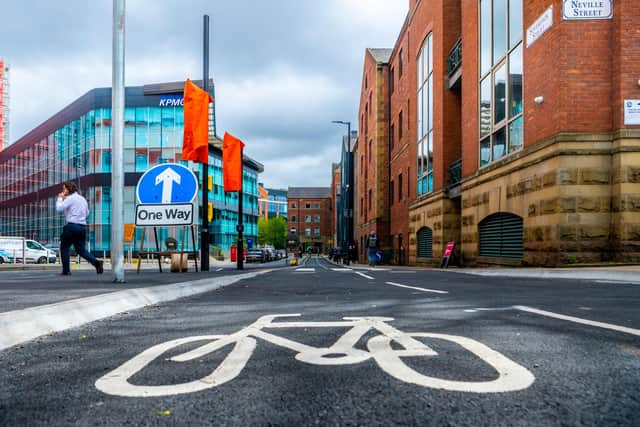
Promoting the benefits of active travel is different to promoting the enablers to active travel. Commuters will have noticed new infrastructure – bike lanes and suchlike – popping up across the region with increasing regularity. Our current City of Culture, Bradford, provides a prime example.
Such measures tend to divide opinion. Prioritisation of pedestrians and cyclists are highlighted by some as a bad use of public funds – or even as further evidence of ‘wokeness’ in pandering to a ‘minority group’. There is talk of ‘war being waged’ on the motorist.
Such views are increasingly isolated, as the benefits of car-free conurbations are being seen first-hand. But it is definitely a marathon and not a sprint.

Compared to other countries, we don’t perform well. The Netherlands is often hailed as a world leader in active travel, with the majority of journeys in Amsterdam now taken by bike. This is facilitated through an astounding 500km of cycling infrastructure.
But other international cities – Barcelona, Paris and Copenhagen all spring to mind – are also building with people, not cars, at the forefront of their plans.
So why has the UK been historically so bad? Our urban spaces have often been sprawling and constrained by historic infrastructure or tricky geography. Car dependency is a difficult habit to break – but it is possible.
Naysayers will question the ability to retrofit an area to be more people friendly, highlighting cost and disruption as barriers. However, the evidence is there that other cities have achieved this, through bold thinking, strong leadership and challenging the status quo.
While the Dutch are now rightly hailed as a nation that has embraced the bike, that has not always been the case. Indeed, if you visited the Netherlands in the early 1970s, you’d have witnessed a very different scene.
Interestingly, it was demands from the public to de-prioritise car use and act on deaths and injuries caused by motor vehicles that was the catalyst for this change. Public opinion and how the message – and benefits – are delivered, is crucial to the success of any change.
The benefits go well beyond a cost/benefit ratio dreamed up by transport planners and civil servants. They can be measured in multiple ways, for example in the increased productivity of a workforce or reduced hospital visits.
If you visit popular urban spaces in our towns and cities – The Piece Hall in Halifax, Centenary Square in Bradford, and newer developments, such as Wellington Place in Leeds – they all have one thing in common: people are prioritised over vehicles.
Normalising the infrastructure required to promote active travel is the only way of bringing these wider benefits to the towns and cities of the region. Yes, Yorkshire does have geographical challenges. If you asked me to commute by bike between Halifax and Leeds, my legs would have a thing or two to say about the hills on route, but where we can make it work, we should.
One of the most pleasing aspects of the renewed focus on active travel in this region, for me, has been in being proved wrong about investment decisions. When imposing and complex cycle lanes started popping up on my own commute into the office, I felt that these would actually deter people from getting on a bike, while causing more angst for those who were already against plans.
However, the mantra of ‘build it and they will come’ seems to ring true in this instance. It has taken a little while to come to fruition, but those cycle lanes have started to fill up.
And most importantly, they are being used by ‘normal’ people. Students dressed for a day of lectures, men and women in work attire and older people nipping into town for provisions (yes, and a few wearing Lycra too).
One of the biggest advocates of this more inclusive approach to active travel has been Chris Boardman. The Merseyside born Olympic and World Champion is now the commissioner for Active Travel England (ATE), the York-based executive agency, which is part of the Department for Transport.
It has recently been announced that Yorkshire has been allocated £29m of funds from ATE to improve, among other things, canal towpaths and walking routes. Speaking about the money, which is part of a wider £300m investment across the country, Boardman noted: “Free exercise, zero emissions and no risk of getting stuck in traffic are benefits already being enjoyed as standard by our European neighbours and it’s time we had the same life-improving choices.”
When we talk about discouraging car usage, we must do it hand-in-hand with improving the alternatives. Whether that is better public transport, reliable infrastructure or active travel, there is much to celebrate about the region’s present direction of travel.
Julian Pearce is the founder of communications agency Yasper.