
Yorkshire already has a richer, stranger and more fascinating version of the Robin Hood story - Michael Carter
The Death of Robin Hood opens this week. Starring Hugh Jackman as the eponymous hero, it’s Hollywood’s latest take on the Robin Hood legends, and in this instance presents audiences with an especially dark, violent and brooding imagining of an aged Robin and his ultimate death at an island nunnery.
Like all its blockbuster predecessors, it plays fast and loose with the centuries-old Robin Hood ballads that have entertained and inspired their readers and listeners since the Middle Ages — especially here in Yorkshire.
The earliest references to an outlaw called Robin Hood date to the thirteenth century. He crops up all over England, even into Scotland. But by 1500 he had acquired an especially close association with Yorkshire. Much of The Gest of Robin Hood, one of the oldest Robin Hood tales, is set in the county, notably Barnsdale Forest, near Doncaster. Yorkshire’s monasteries also play a key, if deeply unflattering, part. The abbot of St Mary’s Abbey, York, is a thoroughly nasty piece of work and it is at Kirklees Priory that the unsuspecting Robin is finally done to death by his kinswoman, its evil, lustful prioress.
It’s a cracking tale and historians have long been scratching their heads as to why Kirklees, one of Yorkshire’s more obscure monasteries, played such a pivotal role in the sad denouement of Robin’s saga.

The priory’s history goes back to the twelfth century. Its founder was one Reiner le Fleming, a Norman knight and local lord. Dedicated to the Virgin Mary, its nuns were recruited from posh families in the immediate locality. Many doubtless had a genuine religious vocation but in the mid-fourteenth century, Kirklees gained an unwanted reputation for scandal when three of its nuns were censured for ‘immoral behaviour.’ Their conduct left an enduring stain on the nunnery’s fame with Eileen Power, an early twentieth-century monastic historian describing the offending nuns as ‘incorrigible.’ For many scholars, it provided a ready explanation for the priory’s shameful role in Robin Hood’s murderous death.
In reality, religious life at Kirklees was probably much more honourable than this Chaucerian sexual scandal would suggest. Indeed, it was initially spared closure by Henry VIII because of its ongoing religious and social utility. When its eventual end came in 1538, the prioress and three of the nuns retreated to a nearby manor house to maintain a quasi-monastic life.
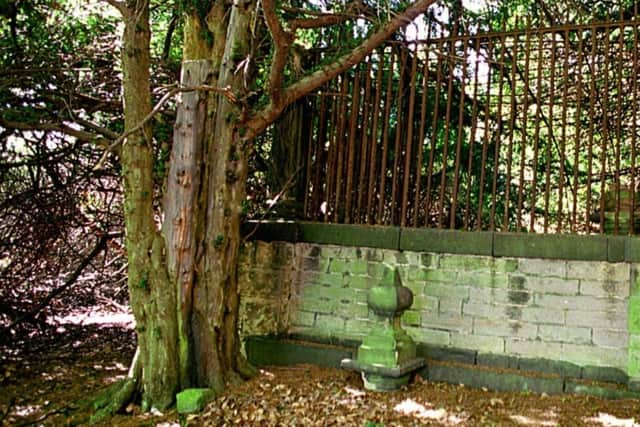
By then their priory’s association with Robin Hood was firmly entrenched. In the 1530s, John Leland, Henry VIII’s royal librarian and an indefatigable topographer, wrote that at Kirklees ‘the noble outlaw Robin Hood is buried.’ A little over a century later a tomb cover was recorded at the priory carved with the inscription, ‘Here lies robard hude…’. Whether this was an embellishment to a genuine medieval memorial is far from clear. Regardless, ’Robin Hood’s Grave’ was soon marked on maps and engravings and became something of an eighteenth-century tourist attraction. Located on a hilltop half a mile from the priory ruins, and therefore well beyond the boundary of the priory’s cemetery and its consecrated grounds, it became accepted as where the outlaw’s arrow, fired as he languished on his deathbed, had landed to mark his desired burial place.
Yorkshire already has a richer, stranger and more fascinating version of the Robin Hood story, especially his death and afterlife, than anything Hollywood can ‘reimagine.’
Michael Carter is a Fellow at the Institute of Historical Research, University of London.