
Zack Polanski’s populism is the leftist counterpoint to Nigel Farage and every bit as hollow - David Behrens
Say what you like about Zack Polanski but he turned out to be a better hypnotist than anyone gave him credit for. He managed to put his whole party to sleep.
Polanski was a small-time actor and sometime hypnotherapist who, before turning to politics, reportedly told a woman that hypnosis could increase the size of her breasts.
Realising it was a controversial if not downright creepy sales pitch, he claimed later to have gone on the BBC to apologise. The BBC searched its archive for his mea culpa but found only a soundbite from Radio Humberside in which he appeared to double down on his theory. “The evidence is growing,” he said, with no apparent irony.
Hypnotherapy is a modern-day variation on the snake-oil remedies of America’s wild west. It is unregulated by law and Polanski holds no medical qualification. If I were his patient I’d want a second opinion.
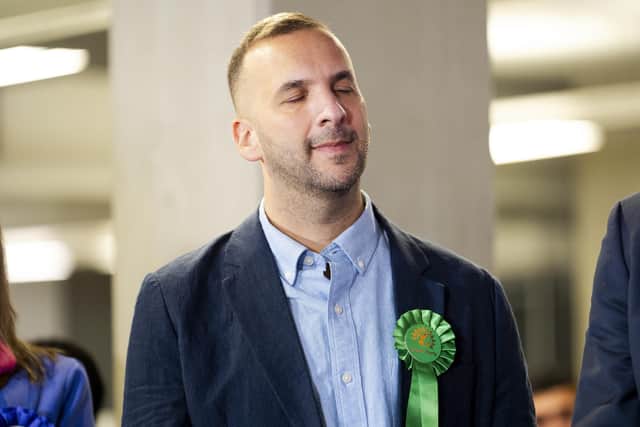

If only the Green Party had been as circumspect.
Polanski became its leader just 14 months ago after a campaign that owed more to a flair for showmanship than to political nous. He presented himself on social media as an ‘eco-populist’, a receptive and malleable agent for change who could steer the party away from its purely ecological agenda into a broader-based coalition of the hard Left.
It was a disastrous strategy that made the Greens a Trojan horse for all the Trotskyites, revolutionaries and militants turfed out by Labour when the Corbyn experiment ended.
To them, Polanski was a useful idiot, a Cold War-era term for a willing accomplice who can be discarded once total control is within sight.
Within a few months of his taking office, around 170,000 newly sprouted Greens had joined the party, almost quadrupling the membership. Today its destiny is in their hands.
Unlike Labour and the Conservatives, the Green Party offers grassroots members direct control of its political agenda. Resolutions passed at its conference automatically become policy, whether the leadership likes it or not.
You could call that democratic or you could call it naive. Either way, it is how it became possible for the Greens to effectively declare that only a racist could support Israel.
It was an empty gesture, for the party has no power and little influence. Its opinion is neither here nor there to Benjamin Netanyahu.
Nor did it seem to trouble Polanski, who ducked the vote because he was too busy with his unsuccessful campaign to replace Sir Keir Starmer as MP for Holborn. Ironically, it was Starmer who had spent years clearing out the very factions that have now washed up with the Greens.
No political leader, not even Liz Truss, has ever been AWOL at such a watershed moment in their party’s history. But the Greens’ constitution reduces the leader to a pawn in the play of the members.
The effects of all this were reflected in the result at Holborn. The Greens polled no better than they and the hard Left candidates between them had managed last time and Polanski, the media savvy populist, was now hiding from the cameras behind a cordon of bodyguards.
Meanwhile, commentators previously seduced by what they mistook for charisma were writing his professional obituary.
The fact that a cardboard cutout candidate could ever have been taken seriously makes me despair of political journalism. Too often it’s swept along on a sea of clichés as reporters run with the pack and try not to be left behind. Too little of it resonates with anyone outside the Westminster bubble.
Polanski’s journey exposes the shallowness of their political stereotyping. His brand of populism was the leftist counterpoint to Nigel Farage and every bit as hollow. But at least green politics was born of a noble ambition to preserve the environment; Reform was only ever an exhaust pipe belching hot air.
Traditional Greens, who joined the party to make a stand against aggressive industrialisation, are now the victims of its open-door rulebook. The latest polling suggests support among prospective voters has halved over the last five months.
That’s a shame, for while this was never going to be a party of government, it has been an important voice in local politics. In Sheffield a decade ago it was Green councillors who were on the physical front line to stop a Labour council destroying thousands of mature street trees that stood in the way of a badly negotiated private finance contract.
Their legacy has been squandered by their current leader. And while the environmental agenda has already been adulterated by nebulous net zero targets which others have weaponised, this latest poisoned arrow – perhaps the fatal one – has been fired by the Green Party itself.