
Could it be that the Government has too much knowledge of farming - Yorkshire Post Letters

From: Hugh Boyd, Acaster Lane, Bishopthorpe, York.
“Government hasn’t a clue about agriculture” writes Andrew Vine.
It would be surprising if members of the Government, or of the Opposition, were familiar with hands-on farming such as ploughing and milking.
Similarly, they don’t know much about the work of plumbers or surgeons, or hi-tech engineers, or computer specialists and all the other specialities which keep our society functioning.
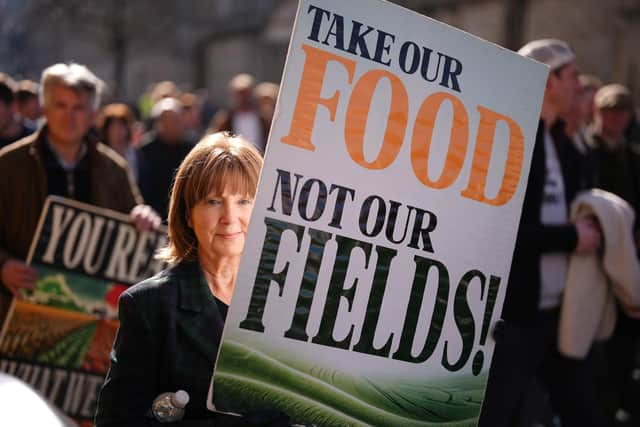

On the other hand, information about the business side of farming is in abundant supply for politicians and civil servants, through data published annually by DEFRA, who answer to the Minister for farming.
Every aspect of every hectare of productive land and every farm in the country is recorded and analysed.
The quality of the land, what each farm produces, efficiency compared with peers, profit or loss of different sectors and seemingly endless valuable information.
What is disturbing is the government’s reluctance to state their food production policies. A report on land usage is due to be published soon which might require a formal response.
It is unfortunate that the policy, which sets the foundations for all other agricultural policies, is open access of British markets of cheap food.
This has been the case for nearly two hundred years since the Repeal of the Corn Laws allowed low-price grain to pour into Britain from the Americas and Australia. This has resulted in cheap food for the masses.
It is not surprising that there is no sign of any government changing this policy voluntarily.
It is possible, however, the source of cheap imports may well disappear through changing circumstances.
Climate change is depressing harvests on a worldwide basis, while increased economic wealth of many previously poor countries is raising demand.
Britain may simply become a less attractive market.
Some governments have mitigated the effect on British farmers by giving them subsidies.
Both the previous government and the current one are paying farmers for specified environmental improvements on their land as their method of passing money to farmers and the rural community.
Farming businesses differ from most others in one notable aspect. Decisions have to be made for a very long time ahead, with many unknowns.
Planning crop rotations and modifying livestock policy, for example, require many years to implement.
Current and recent governments have not supplied the stability which would benefit this characteristic of farming business.
It is ironic that governments are in a similar position of having to make long term policy decisions in a cloud of uncertainty and which will not be implemented for many years.
It does not seem to make them more understanding of farmers.
Too little knowledge of farming may not be the problem. It might be too much.