
Why it's worth remembering Britain’s industrial past - Yorkshire Post Letters

From: John Rayner, North Ferriby.
Ongoing ‘Railway 200’ celebrations mark the 200-year anniversary of the world's first ever passenger train journey - on George Stephenson's steam-hauled iron railway between Stockton and Darlington, in the northeast of England.
While horse-drawn wooden-tracked wagonways already existed for coal transport over many decades - with Leeds' own Middleton route opening in 1758 - the idea that people would pay to travel by rail was a revelation.
Those events form just one of an enormous range of contributions made by UK innovators, creating the foundation of our modern ways of life. Alongside the railway and locomotive pioneer Stephenson, we have Thomas Newcomen, James Watt and Richard Trevithick to thank for original steam power.
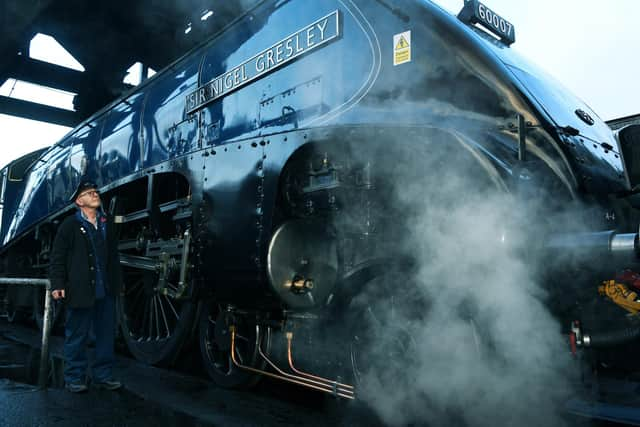

Newcomen created the reciprocating beam engine, allowing water to be pumped out of ever deeper mines; Watt and Matthew Boulton improved efficiency and added rotary motion, which promoted factory mechanisation; Trevithick then applied this to locomotion, which Stephenson developed.
These innovations led to widespread industrial mechanisation, thanks to the likes of Arkwright, Crompton and Hargreaves, and to transport uses - on rails and canals; then by Fowler on farms and roads; and through Brunel's development of iron ships, finally across the oceans.
Alongside Brunel's many contributions we have the likes of Abraham Darby, Smeaton, "Blind Jack" Metcalf, Brindley, Telford and MacAdam developing the practice and theory of Civil Engineering;
On the back of all these advances, over the following decades of the 19th century coal mining expanded enormously as manufacturing, shipping and railways spread around the world - not least through the now often maligned and sometimes wistfully mourned British Empire - delivering manufactured goods and coal for domestic use to an ever expanding population.
Fundamental discoveries and insights in mathematics and science by Bacon, Hooke, Napier and Newton underpinned development by Davy, Faraday and Thompson of electrical technologies, including coal-fired power generation.
Later, Rutherford split atoms, heralding nuclear technologies for better or worse, and Whittle pioneered gas turbines, used in aircraft jet engines and in power generation. The field of Medicine and Biosciences also boasts many Britons, not least Fleming (Alexander), Jenner, Crick, Watson and Franklin.
The modern world of communications grows in part from Rowland Hill's innovation of universal postage, through Bell, Fleming (John), Marconi and Wheatstone in electronics, to the computer innovations of Babbage, Turing, Wilkes and, of most recent major significance, Sir Tim Berners-Lee.
Interestingly, our record with the internal combustion engine is weaker, as most initial development was German - by Daimler, Benz, Diesel and others - and while this country remains at the forefront of science and technological development in several areas, we seem now to have lost impetus in industrial application and manufacturing.
Of course many other nations, mainly European, have contributed on different topics, but uniquely our nation historically can claim responsibility across the board for many developments that first industrialised the world. Sadly though these have, unwittingly at first, led since to the widespread fossil fuel use that has grown to prove so fundamentally damaging to the global environment.