
Why the context of the Battle of Britain matters - Yorkshire Post Letters

From: Lester May (Lieutenant Commander, Royal Navy – retired), Reachview Close, Camden Town, London.
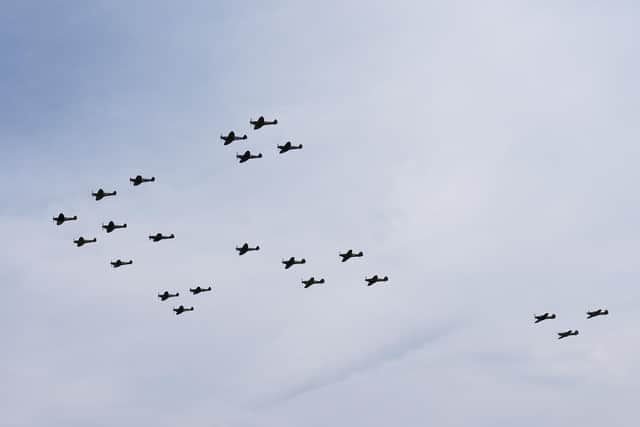
This month sees the 85th anniversary of the Battle of Britain, often claimed as an RAF affair. 2,936 pilots flew, of whom 595 were non-British (from 14 nations) and there were sufficient Poles and Czechs to be able to form discrete RAF Squadrons.
Some 56 Royal Navy and Royal Marines’ aviators flew in the battle, either with 804 Naval Air Squadron (NAS) or 808 NAS, or with RAF Squadrons.
The context of the Battle of Britain matters. From war’s declaration to the invasion of France in May 1940 was the ‘Phoney War’. The British Expeditionary Force was in France from week one – there was no fighting until the Germans invaded 10 May 1940, followed by the Evacuation of Dunkirk from May 26.

Indeed, of all the allied forces, only the Royal Navy and Royal Marines were in action from day one of the war to VJ Day in 1945 – at the outset, defence of trade, blockade of Germany and defence of ‘home waters’ were the Navy’s roles.
Bar the Battle of the River Plate (Dec 1939) and the Battle of Britain (Summer 1940), there was little for Britons to cheer in the first 12 months, although Atlantic convoys were delivering food, equipment and armaments to our islands. Thus, Churchill’s speech about The Few, on August 20, 1940, was a good news salute to buoy up the nation.
Churchill, twice First Lord of the Admiralty, knew that it was the Royal Navy, with hundreds of ships and submarines in Home Waters, that was the nation’s bulwark, the principal guarantor that no German invasion fleet would successfully cross the English Channel.
One of The Few, a wing commander, wrote “It was sea power that ruled the day in 1940 … the real victor was the Royal Navy.”
The air battle was important, not fundamental – it was far from just an RAF affair.
Today’s RAF must be honest with historical facts.