
The BBC still does not get it but I will reluctantly pay my licence fee - Christa Ackroyd
Next week my television licence runs out and I have thought long and hard about whether I will renew it.

So many have not done so and quite legally too. Some because they have lost faith in an organisation that was once the bastion of truth the world over, others because they simply do not watch the BBC any more.
In a week which has seen petrol and oil prices skyrocket it is not the cost that has made me pause. It costs me more to drive to the shops and back each day.
So it is not the money per se. It is almost the principle – and comments from the outgoing Director General whom I suspect felt forced to fall on his sword, as were others before him, which had me spitting feathers.
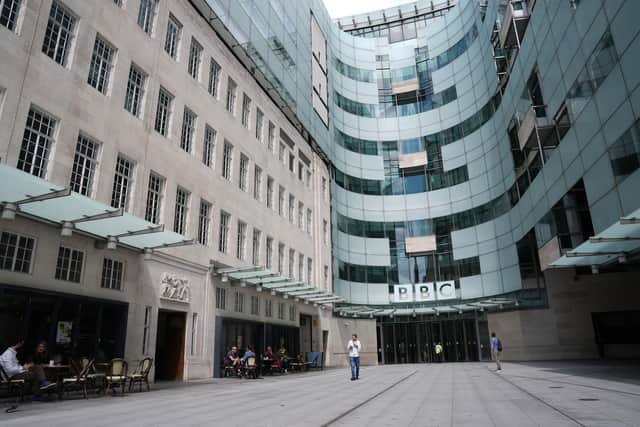

If only they would get outside their ivory towers and into the real world.
Until they do they will continue to make the same mistakes and less and less of us will feel inclined to buy a licence to watch them. And we don’t have to. If you listen to any BBC radio stations you need a licence.
If you watch any live television even the commercial channels, which has always struck me as a bit rich, then you need one.
If you use BBC iPlayer to catch up on their latest offerings you must also fork out the cash.
Apart from the Oscars this week I rarely watch live TV and even Strictly is losing its sparkle as they try to spruce it up after Tess and Claudia’s departure, a series of scandals that we never quite got to the bottom of and a decision to get rid of some of the older dancers and pretend it is all super clean and bang up to date.
Here too they miss the point. We don’t want out with the old and in with the new, we want good old dependable BBC. And it has shown itself to be far from that in recent years.
I am hardly a modern viewer. But then I am no technophobe either.
Even I have cast out tradition and watch most of my television on demand via streaming platforms. ITVX, Channel 4, Channel 5, Netflix, Prime, Disney, Paramount and a myriad of Sky channels provide more than enough instant press of a button TV for one person.
All available when I want and if I feel like a binge watch most allow me to wallow for hours if I so choose instead of waiting for the next episode.
So what have I watched this week? Netflix. Louis Theroux’s thought provoking documentary on toxic masculinity seeping into our culture Manosphere.
I have caught up on ITVX and the latest news, finished Bridgerton (loved it), watched three films on Prime, Gogglebox and Married at First Sight on Channel 4.
None of them live, so apart from the Oscars I would have had no need for a TV licence.
But just when I was about to fill in my standing order for a new licence a speech by the outgoing Director General stuck in my throat, when it should have stuck in his.
There was the usual bleating about funding and looking for a new model, which somewhat misses the point I am trying to make. It was predictable at least.
But that’s not what had me spluttering over my cornflakes. It was the almost, but not quite, apology that much of the BBC’s woes were in the words of Tim Davie because the organisation may have too much of a ‘metropolitan .. lens on life.’ I wanted to scream.
For ‘too metropolitan’ read too London centric not just geographically but in its collective thought process. Yes the BBC has based many programmes in the North.
Yes they have built the huge monolith to broadcasting in Manchester.
But do they really know what makes us tick ? I suspect Mr Davie is almost, but not quite, admitting that outside the capital or the major cities they do not.
Twenty years ago more than 80 per cent of us trusted the BBC to report and work in our best interests. Now that figure is 38 per cent.
It is true that, as Mr Davie pointed out in his speech, ‘out of a thousand stories run, one didn’t get it right’ doesn’t mean the whole organisation is failing.
But to call pointing out their mistakes ‘weaponising’ is just one more example of how out of touch the organisation is becoming.
Because there have been some pretty big mistakes and most of them came from the top unable to handle a tricky situation or at least dithering until they did.
Bashir and Princess Diana; Huw Edwards kept on long after he should have been sacked; appalling behaviour either ignored or tolerated too long on both MasterChef and Strictly; broadcasts containing offensive language and a racial slur at Glastonbury and the Baftas which were put out ‘as live’ despite the fact there was time to edit them out; the editing together of Donald Trump’s speech which made it sound even worse than it was; documentaries on Gaza fronted by children of Hamas leaders. I could go on.
Throw Saville and Hall into the mix and you could be mistaken for thinking the organisation fails to learn by its mistakes. But do you know what I find particularly galling.
If, as Tim Davie suggests, the BBC and he adds other organisations are too metropolitan, and therefore too far removed from its audiences, they have no one else to blame but themselves.
Journalists have fallen back into the trap of interviewing each other about news stories not the subjects. Which means real people with real accents have lost their voice.
And it is too easy to gather opinion from outside the front door of studios obviously centred in metropolitan cities rather than getting into their cars and driving around the regions they serve.
I could go on. But I won’t.
If the BBC thinks it no longer reflects the people it serves then do something about it. If it has a difficult decision to make, then make it.
And don’t wait for yet another lengthy and costly internal hand wringing exercise.
But don’t blame the viewer’s reluctance to part with their hard earned cash on a TV licence. Blame it on good old Yorkshire value for money.
But, and it is a big but, this week, somewhat reluctantly I will renew that TV licence.
As wars rage across a world where people’s voices are stifled, where honest reporting is not allowed, where state run TV is simply a mouthpiece for propaganda, we need the BBC and other broadcasters like them.
For that reason and that reason alone I will fork out the cash, but with one proviso.
If I and millions of other households do so the BBC must also put its money where its mouth is and do better to reflect us all.
Abandon the drinks party and the old boys network principles and get on with what they are charged with doing and which I have to say most of its talented employees want to do and go back to telling it as it is, no frills, no excuses and no prevarication.
And then it will be worth every penny we each pay for the privilege.