
Almost 800 people sign petition for council to reconsider controversial Saltaire building
Amost 800 people have signed a petition calling for Bradford Council to reconsider a controversial decision to allow a building to be constructed in the centre of Saltaire.
In February a Council planning committee approved a planning application to build a Community, Arts, Heritage and Future Technology Centre on the Caroline Street car park in the UNESCO World Heritage Site.
The centre, which would be partly funded by the Government’s Shipley Towns Fund and run by Shipley College, would include classroom space and a visitors’ centre, as well as a new home for the Saltaire Collection.
The decision to grant approval has now been thrown into the spotlight after a Saltaire resident’s Freedom of Information Request revealed that the International Council on Monuments and Sites (ICOMOS) – a body that advises UNESCO, raised serious concerns about the scheme.
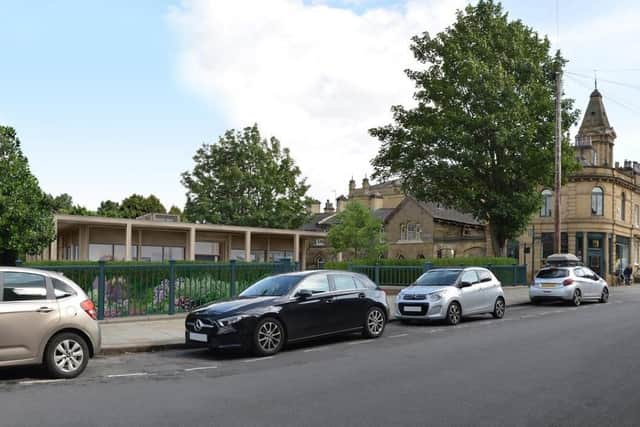

Documents obtained by Kate Rawnsley show that in early 2023 ICOMOS called for the plans to be re-considered, suggesting the facility instead be based in Salts Mill or outside the boundaries of the World Heritage Site.
It also suggests the car park currently at the site be replaced with allotments or a small park.
Since these documents were made public there has been a huge outcry in the village, with a petition calling for the application to go back before a planning committee being signed by 773 people.
It says: “The proposal endangers UNESCO World Heritage status, which is crucial for our community’s cultural heritage and tourism.”
At the Regulatory and Appeals Committee where the decision was made on February 29, members were told that the Council had received no response from UNESCO to the planning application.
In response, Bradford Council has pointed out that the comments from ICOMOS were made in February 2023, during the pre-application process.
The final scheme was not submitted and ratified as a planning application until September 2023.
The submission from ICOMOS said: “The (existing) car park and temporary buildings impact adversely on views of Salts Mill.
“At the moment, the original use of this area as a green space could readily be reinstated – either as allotments or as a small park.
“Once a major new building has been constructed, reinstatement as a green space will become almost impossible.
“Titus Salt’s vision was to provide a healthy environment for his mill workers. As most of the green spaces in the setting of the property have been eroded, this makes it all the more essential to maintain the green spaces within the complex.
“It is difficult to understand how this site could be considered as acceptable for a large new building.
“In the justification put forward, what is stressed is how the social function of the proposed building would be in line with Titus Salt’s social vision. This maybe the case, but it was not Salt’s ideas that gave the property its Outstanding Universal Value, but rather the ways these ideas were translated into a built form as a model industrial complex that has survived almost completely intact.
“As proposed, it is likely that the Centre would have a highly adverse impact on the integrity of the property and its Outstanding Universal Value, through changing the original plan, interrupting its legibility and removing part of a designated green space.
“In an ideal scenario, the original use of the Caroline Street parking area as allotment gardens would be reinstated.
“ICOMOS considers that the Community Arts, Heritage and Future Technology Centre needs to be re-considered and, if it is found not possible to house it in and existing structure, be re-located outside the property.
“ICOMOS also considers that further investigations should be undertaken to assess if land on which the Caroline Street parking, public toilet facilities and Social Club are located could in future be redeveloped as green space, possibly in the form of allotment gardens.”
The FOI also reveals correspondence between Council officers in the run up to the planning committee.
An email from one person, whose name has been redacted, to planning officer Ross Hallam on January 30 2024: “Looking back at our records it is now 23 weeks since we sent information to Historic England for onward issue to ICOMOS and given the 10 to 12 week period initially advised for the notification process, we assume that ICOMOS will not be providing any comments.”
After concerns about the decision were raised last week, a Bradford Council spokesperson said: “ICOMOS provided a technical review to the Department for Digital, Culture, Media & Sport, which was shared with the applicants as part of a separate pre-application process in March 2023 by Historic England.
“A comprehensive planning application was subsequently submitted to the Council in September 2023.
“A full planning application is a completely separate process to a pre-application and can contain many differences to the scheme discussed previously.
“The full application was submitted with a comprehensive Heritage Impact Assessment from the applicant, taking into account the guidance and toolkit document produced by UNESCO, which was used to address the concerns raised by ICOMOS in the pre-application.
“Bradford Council consulted Historic England as a statutory consultee, who expressed support for the scheme, but no comments were received from ICOMOS throughout the formal planning process.
“Only consultation responses submitted as part of the full planning application can be taken into account by officers.
“This is standard practice across the country.
“The Council deemed the scheme a positive development that preserved the Outstanding Universal Value of Saltaire.”