
Bridlington: 'I went on a fishing trip on the Yorkshire coast - it was a most enjoyable family expedition'
Stewart Calligan and his cousin’s son enjoyed a day casting the rods in Bridlington with some success… and a disapproving stare.
On an autumnal crisp, but sunny day I took a member of the Calligan clan for a day’s fishing.
I was planning a beach venue but after checking out Mappleton to Tunstall, the sea was just too rough to fish.
Plan B included the Humber, the inner beach of Spurn Point or Bridlington Harbour wall. As I was already up north, we chose Bridlington.
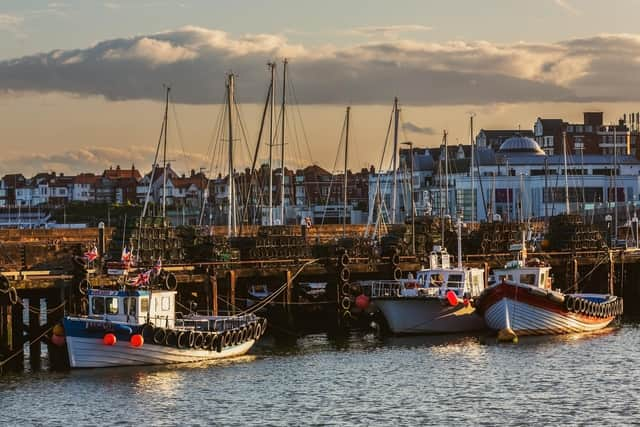

A nice drive through the little villages showing off their autumn colour, was splendid and we were amazed at the variety of shades of brown, red, crimson, orange etc, etc. maybe due to the record breaking long, hot summer drought.
I followed the Town Centre signs and then the harbour signs, leading to two car parks. The left would be best for holiday makers restaurants and shops.
Being anglers, we chose to park in the right-hand side car park, only a short walk to the harbour wall. Several anglers were already set up as no doubt they too feared being washed off the beaches.
We put three hours on the phone parking app, paid a quick visit to the public loos, just opposite the car park, and set off for the wall.

I collected four two hook flapper rigs from the adjacent fishing tackle shop. My cousin’s son, David and I chose a vacant space between two more anglers.
Pleasantries were exchanged and both said they had just arrived and had not had a bite. Undeterred, we set up two long rods, a 16 and a 15-footer, and a shorter one of 12 feet.
All had two hook flappers baited with frozen lugg and squid, that is, six chances of catching. We cast the long rods far out and the shorter one, just over the side of the harbour wall.
The wall was bustling with walkers, vans bringing or taking lobsters and crabs to or from the dealers at the far end of the jetty and commercial fisherpersons leaving or arriving on their boats.
All this activity was taking place on this sunny, but breezy, nippy day. The wind was making the rod tips dance and vibrate. It was difficult to tell what was a bite and what was the wind.
We fished for half an hour, changing the bait about every 10 minutes. Most times when we reeled in, the bait had gone, but put this down to crab activity, not hungry fish.
Crabs are very adept at stripping a hook without registering a bite. I was taught to keep the bait fresh by an expert French sea angler, Pierre, my friend of many years in St Raphael, France.
It paid off as David had a definite bite, with something tugging at the business end of his rod. He struck and was rewarded with what we thought was a young haddock.
On reflection, as there was no black spot near the pectoral fin, we favoured the whiting species. It was unhooked and safely returned.
Cod, haddock, whiting, pollock, pouting and coalfish all have similar characteristics, but I usually have difficulty with identification. Any corrections would be gratefully received.
We would need one ten times the size of whatever it was to be suitable for the pan. We persevered casting, replacing bait and recasting.
Pigeon sized, fast walking birds kept us amused as they comically darted up and down the harbour wall. A passing photographer identified them as Turnstones.
They had a brown speckled top, white underbelly, and orange legs. Food, as with most living creatures, was probably the main attraction.
There was a dozen or so, parading up and down until one was brave enough to run off with a piece of our squid so, I suppose, the mystery was solved.
Anglers bait and cleaning up fishy morsels from the bigger boats that came and went would appease their appetite.
With all this excitement I nearly missed a great bite on the near-in rod. I sprang into action dashing for the rod whose tip was bouncing wildly.
The fish at the sharp end was big enough to warrant taking extra care in landing it. I thought, we have got one for the pan here.
It swam up and down until I risked lifting it out of the water and up the harbour wall. This was over a foot in length and about a pound in weight.
Again, I thought, haddock, and again because of the lack of the black spot, we settled for whiting.
A nice lady had stopped to watch and when I began saying it would make a nice meal, which it probably wouldn’t have done, I saw in her face that look that said, “Take pity and put it back.”
Drat it, I thought, just my luck. Back it went and so did one happy lady with a nice smile and a wave.
More excitement came along with a flock of gulls showing great interest at the sight of a fish.
Now, I know a thing or two about seagulls and I identified them as common herring gulls, with silvery grey tops, white below, pink legs and yellow bills.
I have also seen great black backed gulls, black headed gulls and kittiwakes in Bridlington.
David brought me to my senses with a gentle reminder that the time had expired on our parked car. A rapid tackle down, a check that no litter had been left and a dash back to the car park abruptly ended a most enjoyable Calligan clans fishing expedition.
Fact File - Bridlington was known as Burlington as recent as the 19th century. Possibly derived from an Anglo-Saxon personal name like Bretel, Bridla or Berhtel and ending with the Old English, ingtun, meaning a farm or estate.
Whiting – merlangius merlangus - A member of the cod family with white flesh more delicate in flavour than cod. They are found in the Northen Atlantic and North Sea, mature in two years, can grow to 70cm and eat small fish, shrimp and crustaceans.