
Car review: Volswagen Tayron
Eighty years ago at the end of WW2 Germany was in ruins. In the wreckage was Volkswagen. Its pioneering factory had been making the people’s car. The British army resurrected the factory for the German people to build their volkswagen. The car, the rear-engined two-door Beetle, became the best-seller of all time, a car for millions of us.
The British army resurrected the factory for the German people to build their volkswagen. The car, the rear-engined two-door Beetle, became the best-seller of all time, a car for millions of us.
Volkswagen today has a fifth of its home market. It dominates the UK, selling nearly 154,000 in the first ten months this year. Its nearest rival is that other German icon, upmarket BMW, on 105,000 sales. In summer the Polo reached its half century, with sales of more than 20 million. My car CV includes both the Beetle and the Polo and a camper van.
The Volkswagen group stretches across most continents. Its brands include Audi, Porsche, Seat and Cupra, Skoda and Bentley.
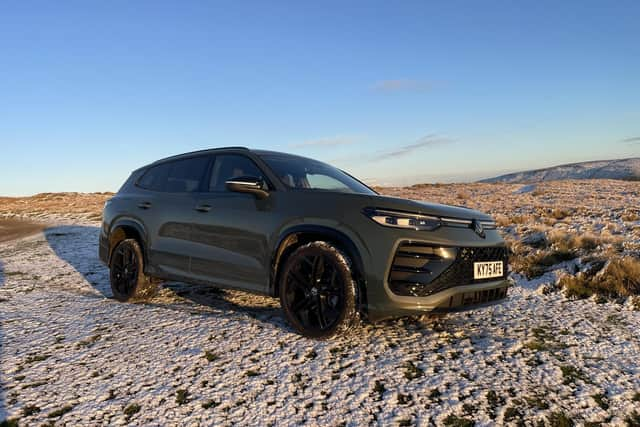

And so to one of the newest VWs, the Tayron, an estate car with five or seven-seats. Its name sounds like an American street kid. It is made in Wolfsburg alongside the legendary Golf, the Touran and VW’s top-seller, the Tiguan. It arrived in January, with prices from £39,850 for the Life 1.5 eTSI to just beyond £50,000 for R-Line versions. The engine choice is petrol, diesel and plug-in eHybrid, all with six or seven speed DSG automatic gears. Seven-seaters include the 4Motion all-wheel-drive models.
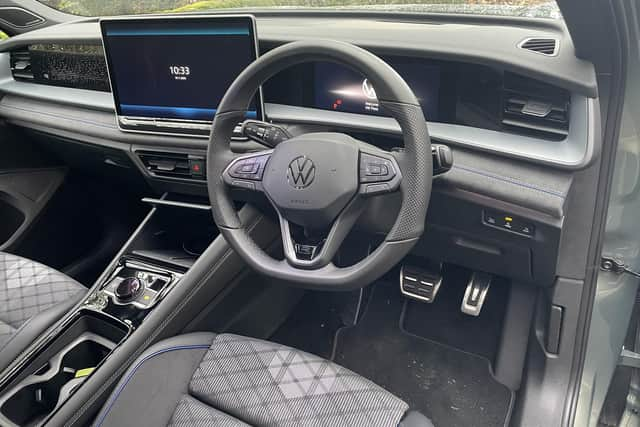
At 189 inches in length, it fits between the Tiguan and the Touareg. Standard stuff brings LED headlamps with automatic dipping, a riot of rear LEDs, triple zone AC, background cabin lighting in 10 lurid colours, a large information screen and what they call “a multi-function driving experience switch for adjusting driving profiles, audio volume and cabin atmospheres using pre-programmed lighting and audio moods”. It’s actually a rotary wheel between the seats which is easier to use than many functions on the touchscreen which can distract a driver new to VW’s systems.
Crash prevention and protection includes braking if turning across another vehicle and emergency stops for pedestrians and cyclists. Helping the Tayron get a high rating from EuroNcap is a new system which prevents a door being opened if something behind is coming past. Other standard help: road sign display, cross traffic warning, lane correction and a predictive speed limiter and an ultra alert driver attention monitor. It all helps.
Tayron is a handsome thing. It is undoubtedly roomy. We were sent the R-Line Edition 1.5 TSI eHybrid 272 PS 6 speed DSG which translates to the most powerful 268 brake horse power version of the remarkably versatile 1.5 litre petrol turbo engine mated to a 19.7 kWh battery s in the top R-Line specification. In theory it will cover 70 miles on the lithium electric battery. At other times it works alongside the petrol engine. The highest torque figure is an instant 295 lb ft from the battery motor which is enough to exercise the front differential lock even on even modest pedal pressure.
Like any PHEV with a charged battery it can achieve three-figure MPG scores. Volkswagen quotes a heady 619mpg and just 10g of CO2 per kilometre. You can replenish the battery from virtually empty to 80 per cent in around half an hour which gives petrol-free, emissions-free and cheap travel for a typical commuter trip. For business users this has the added gain of very low BIK tax.
The other gain from the battery boost is overall power and this Tayron is quick enough for easy overtaking and can run with the fast set on German motorways — when its economy will dissipate.
The starter button is where the handbrake would be if it had one. Forward and reverse and park are selected on a twist device on the steering column. Paddles on the column allow the driver to move through the gears and choose the level of battery regeneration when slowing down.
I admit liking the Tayron despite the screen control methods which took too long to master. The design details are lovely and on the R-Line version bring sports front seats with integral headrests with open centres. The upholstery fabric looked special in shades of grey plaid, piped in blue. The charming cipressino green metallic body paint has hints or wartime khaki and is a no-cost option and the price brings also brings a panoramic glass roof with an opening front section.
I would not choose the pricey eHybrid as a private buyer. Its other disadvantage is added weight (2.5 tons), no seven-seat option and a loss of storage space under the boot floor.
However, you still have a large area with a minimum width of 40 inches. The rear seats slide forward and with them folded flat the supported load length extends to 65 inches. Cabin elbow room is 58 inches, a few inches shy of Honda’s rival CR-V self-charging eHEV.
In its battery-drained state the Tayron economy was disappointing, usually around 35mpg. There is also road noise and a sometimes firm manner over broken surfaces. A curiosity: the powered tailgate opened on three occasions. Perhaps I’d walked too near its sensor before setting off.
Volkswagen Tayron R-Line Edition eHybrid 272PS
Price: From £50,210
Engine: 1.5 petrol turbo
Power: 268bhp
Torque: 184 lb/ft
Electric: 295 lb ft
Transmission: 6-speed automatic
Top speed: 134 mph
0-62mph: 7.3 seconds
Economy: 619 mpg WLTP rating
Tank: 11 gallons
CO 2 emissions:10 g/km
Length: 189 inches
Braked towing limit: 2000 kg
More: volkswagen.co.uk