
D-Day: The momentous Second World War moment which finally swung the war the way of the Allies
Gavin Cordon, Flora Thompson and Samuel Montgomery report on a momentous moment of the Second World War and one that finally swung the balance of the war the way of the Allies.

Early on the morning of June 5 1944, General Dwight D Eisenhower, the supreme allied commander in Europe, finally gave the order to go ahead, telling his staff “I hope to God I know what I’m doing”.
Bad weather over the English Channel meant Operation Neptune, the largest seaborne invasion in history, had already been delayed for a nerve-shredding 24 hours.
Any further postponement would mean waiting at least another two weeks, until the tides were right, with devastating consequences for morale among tens of thousands of troops assembled for the attack, potentially destroying any chance of surprise.

But at a 4am briefing, Eisenhower’s chief meteorologist James Stagg, a 29-year-old Scot who had been given the temporary rank of group captain, told him - not without misgivings - that the next day would see a break in the skies.
That night, transport aircraft packed with 24,000 British and American paratroopers began taking off from airfields across southern England and heading for targets inside Nazi-occupied France.
At 16 minutes past midnight on the morning of Tuesday June 6, the first six Horsa gliders landed on French soil, disgorging men of D Company, 2nd Battalion, Oxford and Bucks Light Infantry who quickly secured their objective, the famous Pegasus Bridge, to cut off any German counterattack.
Then, at 5.50am, as dawn broke over the coast, British and American warships opened up a massive bombardment of the Normandy beaches where the invasion force was heading. D-Day was under way.
Operation Overlord, the code name for the overall operation to secure a foothold in northern France, had been many months in the planning.
It followed intense pressure from Soviet leader Josef Stalin - whose forces had so far borne the brunt of the struggle against Nazi Germany - on the Western allies to open up a “second front”.
Russian victories at Stalingrad and Kursk may have turned the tide of war in the allies’ favour but Hitler remained the master of most of mainland Europe and dislodging him would be a formidable undertaking.
Winston Churchill, the British prime minister, harboured deep misgivings about the prospect of a seaborne invasion following the failure of earlier amphibious operations, most notably the disastrous Dieppe raid of 1942.
Nevertheless at the Tehran conference at the end of 1943, Stalin combined with US President Franklin D Roosevelt to overcome his resistance, securing agreement that the landings would take place the following spring.
The RAF and the US Air Force had by then secured complete aerial superiority over northern France while German U-boats had been driven from the Channel. However, it remained a highly perilous mission.
While the Germans were well aware an invasion was in the offing, a massive deception operation was mounted to confuse them over the exact timing and location.
An imaginary US army group, complete with fake landing craft and dummy tanks - supplied by Shepperton film studios’ set designers - was established in Kent in a ruse to suggest the real target was the Pas de Calais, just over the Dover Straits.
It was supported by intelligence from the German spy network in the UK, which had been rolled up and “turned” by MI5 and was supplying a steady stream of false reporting.
Other deceptions included a visit to Gibraltar by a lookalike of General Bernard Montgomery, the British commander, intended to suggest a Mediterranean landing, and false intelligence pointing to an invasion of Norway.
It proved so successful, that when the actual landings began, the Germans critically delayed sending reinforcements believing they were simply a feint ahead of the main invasion elsewhere.
The first American hit the beaches - codenamed Utah and Omaha - at 6.30am, with the British and Canadians arriving at their three designated beaches, Gold, Juno and Sword, an hour later. Landing was a perilous business. Some troops drowned after jumping off into water that was deeper than expected, while others disappeared under landing craft as they were suddenly swept forward after discharging their loads.
Even light injuries could prove fatal, with wounded men, heavily weighed down with equipment, unable to drag themselves from the sea.
By far the heaviest casualties were suffered by the Americans landing on Omaha beach. Protected by landmines, barbed wire and huge steel anti-tank “hedgehogs” and surrounded by cliffs and bluffs rising to 150ft high, allied planners had always known it would be the most difficult of the five landing zones.
In the event it proved even harder than they had anticipated. For seven hours the troops found themselves pinned down by heavy German fire unable to advance.
US commander General Omar Bradley had been at the point of calling off the assault when the news finally came back that a Ranger battalion had managed to scale the cliffs relatively unscathed.
Accurate fire from British and US destroyers, sailing dangerously close to the shore, helped to finish off the German defences.
The cost was high, with more than 2,000 Americans killed in the course of the battle - accounting for more than half the fatalities suffered by allies on the day.
Nevertheless, by the end of the day, 130,000 US, British and Canadian troops had made it ashore across the five beaches giving them a firm foothold for the first time in German-occupied France.
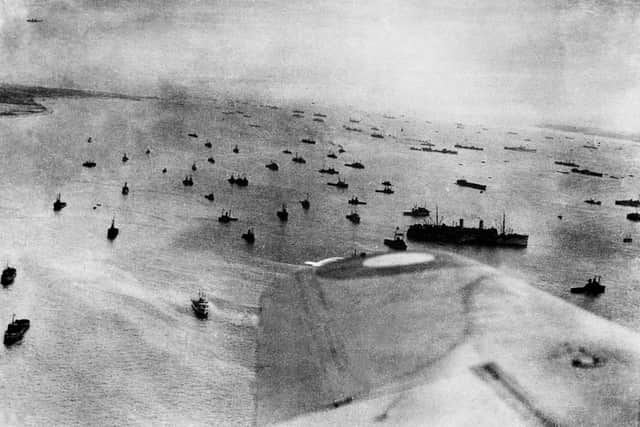
It was a remarkable achievement, involving almost 7,000 vessels - including 1,200 warships and 4,000 landing craft - with allied aircraft flying more than 13,000 sorties.
Breaking out of the beach-heads however was to prove more difficult than expected. The dense hedgerows of the bocage proved to be ideal defensive territory for the Germans, making it almost impossible for the allies to advance.
Casualties meanwhile were continuing to mount on both sides. By late July, the allies had lost 122,000 men killed wounded or captured to the Germans’ 114,000.
Finally, on July 25, Gen Bradley launched Operation Cobra, starting with a massive aerial bombardment of depleted German positions, enabling US armoured divisions at last to break through. Within a month allied troops were in Paris.
There were months more of heavy fighting before the final German surrender in May 1945 but the road to eventual victory had been cleared.
Why D-DAY?
The words “doom”, “debarkation” and “deliverance” have all been suggested as meanings for the “D” in D-Day.
But the letter is derived from the word “Day” and means the day on which a military operation begins.
D-Day has been used for many different operations but is most closely associated with the Allied landings on Normandy’s beaches on June 6 1944.
The day before D-Day was D-1 and the day after was D+1.
It meant that if the date for an operation changed, military staff would not have to alter all the dates in their plan.
This happened during the Normandy D-Day landing operation, which was originally planned for June 5 – but bad weather delayed it by a day.
In the build-up to the Allied invasion, code names and acronyms were vital to help maintain the blanket of secrecy around the operation.
As well as D-Day signalling the date of the operation, other code words included:
H-Hour: The hour of the invasion.
Bolero: The build-up to D-Day in Britain.
Operation Overlord: The overall invasion plan.
Operation Neptune: The seaborne invasion.
Mulberry: Artificial harbours towed across the Channel.
Ham and Jam: The signal indicating the bridges at Benouville (Pegasus Bridge) and Ranville were secured by Allied forces.
Utah, Omaha, Gold, Juno and Sword: Code names for the five landing beaches in Normandy.
The remaining Normandy veterans are heading for northern France to mark the 80th anniversary of the D-Day landings.
They will be travelling across the English Channel for services near the beaches where Allied troops fought their way ashore against fierce German resistance.
The D-Day landings were called Operation Overlord by the Allied commanders, who were appointed at the end of 1943 to plan the invasion.
US General Dwight D Eisenhower was in supreme command of the massive operation which would bring the Allies a crucial victory in the 10-week long battle for Normandy.
The force which took part included 5,300 ships and craft, 150,000 men, 1,500 tanks and 12,000 planes.
British and Commonwealth troops landed at the three beaches of Gold, Juno and Sword.
American soldiers were given the task of getting ashore at the Utah and Omaha beaches. Omaha saw some of the bloodiest fighting, with US troops cut down by intense German machine gun fire.
Further inland, Allied airborne troops had been parachuted in before the dawn beach landings began.
They were to prevent German counter-attacks on the coast and ensure the break out from the beach head could be completed.
A British glider assault, led by Major John Howard successfully captured and held Pegasus Bridge until reinforcements arrived from the coast.
By June 12 1944, more than 320,000 men were ashore with almost 55,000 vehicles and nearly 105,000 tons of stores.