
Delight as charity wins race to keep 1,400-year-old artwork in Yorkshire after 150 people donated thousands of pounds

A charity aiming to open a museum showing off the incredible archaeological discoveries at Pocklington is celebrating after successful raising thousands of pounds to keep a 1,400-year-old artwork in Yorkshire.
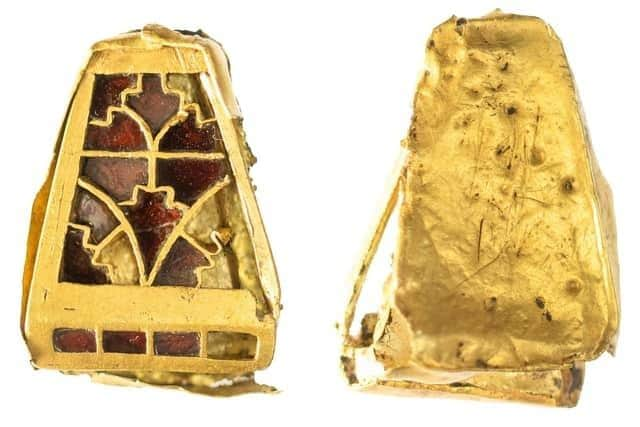
In January the government placed an export ban on the gold and garnet artefact, which was found in a field near Pocklington in 2013, after it was bought at auction in London in 2024 by an overseas buyer.
After consultation with the British Museum, the government said it would give UK institutions the chance to keep it in the country, saying: "The discovery of the panel near Pocklington is significant as it potentially offers insight into the study of artistic, political and cultural relationships between two of the most powerful kingdoms in 7th-century England, East Anglia in the east, and Northumbria in the north.
"The item displays clear links to the significant gold and garnet cloisonné metalwork from the Sutton Hoo ship burial and the Staffordshire Hoard."

Pocklington District Heritage Trust, which has plans to create a museum at the town’s Burnby Hall, sprang into action, raising its target of £4,000 in just two weeks, with 150 people making donations to a crowdfunding appeal.
The charity has now been told they will able to keep the piece.
Trust chairman, Phil Gilbank, said: "This is marvellous news and we owe a massive thank-you to everyone who donated.
"It was a real battle to meet the strict government criteria, plus we were competing with established institutions, but it is great that we will be able to bring the piece back to where it was found.”
The tiny panel has been damaged in antiquity, and is not on a par with some of the Sutton Hoo finds, nevertheless, it is described by experts as a “wonderful artefact”, and one of only three gold and garnet cloisonné pieces found in eastern Yorkshire, with the gold believed to have been brought from the Continent and garnets from Sri Lanka.
The town is believed to have derived its name from the Old English personal name "Pocela" combined with "tun," meaning "farm" or "settlement", meaning "Pocela's farm" or "Pocela's settlement".
Mr Gilbank said: "We are thinking of calling it the 'Pocela Panel' as it dates to AD 600-670, which is when it's believed Pocklington took its name.
“However, there is still a way to go before it ends up back in Yorkshire, we have to arrange condition surveys and negotiate with other local museums to put it on public display until we are ready to give it a permanent home in Pocklington. "A great quantity of finds and information from the Anglo-Saxon and Viking eras has come out of the district around Pocklington in recent years, and we are looking forward to making the Pocela Panel a prize exhibit and a focal point for more research."
The museum will also provide a home for other artefacts found in recent years by archaeologists working for housing developers.
They hope to display a replica of a shield used as part of an elaborate burial rite some 2,400 years ago, involving two ponies staged to look as if they were leaping out of the grave.