
Emission decisions ‘will affect sea levels for centuries’ say scientists
Current decisions on how cutting emissions will determine how much our coastlines are reshaped by sea levels rising for centuries to come, scientists have said.

New research shows that near-term mitigation could spare future generations around 0.6 meters of sea-level rise that would be caused by emissions between 2020 and 2090 following current policies and render many places unihabitable.
A study has been led by researchers from IIASA (International Institute for Applied Systems Analysis) in collaboration with colleagues from institutions in the UK, Belgium, The Netherlands, and Germany.
The paper published in Nature Climate Change goes beyond the usual sea level projections by quantifying how much sea-level rise in 2300 will be “locked in” by emissions this century. It seeks for the first time to provide a direct link between today’s policy choices and sea levels hundreds of years from now.

“It is common for sea-level rise research to deliver projections to 2100 based on a standard set of scenarios, which doesn’t allow to isolate the longer-term sea-level impacts of today’s greenhouse gas emissions. But we have to explore these impacts on timescales beyond 2100 because oceans and ice sheets keep responding for centuries,” said lead author Alexander Nauels, a senior research scholar in the Integrated Climate Impacts Research Group of the IIASA Energy, Climate, and Environment Program.
“Our study shows clearly that mitigation decisions in the next few decades will have multi-century consequences for coastlines worldwide.”
The researchers found that under current policies, emissions from 2020 until 2050 would already commit the world to about 0.3 metres of additional sea-level rise by 2300.
Extending emissions on this trajectory until 2090 would lock in a global rise of about 0.8 metres, of which roughly 0.6 metres could still be avoided if the world started emissions reductions consistent with the 2015 Paris Agreement now. These differences can determine whether some low-lying coastal areas and islands remain habitable or not.
“Our work highlights the long-lasting legacy of today’s emissions and that adaptation planning must consider centuries ahead,” said Dr Matt Palmer from the Met Office, a co-author of the study. “We also illustrate that some regions like the vulnerable Pacific islands will experience even higher sea-level rise than the global average. These regional and local changes have to be understood and resolved in much greater detail to better inform decision makers.”
The authors set out to determine how much future sea-level rise is already committed by past and near-term emissions, and they show how strongly choices in the coming decades influence outcomes centuries from now.
“These choices will determine when more adaptation limits will be reached and how many adaptation options remain for coastal communities in vulnerable regions,” said co-author Aimée Slangen from the Royal Netherlands Institute of Sea Research.
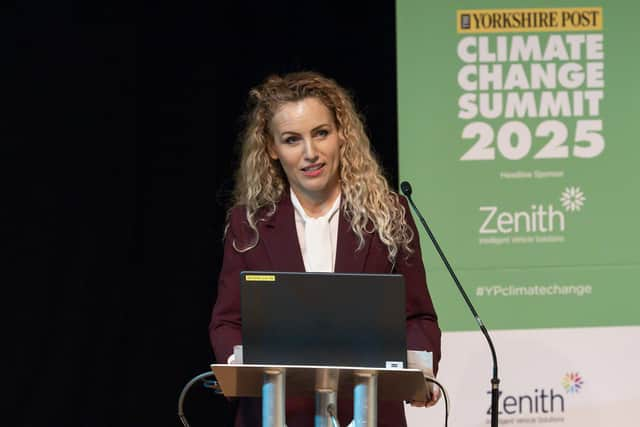
Earlier this month, Climate Minister Katie White told The Yorkshire Post Climate Change Summit that it would be “utter madness” to backtrack from environmental action.
It comes as both the Conservative Party and Reform say they would repeal the Climate Change Act and associated net zero targets.
Ms White described net zero as “the economic opportunity of the 21st Century”.
When asked by an audience member about the need to get across the importance of net zero to the public more effectively, Ms White replied: “We’ve had lots of support over time. [Then] people have been like, ‘Hold on a second, life is tricky – is this something we can delay for future generations?’
“I would say, ‘No, because of what the science is telling us’. Also, we should be really proud of what we have done in Britain and we are about to reap some of the rewards of investing for the last 20 years. The idea that at this stage, when Britain has been leading on some of these areas, that we would backtrack is utter madness to me. We are just about to reap some of those rewards."