
'It gave me and my children a proper life' - The life-changing impact of Leeds Family Drug and Alcohol Court as service marks ten years
The Family Drug and Alcohol Court has helped dozens of families in Leeds over the last ten years. Laura Reid hears about its life-changing impact.

Seven years ago Kelly Thompson was given the news from a family court judge. Her children, now nine and 11, were able to remain in her care. She’d done it. She’d broken free of a crack and heroin addiction that for years had defined her life and with the support of the Leeds The Family Drug and Alcohol Court (FDAC) project, she’d given herself and her family a new future.
“FDAC changed our life, it gave me life and it gave my little people life,” the 44-year-old reflects now. “My children’s lives could have been totally different, they might not have grown up together.”
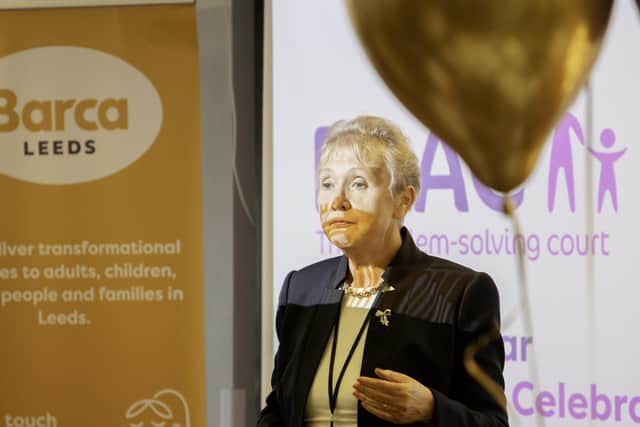
Those involved in FDAC have recently marked ten years of the project in Leeds. Described as a problem-solving therapeutic approach, it was introduced into the city in 2015 with the aim of improving outcomes for children involved in care proceedings by supporting parents to address substance misuse and related problems such as domestic abuse and poor mental health. The service is designed to provide parents with an understanding of the problems that have put their children at risk of serious harm, as well as supporting them to engage with specialist interventions and address entrenched difficulties that led the local authority to be concerned for their family.


Saorsia Jefferson, team manager at FDAC, which sits under the Barca Leeds charity, says the service can take on up to 21 parents a year. It’s an intensive process and parents must be motivated to become abstinent from substances, be able to engage with the project, and have an understanding of what the concerns are for their child or children. “We want parents to be able to understand the needs of their children,” Saorsia says. “We want them to be able to strengthen and rebuild relationships with their children because ultimately trust gets broken down. We want to support parents to be able to have a stable and safe home for their children and to understand why their decision making as parents is vital.”
FDACs have been in existence since 2008, set up to try and break the pattern of recurrent care proceedings, where care applications are made regarding parents who have already had previous children removed from their care. A review by the Centre for Justice Innovation in 2023 suggested there was strong evidence that being in FDAC significantly increases the likelihood of children being reunified with their parents at the end of care proceedings. Where reunification is not possible, FDAC significantly increases the number of family or kinship care placements, and decreases the likelihood that children are placed in local authority care. Compared to standard care proceedings, FDAC also generates cashable savings for local authorities as well as providing financial benefits for other statutory agencies, the report notes.
Sophie Carter is Head of Family Justice Practice at the centre. She says key to FDAC’s success is it being accessible for families. “Care proceedings historically have been extremely adversarial,” she says. “It's very intimidating...It's not something that families feel that they can access. And yet this is the system that is going to probably make one of the hardest decisions in a family's life, lifelong impactful decisions and families say that they don't feel part of it. They don't understand what's going on.
“So part of the model is to break that and to actually make sure that families feel like they can be part of the system. It is accessible. They are spoken to directly. They are understanding of what's expected of them and what the next steps are. That court system is shifted...to become what we call an agent of change. So it actually becomes a motivator. It becomes empowering.” It means families are less likely to contest the outcome at the end of proceedings, she says. It might not be what they’d hoped for but there’s usually an understanding of why the decision has been made.
For Daniela Dagama, the outcome of the FDAC process was reunification with her baby son, who had been in foster care from birth. The 32-year-old had been using drugs and alcohol and had presented at A&E during pregnancy after a binge. Desperate to stop and turn her life around, she started the FDAC project in January 2025, shortly after her boy was born and by June, they were home together with him in her care. FDAC changed her life, she says. “I felt like it was a second chance for me…At the start it was hard. I was still using. I didn’t think I could do it because I’d had so many chances prior to that of starting over but I always fell back to what I knew…But FDAC were speaking to me like Daniela, not Daniela the addict, with mental health problems. That was comforting...And giving birth was mind blowing. I created him, I want to be in his life and he needs me in his life. He was a big inspiration and still is.”
For Kelly, the motivation was simple. “I wanted to be a mum,” she says. “I’ve also got older children that I walked away from, which is a big factor that led me to take the FDAC route. I had to at leas t try. I knew what living without children was like... I was on my knees. I’d wanted to give up using heroin and crack for a long, long time but I didn’t know how to. I was broken.” Kelly’s younger children remained in her care throughout the FDAC project, something she says kept her going. “It’s a really hard process. It’s intrusive, it’s raw. But it saved my life and it gave my children a life. They hadn’t really had one, not a proper one, not a full one...I don’t know if I’d have been able to say it at the time but I can definitely say it today - I’m proud of myself.”
In ten years, FDAC has made a difference to dozens of families like Kelly’s and Saorsia is hopeful of funding support so it can continue to do so for years to come. “You want every parent to be able to access FDAC and this level of support,” she reflects. “I think that’s an aim for Leeds to be able to work that way.”