
London Marathon: 'I'll be fuelled by a determination to make a difference'
Thousands of people will be taking part in this weekend’s London Marathon. Laura Reid shares the stories of some of those from Yorkshire.

A year ago, Sandra Breene was still undergoing life-saving treatment for leukaemia. This weekend, she’s running the London Marathon.
Over 48 weeks, the now 57-year-old received a combination of chemotherapy and immunotherapy to target her blood cancer.
It was a difficult time, but “I am lucky,” reflects Sandra. “The revolutionary treatments I received wouldn’t have been possible without research. Yet my situation is a stark reminder that many are not so fortunate.”
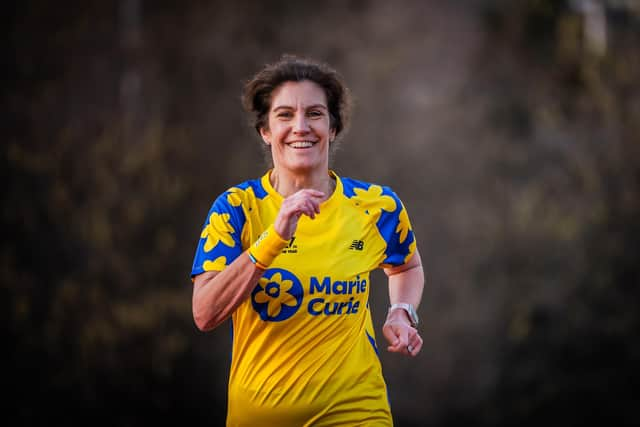

It’s why Sandra, from East Yorkshire, and husband Alan, 67, are taking on the marathon this Sunday, among 56 runners set to raise money through the run for Leukaemia UK.
Sandra, who has already raised more than £14,000 was a regular runner when she was diagnosed with chronic lymphocytic leukaemia (CLL) in 2022, after a routine health assessment from her employer indicated a high white blood cell count. She had no other symptoms.
The disease can develop slowly, meaning it may not need treatment at first. Sandra was placed on a watch and wait list, only starting treatment in September 2024 after blood tests indicated the cancer’s progression.
Thrilled to be back running again once treatment was completed last August, she set herself the marathon goal and says every step will be “fuelled by a determination to make a difference”.
“We are running to ensure that others facing this diagnosis have the same chance for a full life that I have been given,” Sandra says.
Also taking on the challenge for a blood cancer charity is Harrogate father-of-three James Badger.
James, who lost his wife Philippa to an aggressive blood cancer called acute myeloid leukaemia (AML) just two days after her diagnosis, is running the marathon as part of a five-day feat also involving climbing the UK’s three highest mountains and cycling from Snowdonia to London.
James, his wife and their three young children were visiting Robin Hood’s Bay in the spring of 2022 when Phillipa said her legs were feeling a bit tired.

“We didn’t think too much of it,” James remembers, “but that evening she felt a bit worse so she rang our GP. She had blood tests and was told she had acute myeloid leukaemia. After receiving a blood transfusion, she was transferred to a hospital in Leeds but died shortly afterwards.
“It was such a sudden shock for my family, for us all. Going from being a normal healthy person and a normal family to dealing with this in less than two days. The hardest thing I ever had to do was tell my three children that Mummy had died.”
Since Philippa’s death, James has raised hundreds of thousands of pounds for Blood Cancer UK to support research into AML, one of the hardest to treat blood cancers.
His previous challenges include cycling 1,600km from Land’s End to John O’Groats in eight days, and completing an “Everest” cycling challenge in the Yorkshire Dales by riding up the same hill 90 times, passing the churchyard where Philippa is buried on every climb. Last year, he also cycled 500km over three days on a vintage tandem bike from Harrogate to London arriving in time to run his first London Marathon.
The fundraising has already enabled Blood Cancer UK to fully fund a research project into AML at Cardiff University and James now has his sights set on funding another project at the University of York.
He says: “Philippa was an incredible person and an amazing mum. After losing her so suddenly, I wanted to do something positive in her memory and help fund the research that could stop other families going through the same heartbreak.”
Emma Manby knows the grief of quickly losing a loved one to cancer. She admits she was “in denial” when her sister found a lump in her abdomen in 2017.
Kelly Thompson was 34 when she was diagnosed with an undetermined cancer. It had similar characteristics to Ewing sarcoma, which most commonly affects children and young people so Kelly was admitted to a Teenage Cancer Trust ward in Leeds before she passed away in a matter of weeks, leaving behind two children.
Emma, now 45, from Huddersfield, has been fundraising for the charity in Kelly’s memory ever since and this year, with the Manchester Marathon, London Marathon and an ultramarathon also in the capital, she hopes to take her total amount to over £10,000.
Emma, who will be taking on the London Marathon for a third time, says: “The charity was a help for us in our worst time.”
Dr Sarah Holmes knows what it’s like to support families in such dark moments. She’s worked for end of life charity Marie Curie for 25 years and has been a consultant in palliative care since 2007.
Dr Holmes, who is chief medical officer for the charity and also works at its hospice in Bradford, will attempt to set a Guinness World Record when she partakes in the marathon on Sunday.
Her 26.2 miles will be run with team-mates Helen Caldwell and Sam Cheverton who together hope to be the fastest all-female group to complete a four-legged marathon, needing to finish in under five hours.
Dr Holmes, who lives in North Leeds and previously trained as a GP, says running is her way of “destressing from work and life” but typically she stays away from roads and instead follows trails in the Yorkshire countryside.
Reflecting on palliative medicine, she says: “I like the continuity of care. I like getting to know the patient, their story and also their family. Nobody comes by themselves - they all come connected with people that matter to them and it feels like a real privilege to be allowed into people’s lives at that really difficult time. Often we can make big differences by doing relatively small things.”
This time, it’s a mammoth feat she’s set her mind to. The furthest she and her teammates have run tied together so far is five miles, but already they have raised more than £10,000.
“It’s not the most comfortable thing in the world,” Dr Holmes admits. “We have discovered that we are okay running together as long as we don’t talk about anything too complicated because if we talk about something distracting it puts us off our stride and we get out of sync…
“I’m feeling confident about being fit enough to run a marathon and the three of us are pretty determined women so I think we will get ourselves to the finish line come hell or high water. Whether we get ourselves in there in time to set the record is more up for debate but we will absolutely do our best.”
“Being able to run for Marie Curie means a huge amount to me,” she continues. “I’ve worked for the charity for 25 years, I feel quite emotional saying this, and the number of patients and families that I’ve been privileged to see and to get to know and care for has been amazing, to be in people’s lives and to be able to help them.
“The thing that keeps me awake at night though is the people who aren’t able to get care and support. When we’re involved, we’re able to provide wonderful support for people but I worry about all the people that aren’t getting that and are struggling by themselves and the impact that has on them and their family and friends afterwards. To be able to do this, raise money for the organisation and raise awareness of the importance of this work feels really good.”
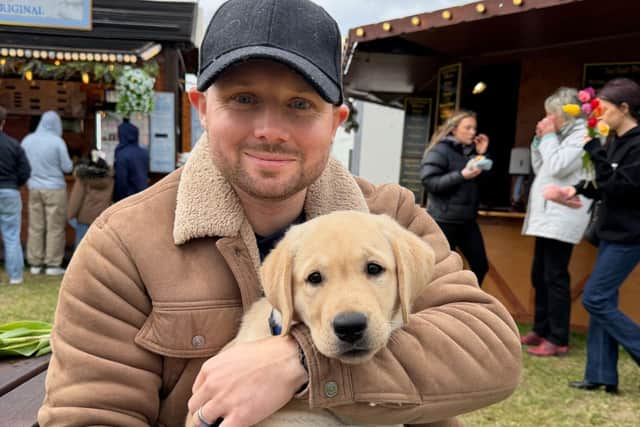
Another West Yorkshire runner, Chris Taylor, is raising awareness for a different cause - the charity Support Dogs.
Headquartered in Sheffield, it provides specialist assistance dogs for autistic children, and those living with epilepsy or a physical disability.
Chris and wife Zoe have helped to raise and socialise puppies for the charity, before the animals have become fully-fledged support dogs.
Businessman Chris, who is taking on his first London Marathon, says: “I just want to help this amazing cause as every pound raised helps more puppies go on to change someone’s life forever.”
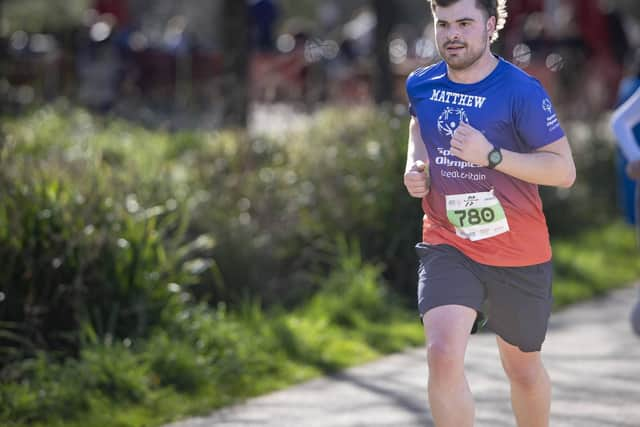
Like Chris, Matthew Brough, 23, from York, and Niall Guite, 31, originally from Sheffield and now living in Eyam, are running the marathon for the first time.
They are among three Yorkshire athletes with intellectual disabilities who are proudly part of the first-ever team of Special Olympics Great Britain (GB) athletes taking part in the event.
They will also be joined by Angus Leckonby, 23, from near Driffield. He ran the marathon for the first time in 2025, setting two new Guinness World Records as the youngest and fastest person with an intellectual disability to complete a marathon.
The team is raising funds for Special Olympics GB’s upcoming National Summer Games, where Angus will participate in swimming, Matthew in tennis and Niall in cycling.
Matthew says: “I want people to be inspired by our team…and to show the world that people with learning disabilities can achieve great things.”
Like Angus, Sheffielder Polly Rippon isn’t a stranger to London, having done the marathon before. But it’s been ten years since she took part in her last 26.2 mile race. The 52-year-old University of Sheffield teacher is pushing herself to do so to raise funds for the Baton of Hope charity in memory of her brother Edd.
The organisation was set up by former Sky News reporter Mike McCarthy after he lost his son, Ross, to suicide in 2021.
Polly, a former journalist, says: “Baton of Hope is doing amazing work in suicide prevention all over the UK and I wanted to do something to help.”
Polly’s younger brother Edd, from Warwickshire, took his life in 2009, aged just 31.
She says: “Losing someone to suicide is utterly devastating and I still find it very difficult to talk about. This is my way of trying to do something useful for the cause and to remember Edd. We miss him every day.”
The Yorkshire Post wishes all the best to those from the region taking part in the London Marathon.