
'My family wish I'd start knitting but instead I've been stitching up war victims in Gaza' - Yorkshire nurse among first to be recognised with Humanitarian Medal
Gran Chris Hunter says her family wish she’d take up knitting rather than go on dangerous deployments to war-torn Gaza. But her vital work in the country has led to her being awarded a Humanitarian Medal, presented to her at Buckingham Palace by the King.
Barnsley-born Chris, a theatre nurse in her 70s, has travelled twice to Gaza with frontline medical charity UK-Med, as part of the UK Government’s humanitarian response to the crisis. She was among the first recipients of the new medal, recognised for her life-saving work at a Foreign, Commonwealth & Development Office funded emergency field hospital – and took her 13-year-old granddaughter Alexis with her to London to receive it.
“I know my family would prefer I just put my feet up and started knitting or something – but I’d far rather help stitch up patients who need our help in Gaza,” Chris says. “Even if I was not ‘nan nan’ to my three grandchildren, it’s only natural my family would be concerned for my safety.
"But they know that once I’ve made up my mind, there’s no point trying to change it. I know I am elderly and aged, but I just feel as though I’ve got so much to offer. I have a lot of experience and skills which are best used supporting people who really need our help in Gaza.”
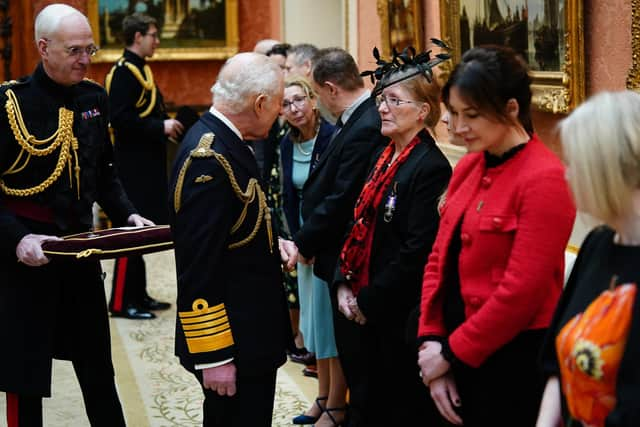

Chris, from Grimsby, served with the Queen Alexandra’s Royal Army Nursing Corps for 32 years and still works as a theatre nurse at the Diana Princess of Wales Hospital in Grimsby. King Charles has recognised her work in helping to establish two emergency field hospitals – based in Al Mawasi and Deir El Balah – which have treated more than 300,000 patients.
"Meeting the King was a wonderful surprise and such an honour. It’s taken me a lifetime to get there,” Chris says. “I actually thought the email telling me about the Humanitarian Medal was a hoax and someone was pulling my leg.
"The King asked my granddaughter Alexis what she wants to do with her life and she said ‘I want to be a nurse’ and the King said ‘Make sure she makes it’. My daughter’s just qualified as a nurse as well so maybe they’ll both follow in my footsteps.
“The King was very easy to talk to and interested to hear what the situation is like on the ground in Gaza. When I told him the infection rate is so bad that you can smell patients before you see them, he pulled a face at the thought.”
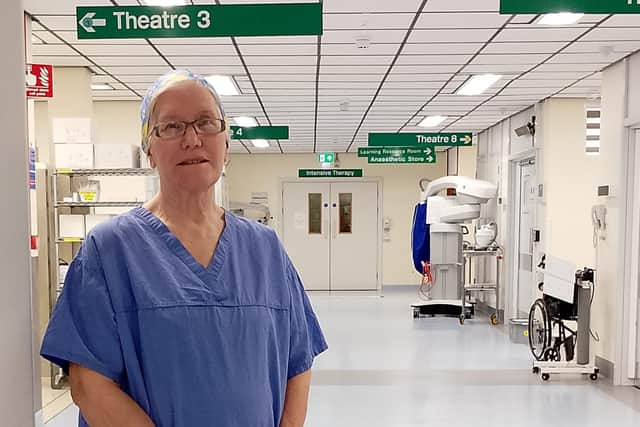
The humanitarian situation in Gaza remains extremely challenging – with over 50,000 people killed and more than 90 per cent of the population displaced from their homes. It is one of the reasons why Chris has no plans to put her feet up and she is currently waiting to hear about another deployment to Gaza or Ukraine.
She previously served with the military in Bosnia, Kosovo, Iraq and Afghanistan but says the scale of human suffering on the ground in Gaza made it her toughest deployment yet. “When I looked at my 13-year-old granddaughter at Buckingham Palace I couldn’t help contrast it with some of the horrendous things I’ve seen happen to children and little girls in Gaza,” she says.
“I remember we had an 18-month-old girl come in and her left hand had been blown off. Two or three fingers on her right hand were gone. She had a fractured leg and little bits of shrapnel imbedded in her head. Her mother and father had been killed in the same incident so she was being looked after by her sister who was only about 14 or 15.
“The mass casualty incidents were relentless. No sooner had you got through one lot of patients, there was another load of ambulances. It was like a conveyor belt of carnage...Some of the old men had had their legs completely blown off to the extent that there was literally just nothing there except bits of skin hanging off their lower abdomen, it’s amazing they survived.”
Others were not so ‘lucky’. “The blockages to getting aid in means the shortage of basic kit was really striking,” Chris says. “There was not much in the way of antibiotics, swabs or even clean water to irrigate wounds. I’ve no idea what Florence Nightingale would have made of it.
"I remember this young chap being wheeled into theatre and when I took his dressings off his abdomen was completely open...We did our best to clean him and patch him up, but he died.”
To add to the challenges, Chris recalls working to the constant sound of nearby explosions. “I remember my shock the first time I experienced explosions going off near me in Iraq, but over the years I think I’ve got used to it,” she says.
“There were a few window shakers in Gaza. Some of my fellow British medics could get a bit worried but I think if you can remain calm, it helps others do the same.
“I remember there was a particularly loud explosion. It was close. I grabbed the doctor beside me just to say ‘I think we’re alright, but let’s await the inevitable mass casualties coming in from that one’. That was another busy day in Gaza.”
Foreign Secretary David Lammy, who has called for more aid to enter Gaza, says the Humanitarian Medal, first announced in July 2023, recognises “the incredible dedication and selfless service of individuals on the frontline of the UK’s responses to some of the world’s most devastating crises”.
“I am delighted the first tranche of awards will recognise members of the UK government’s emergency deployment teams, for their brave work in Libya, Morocco and Gaza.,” he says. “The International Search and Rescue team and Emergency Medical Team are made up of expert firefighters and medics from across the UK, who travel to the most challenging of environments to save lives.”