
Remembrance Day: Soldier's unmarked grave discovered in Yorkshire a century after his death

A soldier's grave, lost and forgotten to the ravages of time, has stood unmarked for over a century. Finally, there is a red poppy to honour his fall. Here lies Emmanuel J Foxton, who went to war as a boy but came home gassed at just 22. He gave his life, in the service of duty, only to drop quietly from the record books; erased.
Now at last a ribbon of wreathes is laid gently besides a shiny white headstone, with a whisper of thanks in his name.
There is a danger in forgetting, said researcher Rona Houlton as she finds his grave after 106 years. A danger in the gloss of reflection that the soft sorrow of heartbreak is buried.
"This young man went out fighting for the safety and freedoms of all of us," she said. "He was one among many who was injured and almost lost.
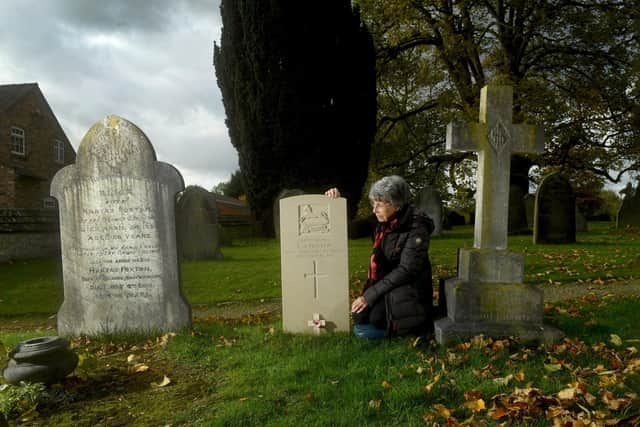

"He was lost, in the system," she added. "He has never been recognised. They gave their lives. They gave their all. We should never forget that history, the history of our past, that has brought us to where we are."
The Commonwealth War Graves Commission (CWGC) dedicated a headstone on Thursday to remember Private Foxton. His name now enters the history books.
And as tomorrow marks Remembrance Sunday, honouring those who lost their lives in war, services give thanks to those who still serve, to protect the freedoms of a nation.
There is Emmanuel, who for the first time will see a poppy laid on his grave. Then D-Day veteran Jack Mortimer, one of Yorkshire's last survivors of the horrors of that momentous day, who will lay his own wreathe as he remembers his pals.
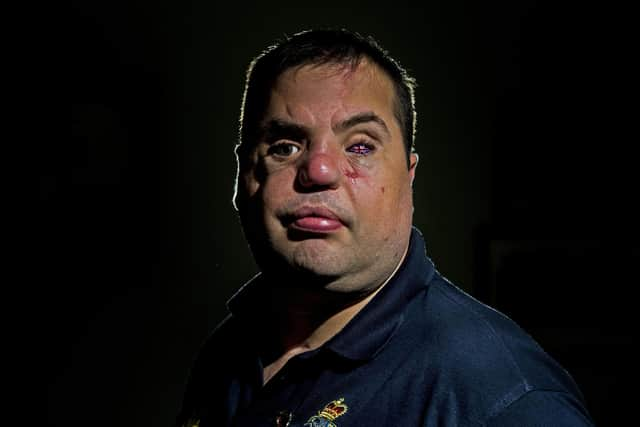
And Simon Brown, of Leeds, who will join parades at the Cenotaph tomorrow after a festival of Remembrance in Morley last night. He was blinded by sniper fire on a tour of Iraq in 2006, shot in the face as he came to the aid of six fellow soldiers in a stranded vehicle.
The poppy, he said, stands today as a symbol of hope for all those who have served in conflict.
"If we look at the context of war in the world today it's more important than ever that we remember," he added. "We honour those serving today, who put their lives on the line. If we don't remember, what future have they got, that we will look after them and their families?"
Military service, he said, isn't just about those who serve and who sign up to protect their country. Often, it's about the loved ones left behind to worry and fear.

"Three times I went into operations," he said. "It's that ripple effect that's hard."
And the symbol of the poppy means just as much to Mr Mortimer, now aged 102, and whose eyes mist over as he looks back through history to the day his own comrades fell.
He had been just 20 years old when he landed on Sword Beach on the D-Day landings of June 6, 1944. He has vivid memories of that day, he said, and of the tanks and artillery and the thunderous boom of fire as shells and mortar flew overhead.
Speaking now, marking the Royal British Legion's (RBL) launch of this year's Poppy Appeal, he said he can never forget.
"It brings back a lot of memories," he said. "Some are memories I won't want to share. They weren't nice memories, in war.
"I say many times to myself 'I'm lucky, to be alive'. 'I'm lucky, to have survived'. I am sorry so many had to die."
Back at Escrick near York, Emmanuel's grave stands out. His headstone, newly carved in France, is white against the mottled grey of age evident in those that surround it.
He lies buried between his father and his grandfather. Nobody has known, for more than a century. Until now, until the work of one woman over more than 12 years.
Aged in her early 80s, Rona's small frame belies the fire that drives her. A fierce determination, to delve deeper into history to right this wrong.
"In my mind this is an injustice that he hasn't been recognised," she said. "I don't like injustice. I was determined that, one way or another, I would remedy it."
Emmanuel's story begins back in 2013 with his name on a roll of honour at St Mary’s Church in Selby. It would often catch Rona's eye.
Ahead of centenary services to mark the outbreak of the First World War, she set to work uncovering more about the names on the list.
She followed all the usual routes, from Ancestry to Find My Past and in particular the CWGC. Soon, she had information for all but one of the soldiers. She said: "There was nothing for Emmanuel. He was a 'non-identity'."
What followed was no small feat in detective work, tracking down the census details to follow his family across Yorkshire and to see his service recognised by the CWGC.
The Foxton family lived at Park Street in Selby, she discovered, and he was baptised at St Mary's. On his father's death, the family moved to Armley in Leeds, but were still wealthy enough to maintain servants.
Soon, with the support of curators at York Army Museum, she uncovered his attestation forms and from there she could track his war service.
Private Emmanuel J Foxton, of the Prince of Wales Own West Yorkshire Regiment, enlisted at just 19 and went to France in January 1917.
War diaries tell of the conditions he endured. Of bitter winter, and ice and snow, and of rations that soon wore thin. And of the "gassing incidents" that eventually killed him.
Emmanuel was evacuated on March 5 by ambulance train and discharged in the April. Nearly two years later, in January 1919, he died as a result of gassing injuries sustained.
His obituary, published in the Selby Times, shows that he had returned to his work as a chemist before he succumbed. His mother was at his bedside when he died.
But that is where the trail ran cold. Until now, Emmanuel's military service has not been listed by the CWGC. His grave lay lost, with no headstone.
Rona's research, submitted to CWGC in 2022, set the wheels into motion. First he was recognised in its Book of Remembrance.
Then in September came the call; a headstone was ready. Church wardens and local historians, late into the night, were readying the cemetery. And the next morning, as Rona parked her car outside, she found that tears were streaming down her face.
"I felt relief, knowing it was there," she said. "I just wanted to see that headstone. He won't be forgotten. As long as I am here."
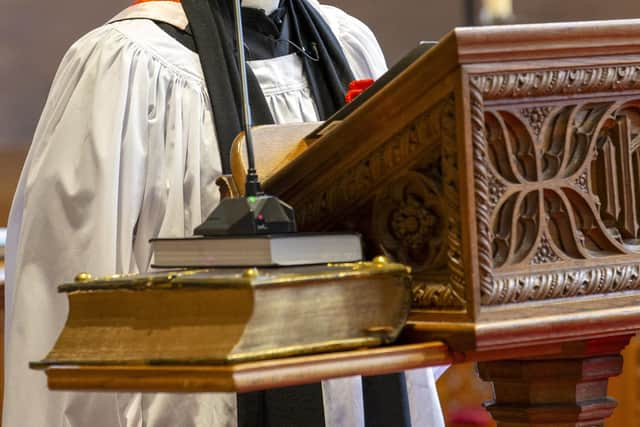
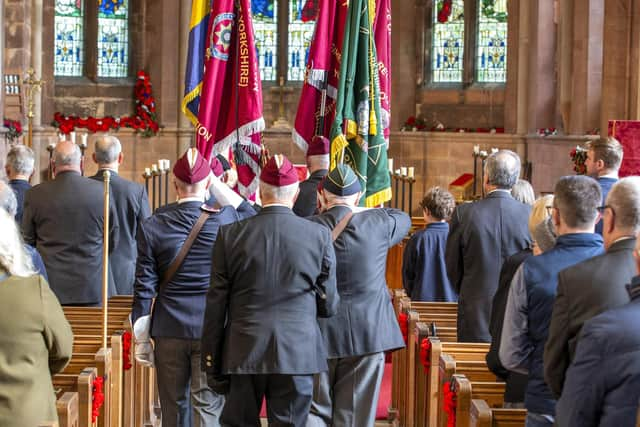
This week, it was formally dedicated, with prayers from MP Keir Mathers and veterans and serving soldiers from Emmanuel's old regiment. Half a dozen standard bearers, to proudly bear witness, and a bugler's haunting call.
Priest-in-Charge Rev Jackie Doyle-Brett led the service at Escrick Church. Every pew was filled, as candlelight glittered gold against a red sea of 5,000 knitted poppies.
Emmanuel, she said, had laid down his life in service to his country more than a century ago.
"May this act of reconciliation remind us of the cost of peace," she said.
"The years since have passed in silence,” she added. “Today we speak his name, acknowledging his sacrifice. This is about more than a headstone. It's a sign, that no life is forgotten."