
September 11 attacks: Andrew Vine recalls reporting from a traumatised New York
Friday marks the 25th anniversary of the September 11 2001 terrorist attacks on the United States which killed almost 3,000 people.

I can picture her face now, even though it’s a quarter of a century since my only glimpse of her.
Wide-eyed, unblinking, trapped in her own private purgatory, her expression flitting from hope to horror, she gripped my forearm with such force that I could not break free as she demanded “Have you seen him? Have you seen him?”, over and over again, her voice rising until it cracked.

In her hand she had a photograph of a man aged about 30, with dark, wavy hair and a broad smile. She was in the picture too, smiling happily alongside the man she obviously loved. No words of mine could get through to her and after a few moments, she let go of my arm and moved on to somebody else, asking the same question.
Four days after the attacks
It was four days after the September 11 2001 attacks on New York, and she was among the crowds who gathered in Union Square, in midtown Manhattan, at dusk to light candles, to pray, to try to comfort each other and for some, like that tormented soul who grabbed me, to pursue the fading hope that somebody had news of a loved one.
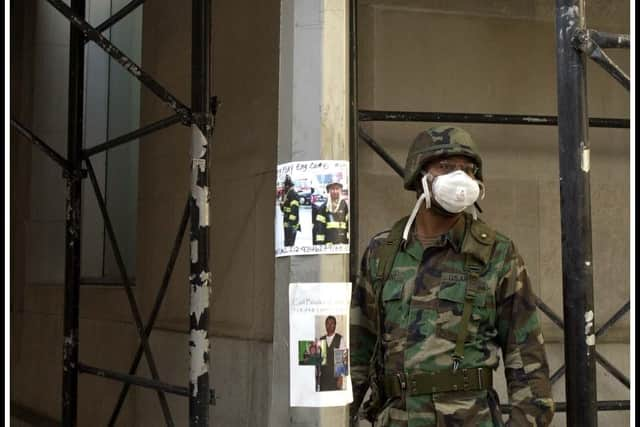
Like everywhere else in the city, the square was plastered with posters of the missing who had simply vanished when the twin towers of the World Trade Center collapsed after hijacked airliners came out of a clear blue sky and were crashed into them.
Dispatched to NY
Along with photographer Bruce Rollinson and feature writer John Woodcock, I had been dispatched to New York by The Yorkshire Post to cover the aftermath of the worst terrorist attack in history.
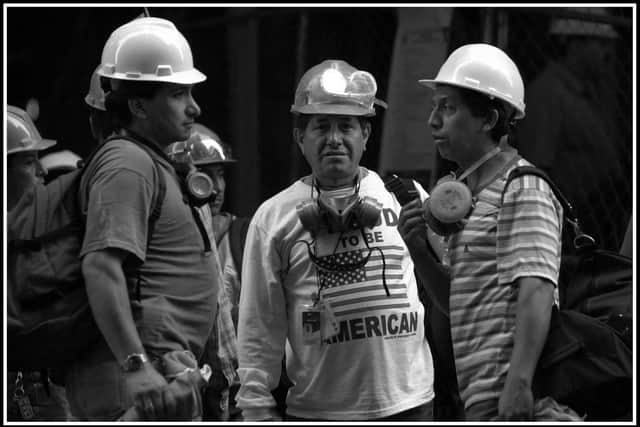
We found a traumatised city struggling to come to terms with what had happened, where shock and disbelief hung in the air like the smoke from the smouldering hell of the debris of those quarter-of-a-mile-high towers that had defined Manhattan’s skyline.
Even though the world had watched as the towers crumbled on live television, nothing could prepare anybody for the impact of what was left behind – a wasteland of tangled steel and pulverised concrete so immense it was visible to satellites orbiting the Earth.
And at its centre, a giant jagged fragment of twisted steel girders that looked for all the world like a hand reaching upwards for help, as emergency workers swarmed over the site no longer in any hope of rescuing the living, but focussed entirely on recovering the dead.
Except with renewed horror, they realised there was little to recover, which made New Yorkers grieve even more deeply.
There were few to be found. Those who had not been killed by the impact of the aircraft or the explosions and fires that followed had simply been obliterated as the towers collapsed, blown out in the obscene grey-black cloud that billowed across the city to settle on the buildings and pavements in tiny, unidentifiable fragments.
Debris in the aftermath
Everyone who walked through lower Manhattan for a mile or two around the debris in those days afterwards was painfully aware of what lay underfoot.
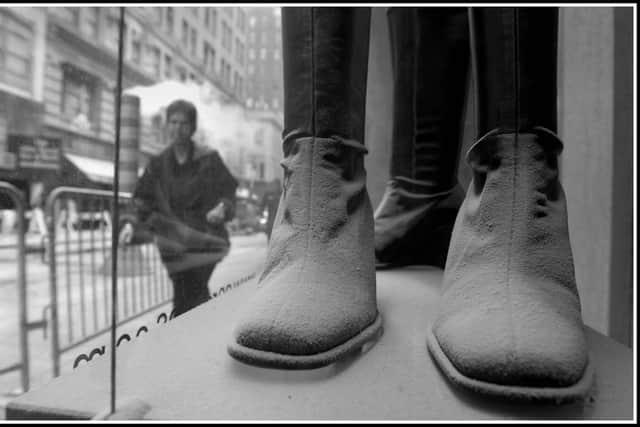
The ground was carpeted with inches of grey dust, which turned to a thick, slimy, sticky sludge when the city’s street-cleaners turned hoses on it to try to swill it into the drains. The only way to shift it was to scrape and shovel it away.
Until it was cleared, every gritty, crunching footstep gnawed at the mind. That was why I saw so many people suddenly burst into tears as they walked along the streets.
And over them hung an ever-present acrid stench that caught and stuck at the back of the throat. It was propelled by the fires that raged below the surface crust of the debris for weeks, fuelled by the millions of gallons of New York’s emergency oil reserve, which was held deep below the twin towers and ignited by their collapse.
Goodness knows what all of us in Manhattan were breathing in. As the days passed, stories emerged of emergency workers suffering severe respiratory problems, and hospitals braced for mass casualties from the towers which never arrived found themselves instead treating people with breathing difficulties.
The New Yorkers I talked to invariably spoke of their struggle to make sense of what had happened and why their city had been targeted.
One manifestation of that was soaring church attendance as people sought solace and strength at a time when there was widespread fear that another wave of attacks would be launched against the city. Churches held additional early morning services, which people attended on their way to work.
Prayer services
Nine days after the attacks, I reported from the prayer service for the British victims, held at the church of St Thomas, on Fifth Avenue. Prime Minister Tony Blair’s voice shook as he told the congregation: “There is no reading, there are no words that can truly bring comfort to those who are missing their loved ones today.”
But even the emotion of that moment paled beside the message from the Queen, read out by Britain’s ambassador to the US, Sir Christopher Meyer, which concluded with the words: “Grief is the price we pay for love.”
For a moment, there was absolute stillness in that packed church, and then a collective sigh from the entire congregation at the wisdom and compassion of what they had just heard.
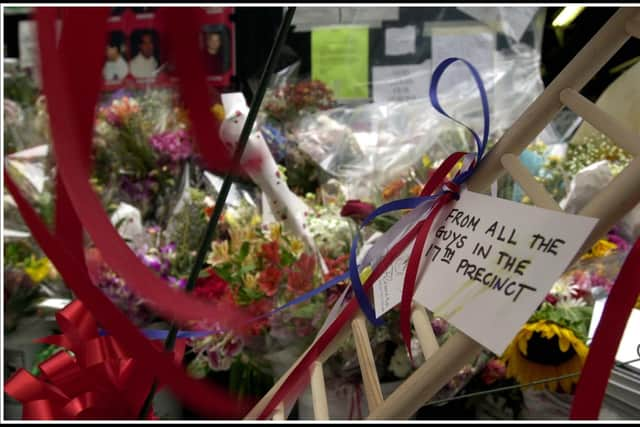
But for every formal commemoration, there must have been a hundred informal and impromptu memorials. They were to be seen outside police and fire stations in tribute to the emergency workers killed when the towers collapsed as they tried to save the lives of those inside – flowers laid, candles lit, photographs of the lost taped to walls.
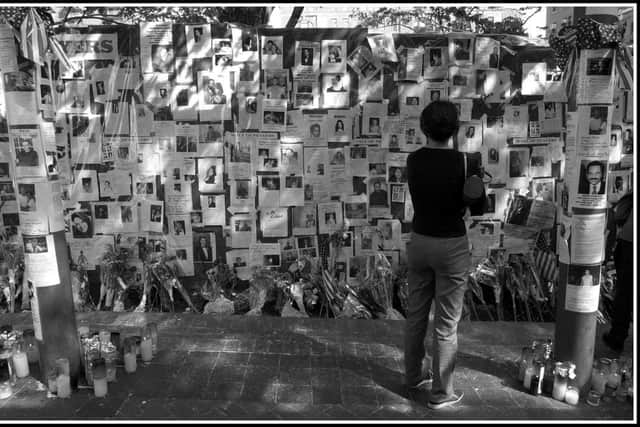
The biggest shrine to the missing was close to the entrance to Bellevue Hospital, a few yards from First Avenue, where a 30-yard-long fence was covered with posters carrying pictures of more than 1,000 people who had not been seen or heard from since the towers fell.
Relatives had begun pinning them there within hours of the attack, in the hope that hospital staff arriving for work would recognise someone. The posters were heartbreaking, and not just because most carried smiling faces.
Desperate families reasoned that their loved ones might be unconscious, so included intimate details of birthmarks, moles, scars and tattoos that they hoped would help medical staff identify them.
Even their jewellery was described in detail – a Cartier watch that Alisha Levin wore, a diamond engagement ring on Monica Goldstein’s finger, an ankle bracelet that Victoria Alvarez Brito never took off.
Leafing through my notes from the time, I find the names and what was written about them no less poignant now than on the day I copied them down.
There was Deanna Micculli, “Just married six weeks ago and is seven months pregnant with her first child”. Marian Victoria Hamilton was “My precious wife, my whole life”. A picture of Gregg Preziose simply said, “Please find my daddy”. And hundreds upon hundreds more, each a story of broken hearts.
The fence and its posters became known as the Wall of Prayers, where New Yorkers came to pay their respects to the lost. Cleaners from the hospital kept the site immaculate, relighting candles that had blown out and neatly arranging the countless bunches of flowers left below the pictures.
All those names are now carved on the 9/11 memorials, but the fading of hope for the missing as the days ticked by felt like another blow for that great city and its people who had suffered so grievously.
Scale of human tragedy
I’m certain that somewhere on the Wall of Prayers would have been the picture that distraught woman showed me in Union Square.
She’ll be about 50 now, I guess, and on every anniversary of September 11, I’ve wondered what became of her and how she ever came to terms with finding out that there was to be no miracle and her partner was one of the almost 3,000 people killed in the attacks on the US.
It was the sheer scale of the human tragedy that I took with me from New York. The buildings have risen again. The lives left behind? I’m not sure they could ever be rebuilt.