
The Peg Loomer: 'I can get lost in weaving - and it's a sustainable craft'
The quest for sustainability led Sophie Hetherington Heywood on the path to becoming The Peg Loomer. Sally Clifford chats to her about the journey.
Growing up in Saddleworth, Sophie Hetherington Heywood was well accustomed to being totally encapsulated by the stunning rural backdrop which surrounded her throughout childhood.
Home to several villages and hundreds of listed buildings, this civil parish is, perhaps, best known for its expansive moorland forming part of the glorious Peak District National Park.
Farms and flocks not only go hand-in-hand with Sophie’s home territory; they have become an integral part of her working life.
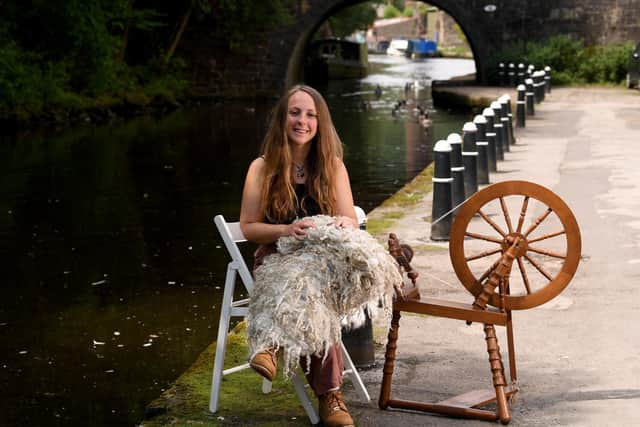

“Six years ago, just after the first lockdown, I went to an off-grid community in Wales where I was taught how to weave on a peg loom. I have always been interested in living sustainably and having a light footprint on the planet, and friends of mine knew people who lived there, so we went to visit.”
Enthused by how quickly her craft project came to fruition, Sophie bought a peg loom and some fleece, and so began The Peg Loomer’s journey.
“I am not a knitter, but I made a rug quite easily and thought, ‘This is great’. It is easy to learn and it is very therapeutic.
“I was also unemployed at the time, because of Covid, and I asked farmers if they had any fleece I could buy. I was inundated, and I learned how undervalued wool is. I started to learn all about that, and it just clicked with me.
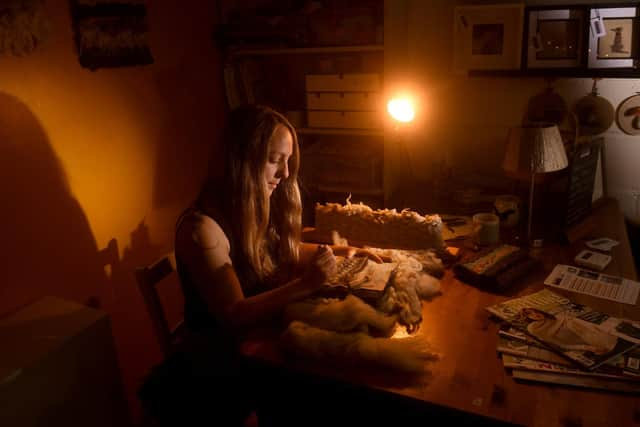
“I thought we had all this fibre that we used – people were using wool; that is how we have lived for however many thousands of years, and all of a sudden it is worth nothing because of mass-produced synthetics,” explains Sophie.
Conscious of this, and keen to ensure this valuable natural resource, renowned to be warm; waterproof and fire resistant, wouldn’t go to waste, Sophie began sourcing fleeces from local farms to weave her crafty projects which she sold through the café she and her mum, Jackie Hetherington, a keen knitter, were running in Saddleworth at the time.
“We were only open for takeaways, and I was weaving in the back room, and customers were buying rugs off me.”
The gift of a felting kit for Christmas led to Sophie expanding her range. Felted sheep, styled as ‘Baables’ during the festive season, sterling silver felted earrings featuring nature-inspired designs and colourful felted pendants – all crafted from British wool – along with gloves, hats and scarves are among the many items for sale in her shop within the picturesque canalside setting of Hebble End Works – a hub of independents occupying a former mill and dyeworks in the creative community of Hebden Bridge, where Sophie moved three years ago.
Adorning the walls 3D fibre artworks – felted toadstools, hand-dyed from the plants and plant powder Sophie uses to achieve her specific colour schemes, and felted onto recycled fabrics and framed, along with pet portraits, are examples of the projects Sophie offers in the regular workshops she runs for small groups at her shop and at other locations – Gordon Rigg Garden Centre in Todmorden, Authentic Gift Shop in Saddleworth and craft events – Yarndale in Skipton in September and Haddon Hall in Bakewell in November.
Placing her peg loom on the table, Sophie explains how the warp string is fed through the holes in the individual wooden dowels sitting within the block of wood. She then weaves carded wool or washed fleece in and out of the pegs. When the pegs are full, they are removed, and the woven fleece is pushed down the strings.
Sophie continues this process until she has woven enough wool to fill the warp strings. The ends are then tied off to secure the rugs, mats and headbands she creates.
“I started doing workshops just to teach other people this craft, which is really accessible. I know there are crafts where people have to practise for years and years, but I think it is also nice to show there are crafts you can just put your hand to, and the more you practise, the better you get.
“It is practice and having an eye for it, but it is nice to have more specific crafts that people can have a go at.”
Sophie says participants range from mums wanting to set time aside for themselves and friends wanting to do something together to those who turn up alone to participate in a social activity.
“They come and do something wholesome and go away with something they have made and that is always lovely. I think crafting is definitely having a resurgence – people want to know more about where things are coming from, and I explain to them in every workshop about British wool and how I got into it and why I am passionate about it.”
Draped over a wooden frame is a rug Sophie wove on her peg loom from the fleece of Masham sheep.
“It took a long time because it has all these beautiful locks – I just love it,” she says.
The largest rug she made, for a commission, was 1.5m by 2m. “That was for a farmer in the Cotswolds who brought me the fleece – she had Herdwick sheep.”
Baskets boast five blends of spun yarn in white and grey and Sophie’s favourite rich brown from the Manx Loaghtan, a small primitive rare breed sheep native to the Isle of Man.
Yarn sourced from flocks in Saddleworth; Temple Newsam, Leeds; and small holdings in North Yorkshire and Halifax adorn the shelves in the shop, where items showcasing the yarn have been knitted up by local knitter Janet Byrom to designs created by Sophie’s friend, renowned knitwear designer Jacinta Bowie.
Little bears and sheep, of course, demonstrate the knit kits, designed by Jacinta and sold by Sophie.
“When I was weaving back home, I was only getting fleece from local farms, but I found I couldn’t keep up with the washing.”
Sophie, who is a member of the Northern England Fibre Shed, an organisation using and promoting fibre and plant dyes from the North of England, outsourced the washing of the fleece she uses for weaving rugs and found Halifax Spinning Mill in East Yorkshire, which uses traditional processes to card and spin her fleeces to produce her wool.
“I asked Jacinta what she thought about getting this wool spun, and she said, ‘Go for it’. She has been championing British wool for years,” says Sophie. “Places like Halifax Spinning Mill are vital in keeping wool manufacturing in the North of England.”
Sophie credits Jacinta’s support in helping her to profile her yarns in knitting magazines.
Such a profile reinforces her quest to promote those involved in producing locally sourced wool from fleece to finished product.
Perhaps the most important element of ‘The Peg Loomer’ is bringing together the key components: the farmers who supply the fleece, the mill that spins the wool and the designer and knitter who can showcase what is possible through patterns and skill to keep what is one of the oldest methods of fibre weaving alive while ensuring fleece isn’t wasted but utilised in a sustainable and creative way.
“I always say I am not an expert, but I have the support of all the experts,” says Sophie. “I really like using the rare breed wool because I know I am supporting the farmer to keep these rare breeds going. It is about promoting the rare breeds so we don’t lose them.
“I also like working for myself. I have always been creative, but I have never had a specific outlet, and, for me, it is about promoting a natural fibre and something that is good for the planet.
“I can get lost in weaving – and it is vital for me to know it is and continues to be a sustainable craft.”
Visit www.thepegloomer.co.uk. Search @ThePegLoomer on Facebook and Instagram.