
The Yorkshire Witch: 'Mary Bateman was successful because people wanted to believe in something'
A new play telling the story of Mary Bateman, dubbed the Yorkshire Witch, opens in Leeds this week. Chris Bond spoke to playwright Chris Singleton about her life.

It was six years ago, while working as writer in residence at Leeds Central Library, that Chris Singleton came across the story of Mary Bateman, the woman known as ‘the Yorkshire Witch.’
Bateman was born near Thirsk and at the start of the 19th century she was living in Leeds.
By this time she had carved out a career as a so-called ‘wise woman’ – selling magic charms and potions and claiming to have the powers to heal and banish evil.

She was a con-artist with a darker side and her life of crime caught up with her when she was convicted of murdering a woman called Rebecca Perigo and hanged at the gallows overlooking St George’s Fields in York on March 20, 1809.
For Singleton, Bateman’s story had all the makings of a stage show. “I immediately thought it would make a cracking play in a kind of League of Gentlemen-esque, Fleabag kind of style, where the female lead talks directly to the audience,” he says.
He started writing the story and after getting funding to turn it into a theatre production, the play – Mutton – opens today (November 13) at Leeds Central Library before going on tour this month in Leeds, Harrogate and Barnsley, including two venues as part of the Red Ladder Local programme, run by Red Ladder Theatre.
“Mary got a bit of a reputation as a thief and wrongdoer from an early age. By the time she was five was described as ‘knavish’ and ‘vicious’ and this reputation followed her around,” says Singleton.

“She moved to Leeds and continued her career of crime. Amongst her crimes – and this is where the title of the play comes from – she intercepted a butcher’s boy on his delivery round and demanded a leg of lamb saying the Lord wanted it and snatched it from him and took it home for her tea.”
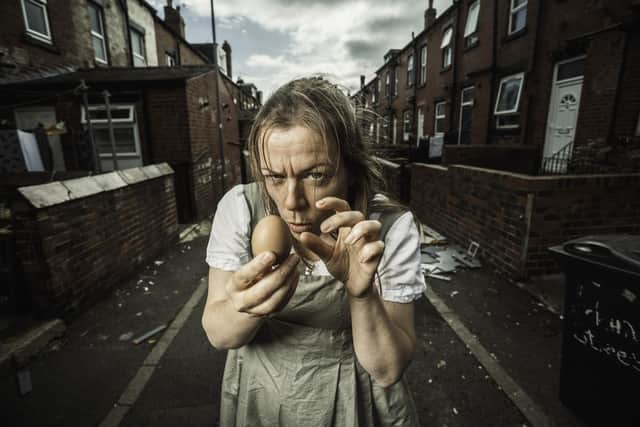
Bateman sold charms under various guises but her biggest con revolved around what became known as the ‘Prophet Hen of Leeds.’ “She wrote ‘Christ is coming’ on a load of eggs, hilariously misspelling Christ without the ‘h’,” says Singleton.
“She convinced some people that her hen was laying these holy eggs and charged people a penny a go to see them. She became a bit of a local celebrity through her ‘holy hen’ and prophesying the end of the world.”
However, her ruse was uncovered, and it was found she used concentrated vinegar or corrosive ink to write on the eggs, which she then reinserted back into the poor hen.
Bateman’s criminal activities grew increasingly malicious.
“She started poisoning people to keep them under her control by convincing them they needed her healing skills and eventually poisoned the wrong person and was caught.
"She was imprisoned in York and later hanged in front of what was believed to be a crowd of between 5,000 and 10,000 people.
"It was reported that some had walked all the way from Leeds to see the hanging, either because they had been her victims or wanted to see if the Yorkshire Witch had one final spell that would help her escape the gallows, which of course she didn’t.”
Singleton is artistic director of Brave Words, a not-for-profit theatre company based in Leeds that is producing Mutton.
“The play opens on the gallows moments before Mary is hanged and it ends on the gallows, and in between is Mary telling a version of her story to the audience, alongside a collection of characters she conned during her life.
"It’s framed around the idea of who tells our stories, and it also raises questions about whether we can trust the people who tell them.”
He believes the story has something to say about our world today. “Back in the early 1800s, a lot of people were living in poverty.
"The Industrial Revolution was underway and there was fear of new technology in the mills and factories and people were desperate for anything that might make their lives a little bit better. That’s why Mary was successful, people wanted to believe in something.
"As I was writing the play I kept thinking about the similarities with today. People are struggling, they’re worried about new technology in the form of AI and being conned by false prophets who claim they have the answers,” he says.
“The idea of Mary claiming to be able to make people’s lives better when doing it for selfish reasons is something that chimes with our world. Mary was a charismatic person who was able to convince people of things.
"She was a grifter, who was running from one con to the next, who would jump on a bandwagon if she thought it would benefit her. You only have to look at the world of politics to see this is still happening.”
Singleton was also intrigued by what drove Mary, as a poor working-class woman, to such extremes.
“She grew up with no agency over her life and took agency by pretending to have magic powers and we wanted to explore the idea of a woman living in what was a very patriarchal society.
"We’re not trying to say she wasn’t a villain, because she was, but we wanted to explore the reasons that might lead someone to do the audacious things she did.”
He points out, too, that while witchcraft wasn’t as prevalent in the 1800s as it was a couple of centuries earlier, it still intrigued people and does even to this day.
“I don’t think that fascination has ever gone away. People are still interested in stories about magic and witchcraft.”
For the full list of tour dates and to book tickets for the show, visit bravewords.co.uk/mutton