
World's Toughest Row: 'I'm planning 3,000 mile crossing of Atlantic Ocean in a rowing boat - this is why'
When Jake Still heard about the World’s Toughest Row, he was determined to take part – despite, at the time, having no experience on the water. Laura Reid reports.
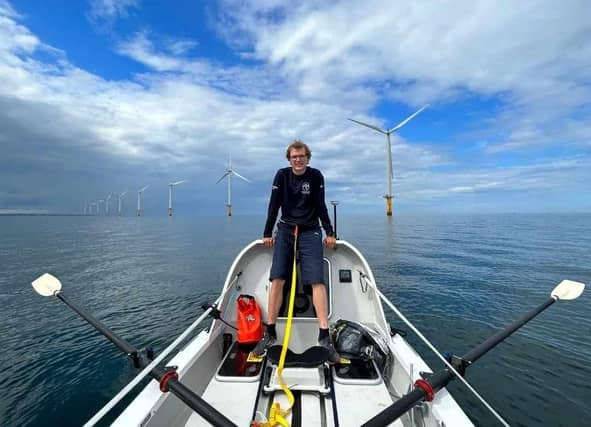


It didn’t matter to Jake Still that his rowing experience was entirely non-existent. His mind was set on his next big adventure being a 3,000 mile crossing of the Atlantic Ocean, a challenge dubbed the World’s Toughest Row.
The 26-year-old’s adventurous streak had blossomed with scouting and Duke of Edinburgh expeditions in his youth – and as he came to the end of his physics degree, on a high after a trek to Everest Base Camp earlier in his university days, he was looking for a new goal to work towards.
“I didn’t know rowing an ocean was an actual thing, I didn’t know you could just go out and do that (until I stumbled across this challenge),” he says. “I know people cycle across the continent. That's equally demanding, but it's not as daunting, I guess, as the sea.”
The World’s Toughest Row brings together people from all walks of life, united by the same objective of crossing an ocean in a rowing boat.
Those taking part will battle with sleep deprivation, salt sores and physical extremes as they navigate across the vast expanse of water, facing waves up to 20ft high and temperatures ranging from 10 degrees to well into the 30s.
“A lot of other people from different backgrounds have done this race so (not having rowing experience) wasn't something that deterred me,” says Jake, who lives in Pudsey, Leeds. His thinking, instead, was that he could learn.
He joined Bradford Amateur Rowing Club in the summer of 2021, after finishing his studies at Durham University. By February the following year, he’d signed up for the race, which begins in La Gomera in the Canary Islands, and takes place this December. Jake is aiming to reach the finish line in Antigua, after around 40 days at sea, completely alone.
The majority of this year’s entrants are taking part in teams of two, three, or four, but Jake, who is competing under the name Aire Wave, is one of ten people rowing solo.
The job to get safely to the other side falls solely on him – and that means cleaning the boat, navigating, making repairs and rowing in excess of 1.5 million oar strokes.
“Because you're alone that means you have to be on board with all the tasks,” he explains. “You have to have your own discipline about what you're going to do…
"It's a little daunting getting in the water, compared to the other teams, as a solo. You make sure you're all clipped in and tied on but I guess that's my only main worry (about being alone).”
Jake can still remember his mum taking him to his local scouting group in Farsley for the first time at the age of nine. Over the next ten years, he would develop a passion for adventures and expeditions.
“I don't know what it was, but something about travelling from point A to B under your own physical effort and being immersed in the tranquil atmosphere of nature was very appealing to me,” he explains.
"I am someone who likes to improve myself and enjoys working towards a goal,” Jake adds. “And once I set my mind on something, I have absolute focus on achieving that objective.”
It’s why, these days, the data scientist can often be found on the River Aire at Bradford Amateur Rowing Club, as he aims to prepare for what’s to come.
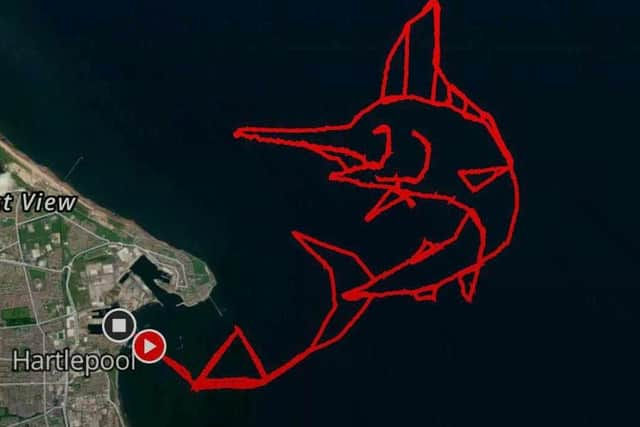
Jake’s training has also seen him spend more than 300 hours off the Hartlepool coast in the North Sea. There, he’s been setting himself challenges to create GPS art with his ocean rowing boat, designs like Homer Simpson, Darth Vader, and a Blue Marlin fish, each taking eight to 14 hours to complete.
“I thought it'd be an interesting goal to have while training,” he says, “just something fun to do, but also it's it's a good way to experience the conditions in all directions.
"Because of the complex shape you’re making, you're going back and forth, up and down and so you can experience the waves and wind in all directions. It's good practice.”
Still, the British coastline is quite different to being in the middle of the Atlantic Ocean, he admits. “Am I ready for it really? I guess it's hard to say. You can't really truly prepare for the Atlantic on the coast…You can only really experience true conditions out in the open ocean.
“The winds will be higher which normally leads to waves breaking and that's when people capsize or they get pushed around, it can be quite scary.
"And this can happen at night. It really depends on the conditions. It might happen once or twice a crossing, if you're lucky, or it happens over 30 times.”
A capsize experience in his local waterway in part inspired Jake to use his challenge to raise funds to support the work of the Aire Rivers Trust and The Rivers Trust. He fell sick after falling into the water and believes it was as a result of pollution.
Rowing in rivers each week, Jake says he witnesses first-hand the challenges that are facing them – pollution from litter, sewage or agricultural run off, for example, and, dangerously high water levels, or flooding, as a result of heavy rain.
“If our rivers thrive, so do we,” Jake says. “With this Atlantic row, I thought I could do something to give back to the community trying to combat the issues.”
That drive to support rivers is helping him to keep motivated in the months ahead. "And I just like to challenge myself really,” Jake says. “I think that's what this stems down to - (achieving) something I have never done before.”
For more on Jake’s challenge, visit airewave.co.uk.
Donations can be made at givestar.io/gs/project-airewave---rowing-3000-miles-across-the-atlantic