
Yorkshire documentary maker Paul Berriff: 'I was caught up in September 11 terror attack - it made me appreciate how precious life is'
Paul Berriff was in New York when the twin towers were struck in a terror attack 25 years ago. He speaks to Laura Reid about the events of that day and how they have shaped him.

In New York, Paul Berriff retraced the steps he’d taken 25 years earlier, this time with his teenage grandchildren by his side. The twin towers no longer part of the skyline, the 9/11 Memorial Museum at the World Trade Center standing in their place instead.
Last month was the first time Paul had visited the museum, coming face-to-face with its many personal stories of loss, recovery, and hope.
For his family, each one offered a new perspective on a harrowing tale they’d heard their grandfather recount, a reality he’d lived through in 2001 and one which remains as vivid for him today as it was a quarter of a century ago.
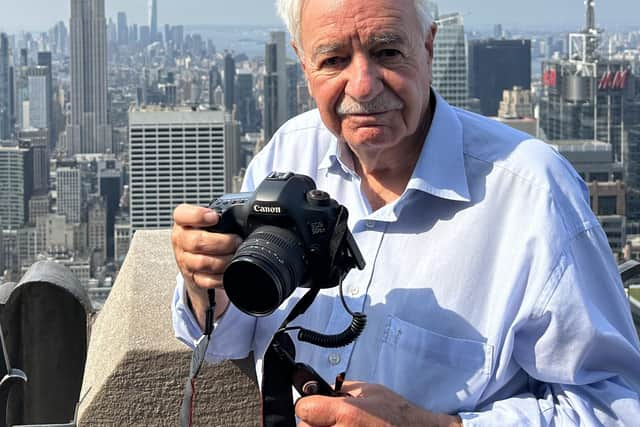

“It doesn’t seem two minutes since it happened,” says 80-year-old Paul, speaking from his home in North Yorkshire. “That day is very vivid. I can remember every minute from the moment someone came into the office where I was working and said a plane had hit the World Trade Center. That day is one we should never forget.”
In 2001, documentary filmmaker Paul was in the US creating a series focused on the law enforcement unit of the American Society for the Prevention of Cruelty to Animals (ASPCA). He and his crew were little over three miles away from the World Trade Center when they heard that a plane had crashed into one of the towers.
Paul found himself making his way to the epicentre, to witness the events unfolding before him, his camera rolling.
“Every day there were light aircraft and helicopters flying around that area because that is the shot of New York you see in all the movies,” he says. “So at first, we thought it must be one of those that had hit the towers.
“My journalistic instinct kicked in and I got my crew and said let’s have a ride down and see what’s going on. As we drove down there, the towers came into view and we saw part of them were on fire and we knew then it was more serious…We could see these black dots around the building and as we got closer we realised those black dots were actually people jumping. We knew then how serious it all was.”
Leeds-born Paul reached the base of the towers just as a senior commissioner in the New York Fire Department was setting up an incident control station. He was given the go-ahead to film as firefighters arrived and were sent into the towers to try to rescue those who were trapped.
Less than half an hour later, Paul recalls hearing what sounded like an explosion.
“I panned the camera around just to see the top of the south tower peeling away like a giant umbrella opening literally above me,” he previously told The Yorkshire Post.
“As soon as the firefighters saw what was happening they were shouting ‘run, run, run’ but I stayed there for a couple of seconds with my sound recordist and stuff was travelling at speed towards us…
“Then we started to run down the street and as we did, I kept my camera running - it was pointing over my shoulder at what was happening. I could hear it and it was this incredible sound, like being on the main runway at Heathrow Airport with jumbo jets taking off above you.
“As we ran down the street, the sound got louder and louder and I remember the camera leaving my hand in slow motion and that’s when everything went black and I was knocked unconscious.”
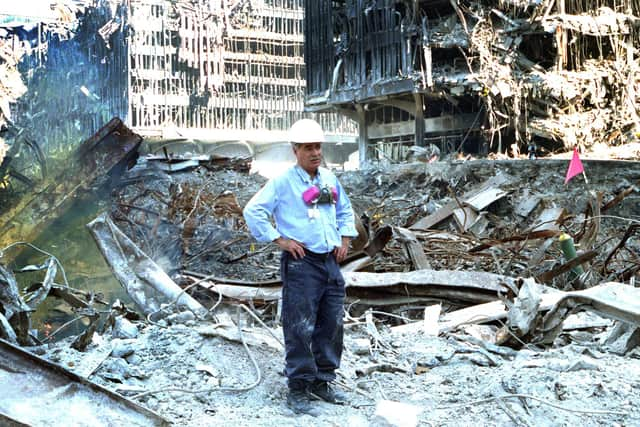
When he woke up around half an hour later, the North Tower had also collapsed and Paul was faced with a scene he can only describe as apocalyptic.
Emergency vehicles had gone up in flames and the building immediately to his right was ablaze from its ground floor to its top. Embedded in the street, which he had crawled along only minutes ago, were shards of concrete debris – the shattered remains of what had been two of the tallest buildings in the world.
Paul contemplated the destruction before him. Somehow, he was alive. “Every major disaster leaves a signature smell…and for me, 9/11 is burning plastic,” he reflects. “If I smell that now, it reminds me of that day. That’s what really sticks in my mind.”
“It makes you understand how precious life is, having walked, well crawled, my way out of something like that,” he continues. “I know I now take every day as it comes and enjoy it because you just don’t know what’s coming next.”
In the months after the terrorist attack, Paul was back at Ground Zero, filming the search and recovery efforts for a documentary.
“I lived through the day and right through the aftermath and I was there right until the last lorry load of debris was taken away. So I saw the whole incident, the story,” he says.
As a cinematographer, Paul had previously survived a major helicopter crash during his years of filming, leapt from a sinking ship in the North Sea and escaped death when a volcano erupted around him in Nicaragua. But nothing came close to this.
“I’ve had four near-death experiences while filming but this is in no doubt the one where I should not have survived,” he says in his print and audiobook 9/11 Wrong Place Right Time: Me, My Wife and Muffin Our Cat.
He’s now writing a book about his exploits behind the camera over the last 60-plus years, tracing a career that began at the Yorkshire Evening Post at the age of 16.
Talking about his experiences “is a sort of therapy”, he says, “a way of releasing it all from me”.
“I’ve been doing journalism, news, current affairs and documentaries since I was a teenager so I’ve been exposed to lots of disasters. I also set up the Humber Rescue lifeboat station and was a lifeboatman for years so I’ve been on rescues and recovered bodies from the water and all sorts of things.
“I’m used to dealing with that frontline immediacy of death and destruction whereas most people aren’t. I can see awful things and it doesn’t really get to me. The worst thing about 9/11 was all the people jumping from the towers. That was quite horrific really. But you can’t dwell on it.”
Physically however, Paul says he is now feeling the effects of being amongst the rubble, when his mouth, eyes, nose and ears “were full of gunge, a cement-like paste”.
Earlier this week, ahead of the 25th anniversary of the attacks, New York City Mayor Zohran Kwame Mamdani announced the release of more than 170,000 pages of records documenting health concerns, air quality and the city’s response to 9/11.
The opening page of the document portal features a message from the 83rd Corporation Counsel Steven Banks, who says: “The horrific terrorist attacks of September 11th, 2001 stole the lives of nearly 3,000 people, including hundreds of first responders and city workers who ran towards danger to bring others to safety.
“In the years since, thousands more have become devastatingly – often fatally – ill from toxins and debris, though the true magnitude of the attack’s impact has yet to be fully realised. Every day, we remember the lives lost, the families that were irreparably shattered, and the city that bore the unimaginable.”
Paul says he is under medical care for pulmonary fibrosis, a lung condition which in some cases has been linked to things like long-term exposure to certain types of dust, such as metal, wood or asbestos.
He believes it stems back to what happened that day. “We thought we’d all escaped that day but it’s come around to bite us. It’s a sting in the tail really,” he says.
His 25th anniversary trip last month to revisit the attack site was “quite something” he adds. Like many of those who were caught up in the horror, it will never leave him, but retracing his footsteps with members of his family “brought it all back”.
“If you’ve had something close to death like I have, it does make you appreciate what life is all about,” he reflects. “If the rest of the world went through something similar, it would change their lives I think - there’d be no fighting and shooting and murders. It makes you appreciate what life is.”