
Yorkshire Remembrance: Incredible tales of bravery and valour for Doncaster seven awarded the Victoria Cross

A soldier’s sacrifice fades to grey with the softening of stone, as time takes its toll on the sharp strokes carved into monuments. There is a danger, in forgetting, that history repeats. Yet how can we remember those whose names we cannot see?
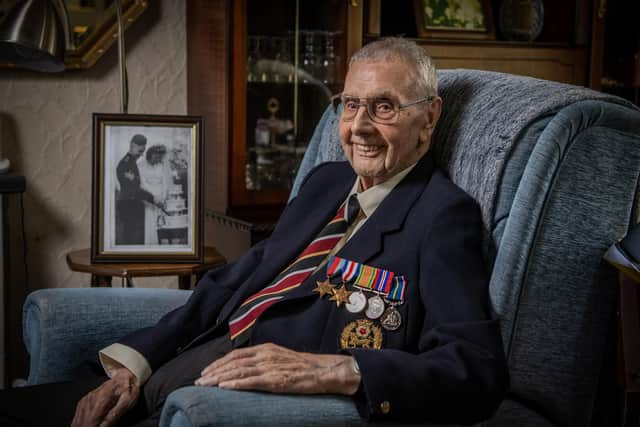
Arnold Walton, in Rotherham, only has to close his eyes to picture his comrades. Stanley Antcliffe, or ‘Auntie’, as they called him. George Alfred Yorke, known to all as Dan. These were the lads left behind, in Holland.
At the haunting call of The Last Post, Mr Walton, now aged 100, will remember them. He will watch from his window as it overlooks the war memorial.
“They got killed, just before the end of the war,” he said. “None of us even got a scratch, and then right at the end we lost them. It still sticks in my mind, vividly.

“It was togetherness, that’s why we signed up,” he added. “But I see them, still, as boys. I see them as they were.”
Soldiers from all wars are to be honoured in Remembrance, as Yorkshire takes pause to pay tribute to the fallen and those who served.
Among the names carved into stone, a great scar of loss, are seven men from Doncaster whose incredible actions were to set them apart.
There is a greengrocer, a policeman, a pilot and a miner. Men whose valour in the face of the enemy was to see them awarded the Victoria Cross (VC).
Now their names are carved into history.
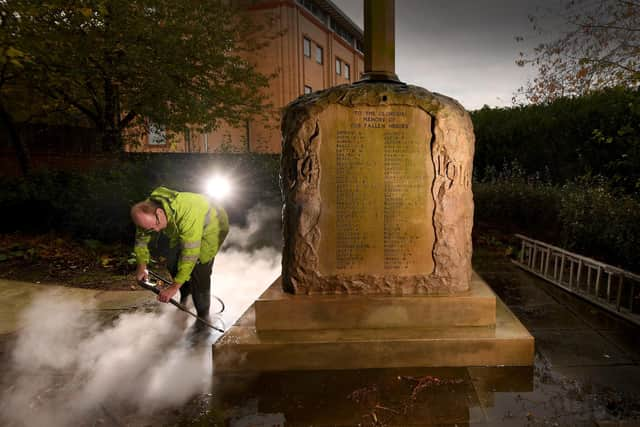
Keith Lumley is a former Chief Supt with South Yorkshire Police, who retrained as a stonemason to care for the memorials of those awarded the VC.
It is “incredible”, he said, to see such a concentration of bravery. No other town has so many.
One man, George Wyatt, was a police constable before the war. But in France, in 1914, he was a fearless hero.
The enemy had set some straw sacks alight, close to farm buildings where his unit was sheltering.
Time and again the L/Cpl braved enemy fire, dodging bullets to extinguish the flames.
Years later, he stepped in to save a woman once more, as a horse bolted.
This instinct to act, to fight rather than freeze, was born into the DNA of these young Yorkshire men, said Mr Lumley.
They were “hard lads”, he said, always have been. Had to have been, in the pits, or in mining towns, in the factories or frozen fields around Doncaster.
“They came from tough communities,” he said. “If they had a situation in front of them, fighting for their lives and communities, they were going to put everything into it.
“It’s that mindset,” he added. “And that toughness, if you like, from that generation and in that area, that makes it so prevalent. It’s incredible that we have that many.”
Mr Lumley, chair of trustees with the Victoria Cross Trust (VCT), works with fellow stonemason Steve Abell to care for the graves and memorials of VC recipients.
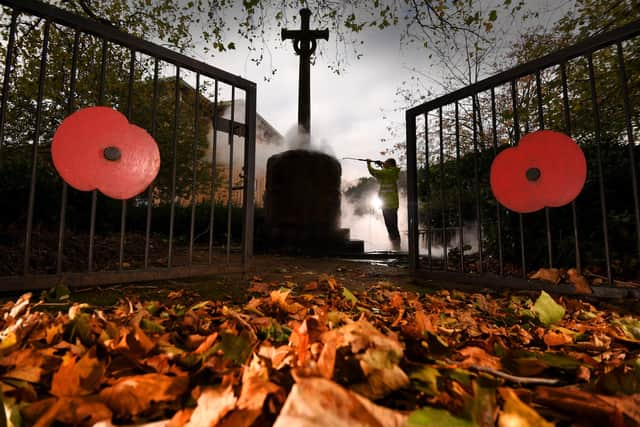
The charity, with a shop to fund its work, has cleaned or repaired 200 graves this year. Cleaning, and steaming the stone, recarving, pointing, re-sitting.
Then visiting schools to share the stories of the men. It was a school pupil, said Mr Lumley, who put their work into the purest words: “We clean the memorials so that when we can see their names, we can remember them.”
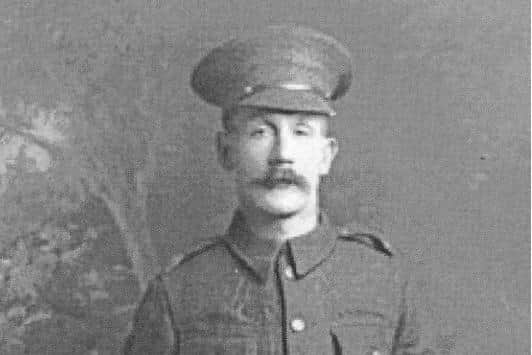
Among the seven was pilot Lt Gilbert Insall who, in 1915, was flying over France when his aircraft was brought into battle with enemy fire.
He forced down the German aircraft, but then had to crash land behind Allied lines as his own engine was damaged.
Through the night he worked on repairs, despite a barrage of artillery shelling, and he was able to return home safely the next morning.
Through the terror of nighttime, behind enemy lines, he had held his daring.
The VC is the absolute highest and most prestigious of medals. The distinction is valour, in the presence of the enemy.
At Arras, in France, in 1917, L/Cpl Thomas Bryan was wounded in the arm. Still he crept alone through the enemy’s trench, to silence a machine-gunner attacking his unit.
He disabled the gun, shooting two of the enemy crew. The rest were to flee, abandoning their post.
Bryan had been a rugby player before he enlisted, and a miner at Whitwood Colliery.
After the war, recovering in hospital, he was to go on to save a three-year-old girl from drowning, resuscitating her. Later, he opened a greengrocer’s.
There are four more. For such a small area, it is a remarkable number. To see such a concentration in one small area is an incredible feat.
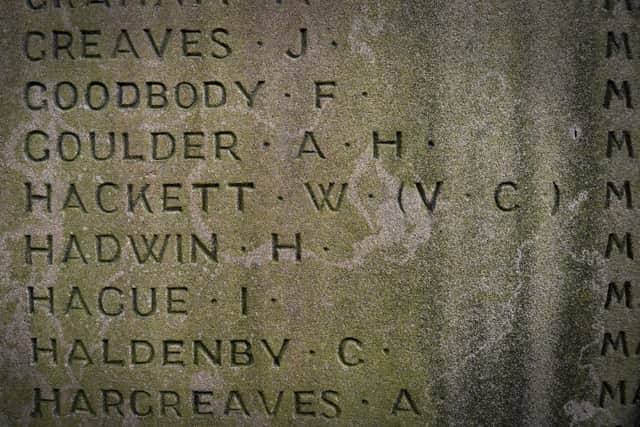
William Hackett, whose name is on the Aldwick war memorial, above, is a name that stands out to Mr Lumley. The sapper was a coal miner before the war, married with two young children. He joined the Royal Engineers as a tunneler.
But when a German mine explosion closed the shaft he was working on, in June 1916, he became trapped - entombed with his fellow soldiers. He dug for 20 hours to help three of them escape. But he absolutely refused to leave the last man standing. They died together in that dark shaft, where they are still buried.
What does it take to stand firm in the face of such bleak terror? To know, by your own hand and sacrifice, the consequences of valour?
To Mr Lumley, it’s the mark of a man. To be brave and to stand strong and firm and to act, always, with the best of intentions.
Sgt Laurence Calvert was a haulage hand at Denaby. His bravery, in the face of the enemy, saw him lead the charge in September, 1918.
With his battalion pinned down and facing heavy losses under fire, he rushed forward alone.
He stormed not one but two machine gun posts, killing both crews and capturing the positions. He saved his battalion.
L/Cpl Thomas Jackson was a locomotive engineer before the war, a carriage cleaner at Mexborough. In September 1918, he volunteered to follow his officer into a canal under intense and devastating fire. Scaling the other side, they captured two machine guns and 12 prisoners. He was killed later that morning as he charged a German trench.
Cpl John Harper was a peat digger before he was killed in action in the Second World War. He had led his section over 300 yards of exposed ground as a hail of mortar shells fell, capturing their position.
There is no permanent memorial to the Doncaster seven, a fact the VCT is trying to change. The charity, run by volunteers, is to host a special commemoration on Tuesday, November 10, opening up this history at the Corn Exchange with artefacts and memorabilia.
Among those to speak, before local history groups, is trust patron and author Rusty Firmin, a former SAS officer who led a team into the Iranian Embassy to rescue hostages.
It is each person’s choice to remember the fallen in the best way they can, said Mr Lumley. But it is a choice afforded to us by the sacrifice they made.
“All of the choices we have now are born out of those sacrifices,” he said. “If we don’t remember them we forget why we have those freedoms now.
“And if we’re not careful we won’t learn from the mistakes of the past. If we don’t remember, it happens again.”
And for Mr Walton, who will turn 101 next month, there is a special reason to remember.
He returned to Holland three times this year, first under a crowdfunding campaign to return to the Dutch city of Arnhem he helped liberate as a Cpl in the Second World War.
He travelled with his neighbours, Tracy and Gary Richardson, returning with the Taxi Charity for Military Veterans for the world’s largest commemorative walk Wandeltocht.
What mattered was that he was able to take a tot of brandy to the graves of his pals. One for him, and another that he poured over the ground before Stanley and Dan Yorke.
“Once you forget the friends that you had, you have nothing,” he added. “We would go on patrol. We’d look around and at each other and think ‘are we coming back together?’.
“We lost a lot of men in our regiment,” he added. “They gave their lives for us so we can be here now.”