
Nick Clegg hits back at critics: 'Don't read my book if you think Mark Zuckerberg should be behind bars'
Nick Clegg will be back in Yorkshire next week as the former Deputy Prime Minister turned senior Facebook executive shares his thoughts on ‘how to save the internet’. Chris Burn speaks to him.
Nick Clegg’s new book vividly describes Mark Zuckerberg gathering his top executives for mixed martial arts training which resulted in the former Deputy Prime Minister being straddled in a ‘domination mount’ by a colleague who ended up taking his job.
But the ex-Yorkshire MP bristles against accusations by some critics that he has pulled his own punches when it comes to his time with the Facebook founder.
While his book How to Save The Internet does not give social media giants like Zuckerberg’s Meta – the giant corporation which owns Facebook, Instagram and WhatsApp – a completely free pass when assessing the problems of the online age, its greater focus is on what Sir Nick terms the growing ‘Balkanisation’ of the internet as more nations follow China and Russia in increasingly controlling what their citizens are allowed to see, say and do on the web.
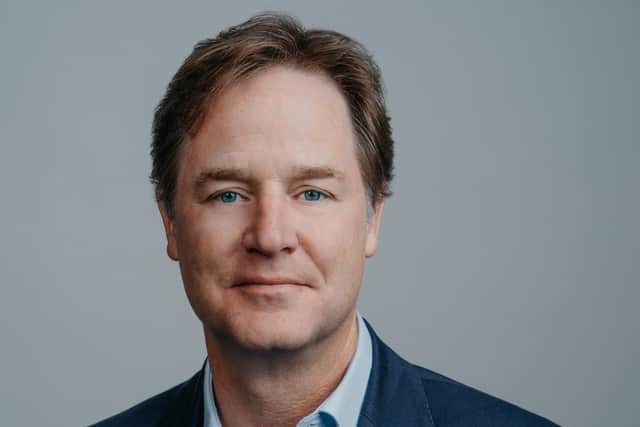

Sir Nick, who will be discussing his book at the Ilkley Literature Festival next Friday, spent seven years at Meta as vice-president and then president for global affairs – playing a central role in suspending Donald Trump’s Facebook and Instagram accounts following the January 6 insurrection in 2021 and departing Meta at the start of this year in advance of the president’s return to the White House.
He was replaced by his deputy and one-time wrestling partner Joel Kaplan, a prominent Republican whose promotion was widely reported as an attempt by Meta to rebuild relations with the returning Trump administration.
There certainly appears to be no ill-feeling from Clegg; one passage reads “it is commonly understood that Mark Zuckerberg is a visionary innovator, but the two things that struck me most about him are his endless curiosity and his indefatigable competitiveness”.
Sir Nick says he has simply given his honest opinion and feels some of the criticism he has received is unfair.
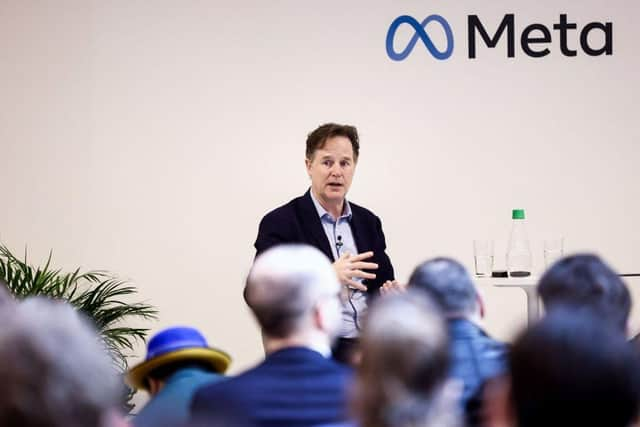
"If what you want to read a book where someone says Silicon Valley is evil, Mark Zuckerberg should be behind bars and social media is the worst technology ever invented, don’t read my book,” he says.
"I’m serious. There are lots of books like that and that’s not the book I was ever going to write because I wouldn’t have worked for the company in the first place if that was my opinion.
"So it is weird. I find it a little bit off reviewers are sort of condemning me for not writing a book I was never going to write. And if I had, they would rightly accuse me of hypocrisy for working for them for seven years and then trashing them.
"I hope any objective reader would see two things; firstly, that I try and be as dispassionate as possible and try to present the research and pick my way through the claims and counter-claims.
"But the main thing is the book about a much bigger issue; the fragmentation and splintering of the internet and what we can do about it. I’m very open about my experiences but this is not a kiss and tell book.”
We are speaking days after the Republican Governor of Utah Spencer Cox described social media as a “cancer” following highly graphic videos of the shooting of political activist Charlie Kirk being instantly spread online to millions.
Sir Nick says he disagrees with the governor’s assertion and believes there are many positives to social media.
"I don’t agree with that characterisation otherwise I wouldn’t have worked for world’s largest social media platform for seven years,” he says.
"There are millions if not billions of people who derive a lot of pleasure and joy and find things that entertain and educate them on social media. There are many businesses in Yorkshire and elsewhere who would only survive because they use social media to advertise. For small businesses and family businesses, social media is an absolute lifeline.”
When pressed about the governor’s central point about the widespread sharing of the moment Kirk was shot on social media platforms, Sir Nick says: "It is extremely difficult to moderate content online when you are talking about billions and billions of messages being circulated online every single day on vast networks.
"Sometimes [showing] violence is important on social media to reveal injustices and expose the brutality of regimes or the suffering of innocent victims or the plight of human rights campaigners. These are engineering systems which have to distinguish between different kinds of violence. The rule at Meta was the company did not allow content which sought to glorify or promote violence.
"It is always very easy to say we don’t like that type of content but you have to put yourself in the shoes of people who have to design the systems which distinguish between one expletive and another. One person’s hate speech is another person’s free expression.
"It is much more tricky than simply saying you can push a button and make everything nice online. The online world, much like the offline world, is not nice and I wouldn’t ever claim it is."
The book reflects on past moral panics that have taken hold when a new technology is introduced – from television to radio and even bicycles.
Sir Nick says while the situation is “more nuanced” when it comes to social media, he does believe much of the criticism of companies like Meta is over-the-top.
“There is a tendency to ascribe to not just social media but technology generally a superhuman power it doesn’t necessarily possess. It took a while for society to work out you need to have speed limits on cars and seatbelts and I think we are going through that process now with social media.
"I hope most people would agree you don't throw the baby out with the bathwater – you don’t reject the technology altogether but you try and amplify the good while minimising the bad. I think we are still in the middle of that process.”
Sir Nick’s bigger area of concern in his book is how to tackle the splintering of the internet as nations increasingly control the flow of online information in their countries.
He proposes a US-led global deal between ‘techno-democracies’ such as the UK, India and the European Union involving the open flow of data, the sharing of AI infrastructure and development standards and cooperation on areas like security and intelligence.
Sir Nick admits such a deal is unlikely under the isolationist Trump administration. "I think in the medium term it is much more likely because I don’t think the current trajectory that the United States is on is going to work for them. When America realises it isn’t going to deliver a knockout blow against China in the race for AI supremacy, regardless of whether there’s a Republican or Democrat in the White House, I think they will relearn the importance of partnership with their democratic allies.”
When it comes to the UK’s own actions following the controversial introduction of the Online Safety Act, Sir Nick says he feels “we’ve got the balance slightly wrong”.
"The police are arresting up to 30 people a day for online speech offences. We are probably being over-censorious for speech that may be awful, ghastly, ugly and offensive but not the kind of speech we should be having the police involved in whilst at the same time not doing enough to be vigilant about the age at which kids use these social media apps.”
As someone with a fairly unique insight into the heart of both government and a social media giant, Sir Nick does not grapple for an answer when asked which holds the greater power.
"Governments do. Social media companies are very influential because so many people use their products. But at the end of the day, Mark Zuckerberg doesn’t tell me how to use WhatsApp or Facebook. I’m using these services because I find them useful. It is an indirect form of influence.
"In government, you have a very direct influence on what taxes people pay, whether we go to war or not, what is in our hIstory curriculum and whether your local hospital is going to have an extra ward built.
"It is a much more hands-on influence on people’s daily lives. I don’t think the slightly lazy journalistic assertion that these big tech companies are much more powerful than government is actually true.”
How to Save The Internet by Nick Clegg is out now. He will appear at Ilkley Literature Festival on October 3.