
Sheffield Hallam: Lib Dems hope to reclaim seat in three-way battle for constituency
The Liberal Democrats are attempting to reclaim the seat once held by their former leader Nick Clegg. Mason Boycott-Owen asses their chances.

In 2010 the Liberal Democrats occupied a pivotal position within British politics under the leadership of Nick Clegg, the then-Sheffield Hallam MP.
After shepherding his MPs into government as coalition partners with almost seven million votes, and becoming deputy prime minister himself, things started to go very wrong for him and his party, and the Lib Dems are yet to recover.
In 2015 the party dropped to less than 2.5 million votes, and lost 49 of its MPs, leaving them with eight, and ushered in the wilderness years for the party.
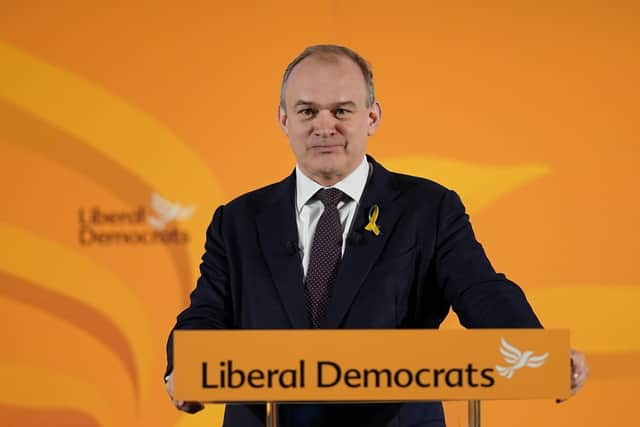

Nick Clegg quit as leader in 2015, but then saw further humiliation when he lost his seat to Labour in the 2017 general election.
Soon after he moved to Facebook as a lobbyist, joining, by an odd quirk of politics, the man he replaced as Sheffield Hallam’s MP, Richard Allan.
Almost a decade and a half since overseeing the Lib Dems’ summit of political achievement, Nick Clegg is now understood to be pouring tens of thousands into the party’s campaign in his old seat, just as his party is expected to win anywhere from 30 to 59 seats, though still shy of the party’s record 62 seats under Paddy Ashdown.
Sadly for Hallam’s former MP, it looks like politics has moved on from the Liberal Democrats in Yorkshire, at least at this general election.
In 2010 the Liberal Democrats’ pivotal position in politics came from their ability to be the third party of Britain, able to take a chunk out of both the Labour and Tory vote.
In Yorkshire, the party picked up Bradford East from Labour, and held both Sheffield Hallam and Leeds North West.
In 2024 the Liberal Democrats exist broadly as a nightmare to haunt the dreams of Tory MPs in previously safe seats in the South.
According to recent MRP superpolls the party is expected to win one seat, at a push, and it is not Sheffield Hallam. Harrogate and Knaresborough, like Sheffield Hallam, is however so affluent that on paper many may mistake it for a rural seat in the South.
This seemingly poses a problem for the so-called “Lib Dem fightback” if it seemingly cannot regain the seats which were the bedrock of its success in the past, but the party is fighting a different battle to previous elections.
The Lib Dems are not fighting Labour at this election. Virtually every seat that it is targeting is Conservative, all of its attack lines are focused on the Tories, every stunt is a visage of orange smashing blue.
Sheffield Hallam is the incredibly rare exception to this, where both candidates are fighting over the some 15,000 Conservative voters in the seat from the last election, with an only 712 majority of breathing room.
“Of course we criticise the Government where they need criticism, and by gum, they've got some criticism heading their way,” says Shaffaq Mohammed, the former-MEP who is the Lib Dems’ candidate in Hallam.
His targeting of Labour in the seat comes down to local issues, with the MP, he says, voting with the Conservatives on sewage.
“Sewage is a huge issue within Sheffield Hallam,” he says, adding that the area’s rivers have had around 300 individual spillages across 15 sites, totalling around 1,500 hours of sewage.
“You’d think the local MP would actually stand up against the Government, but if you look back at the record of Olivia Blake, she and other MPs voted with the Government in terms of downgrading Ofwat’s (the water regulator) powers.”
At the time Labour MPs backed this piece of legislation as it was aimed at being pro-growth, but Mr Mohammed argues that the residents of Sheffield Hallam “have not sent Olivia Blake to Parliament to vote alongside the Conservatives”.
This, alongside being disappointed that Labour did not back a youth mobility programme which would have allowed access for youngsters to live and work in Europe, akin to the pre-Brexit era, was Mr Mohammed’s main criticisms of Labour.
The Liberal Democrats’ worldview seems to have narrowed significantly in the past decade, with this election seeing them, to put it unkindly, as “The Sewage and Dentist Party” following the constant stream of announcements and press releases from the party on these subjects.
This is due, in part, to the ability of Labour to squeeze the Liberal Democrat vote in recent years, most notably following Jeremy Corbyn’s departure from the party’s hierarchy.
Labour have outflanked the Lib Dems on so much to the centre of politics that it has engulfed a lot of its core vote, meaning that it will struggle to campaign on the slogan “we agree with Labour, but vote for us instead”.
This has seen Labour leapfrog the Liberal Democrats from third to first in many seats in the South, and means that its task of winning back its heartlands is even trickier.
“It's a very three way split in this seat,” says Olivia Blake, the incumbent MP and Labour’s candidate for this election.
“The Conservatives got 15,000 votes at the last election, which is quite significant.
“This time I think the choice is much, much clearer for people. The majority of conversations I'm having are about that bigger picture and who they want to be in Number 10.
“There's much more conversation with ex-Tory voters saying that they're going to vote Labour for the first time here, which is really interesting to see.
“Historically, the Lib Dems do very well in the local elections, but I think the main thrust of the general election is really about that big question about who they want to lead the country.”
Whether it is Ed Davey falling off a paddleboard into a river, or Ed Davey going down a waterslide, or Ed Davey cycling down a hill looking like Mr Bean, the Liberal Democrats aren’t interested in the big questions about who they want to lead the country.
Though poll projections suggest the Lib Dems are heading back to the number of seats that they last saw in government, this party is remarkably different to the one which Nick Clegg led to the cabinet table.
Whether it’s a national campaign fought on finely-honed local issues, or a level of frivolity meant as an antidote to the rather dull and depressing hegemony of Labour and the Tories, the Liberal Democrats are fighting an odd election, but one that may reap rewards in the South.
Beyond that, the future is very uncertain for the Liberal Democrats, but, tentatively, despite what happens in Sheffield Hallam, Ed Davey could well have played a blinder for now.