
Sir Keir Starmer 'may use Henry VIII powers' on EU alignment

Sir Keir Starmer’s Government will follow European Union rules without necessarily giving MPs a vote on each piece of red tape under so-called Henry VIII powers which will be unveiled in the King’s Speech.
As part of the Prime Minister’s reset with Brussels, the UK Government will seek to pass a new law which would allow single market rules to be adopted through secondary legislation.
That is likely to mean new rules being rubber stamped by MPs as Parliament can either approve or reject secondary legislation but cannot amend it.
The UK-EU reset legislation enabling the use of the so-called Henry VIII powers is expected to be part of the King’s Speech package set out on May 13 and will be subject to the full parliamentary scrutiny process as usual.
But critics said the plan to allow the use of secondary legislation for dynamic alignment with Brussels – changing the UK’s rules to mirror those set in Brussels to make trade easier – would sideline Westminster.
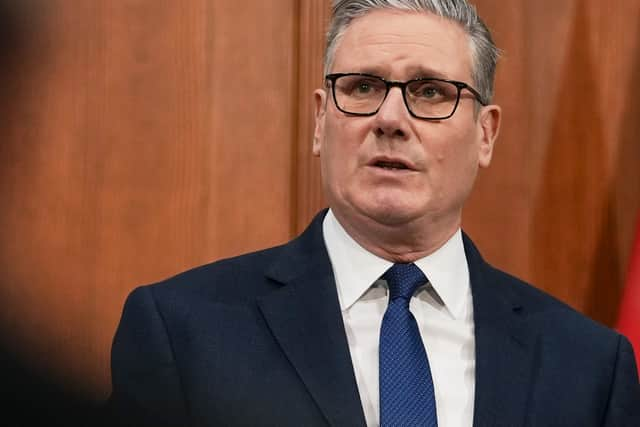

Speaking to BBC Radio 5 Live, the Prime Minister said the changes will only come into force if Parliament passes the legislation, adding that a stronger relationship with Europe is in the “UK’s best interest”.
He said: “We’re in a world where there’s massive conflict, great uncertainty, and I strongly believe that the UK’s best interests are in a stronger, closer relationship with Europe, whether that’s defence and security… energy, inevitably, and also, our economy.”
Sir Keir added that the legislation will make trade easier, reducing “burdens” on businesses and lowering prices.
“A stronger, closer relationship with Europe is in the UK’s best interest, particularly in a world that is as volatile as it is at the moment, and I know that worries a lot of people,” he said.
It comes ahead of the long-awaited SPS (sanitary and phytosanitary) agreement which is slated to come in in 2027.
The Government has claimed that “a food and drink agreement with the EU could add up to £5.1bn to our economy, increase agricultural exports to the EU by 16 per cent and mean lorries will spend less time at the border”.
This will see British farmers aligning with their EU counterparts, including potentially on hygiene rules applying to UK slaughterhouses, meat processors, and dairy producers.
A Government spokesman said: “The Bill will go through Parliament in the normal way.
“Any new treaties or deals with the EU will also face parliamentary scrutiny, and Parliament will have a role in approving new EU laws required under those deals via secondary legislation.
“This will allow us to deliver a food and drink trade deal worth £5.1 billion a year, backing British jobs and slashing costly red tape for our farmers, producers and businesses.”
The Government has repeatedly made clear the UK will not rejoin the single market but Chancellor Rachel Reeves has set out that areas where the UK diverts from the Brussels rules should be the “exception, not the norm”.
The plans under the new “UK-EU reset Bill”, as it has been unofficially called within Whitehall, would give the Government the mechanism to adopt EU rules in areas where it has signed deals with Brussels.
A Whitehall source said: “We are clear Parliament will have a role for new deals and on new EU laws applying under those deals.”
Conservative leader Kemi Badenoch told LBC that this would be “the worst of both worlds”.
“We're not in the EU where we can have a say, but we're still taking the rules and we're not using our sovereignty,” she said.
“As Trade Secretary, what I saw is that the EU wants to compete with the UK.
“It's not going to make rules that are going to make our lives easier. It's going to make rules that make life easier for them.”
However, Health Secretary Wes Streeting said: “The greatest betrayal of Brexit was the lies that were told to people about all the benefits.”