
Yorkshire's latest peer speaks about 'proud roots' in maiden House of Lords speech
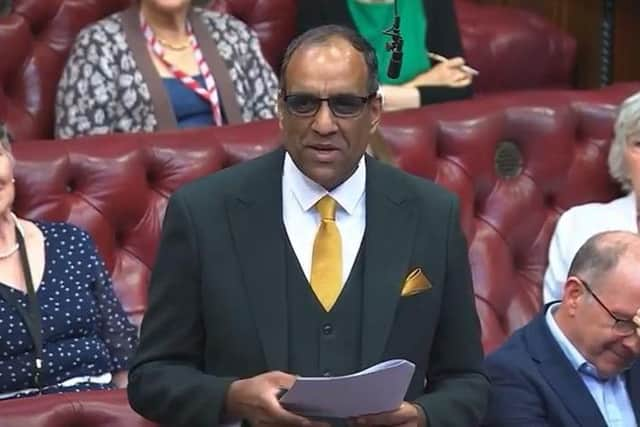
Yorkshire’s latest peer has made his first speech in the House of Lords, talking about his upbringing in the “proud community” in South Yorkshire after his family arrived here from Kashmir and the importance of education.
Shaffaq Mohammed, who is now Baron Mohammed of Tinsley, is the former leader of the LibDems group on Sheffield City Council and is still serving as a councillor for the Ecclesall ward. He stepped down from the leadership after his peerage was announced and has been replaced by Coun Martin Smith.
Lord Mohammed, aged 52, was nominated for a life peerage by Lib Dem leader Ed Davey last December. He also served as a Member of the European Parliament for Yorkshire and Humber from 2019 to 2020.
He spoke during a debate on the Children’s Wellbeing and Schools Bill. It aims to strengthen children’s social care safeguards, offer increased support for care leavers, regulate the use of social worker agencies and enshrine kinship carers – family members or friends who take over the care of children from their parents – in law.

The Bill will also require primary schools to offer free breakfast clubs, limit the use of uniforms branded with school logos, regulate academies and introduce a register of children not in school.
Lord Mohammed said in his maiden speech: “Never could I have imagined, as a child born in Kashmir to parents from a humble farming background, that one day I would stand here amongst you — not as an observer, but as an equal — entrusted with the responsibility to speak up for communities like the one that raised me.
“I arrived in the United Kingdom in 1977 at the age of four with my mother Khadija Bi, settling with my family in Tinsley, Sheffield — a proud community, poor in material wealth but rich in spirit. The contrast could not have been greater – the clear, ice-cold streams of the valleys of Kashmir, to the smoky steel mills of the Lower Don Valley.
“Yet it was here that I learned resilience, solidarity, and the value of opportunity.”
Lord Mohammed said that he had not followed “the traditional path that one might expect from a Member of this House.
“My father, Mohammed Saddique, grew up working small pieces of land with his siblings, they all lived in a simple, fragile home, made of mud, straw, rock and wood.
“Life was harsh: food often consisted of little more than a chapati and a raw onion while they harvested wheat by hand under the searing midday sun was gruelling.
“When the opportunity arose to work in Britain’s steel industry, he grasped it, bringing with him dreams of a better life for the generations to come.
“The steel mills of Sheffield gave my family hope — but the decline in the early 1980s took much of that security away. Like many others, my father lost his job; and like many others, we relied on the state for support.
“I grew up receiving free school meals and free clothing grants from Sheffield City Council, who were led at the time by a very youthful leader. I emphasise youthful because he was known as David Blunkett – I wonder what happened to him, my Lordships?”
Members appreciated the joke about city Labour peer Lord Blunkett.
He continued: “Although I excelled in school, particularly in mathematics, family necessity meant that at the age of 16, I entered the world of work through the Youth Training Scheme, earning £27.50 working a 40-hour week unloading lorries at the Sheffield Co-op Superstore in Hillsborough.
“It was a tough start — but not without its blessings. A supportive manager, Mr Bryan Richardson, gave me Wednesdays off not to watch my beloved Sheffield Wednesday, but actually to attend Loxley College and complete my A-Levels.
“This small act of faith helped me secure a place at the University of Sheffield, where I studied business as a mature student. I was the first in my family to go to university.
“After graduating, I dedicated myself to youth work in Sheffield, supporting young people who, like me, needed a second chance. That passion led to my election to Sheffield City Council in 2004 followed by a spell in the European Parliament, where I championed young people, women’s rights, human rights and international development.
“I see my arrival as a mark of this House’s enduring commitment to represent all walks of life, to recognise the importance of lived experiences alongside legal, academic, and business expertise.”
He continued: “Turning to the important business before us today — the Children’s Wellbeing and Schools Bill — I wish to speak briefly on the issue of home education.
“My Lords, during my time as a youth worker, I worked with “post-16 NEETs” — young people not in education, employment, or training — I often encountered those who had been educated at home, or had suffered disrupted schooling.
“Without structured support and oversight, these young people can easily slip through the net, falling far behind their peers and missing opportunities to enable them to thrive.
“This is why I welcome the Bill’s provisions for local authorities to maintain contact with home-educated children — not as a heavy-handed intrusion, but as a vital safeguard to ensure that no young person is left behind.”
He added: “Supporting our young people is not merely a moral imperative — it is a national investment.
“When we help a young person realise their potential, we strengthen the fabric of our society for generations to come.
“My Lords, I owe everything I have achieved to the resilience of my parents, the kindness of strangers who believed in me, and the opportunities afforded by this great country.
“It is now my privilege to give back — to serve your Lordships’ House with the same spirit of duty and hope that has brought me here.”