
Railway 200: How Leeds and Bradford transformed society with rail and how trams could link them in future
Trains, trams and trolley buses transformed life in Britain, with West Yorkshire being a great example. But as we celebrate Railway 200, what’s their future?
The Railway 200 celebrations are taking place across the country, as Britain marks two centuries of modern rail, which powered the industrial revolution and still provides vital passenger and freight links to this day.
West Yorkshire was central to the industrialisation of Britain in the 19th century, both geographically and as a world centre of the wool and textile trades – and this explosion of industry went hand-in-hand with the development of the region’s railways.
“Leeds was effectively just a large town before the railways,” says trustee of the Leeds Civic Trust, Clifford Stead.
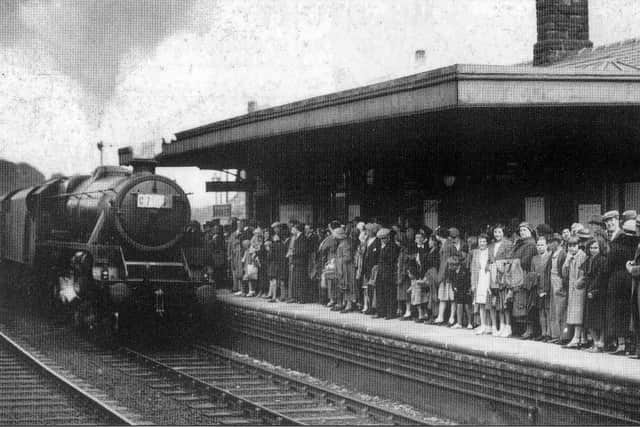

“After the first rail station in the city opened in 1834, it led to Leeds becoming an industrial powerhouse by the middle of the century.”
Bradford-based author and historian David Pendleton adds: “It was the price of goods that brought the railways to Bradford.
“In the 1830s, it was said that it cost about the same to transport wool nine miles from Leeds to Bradford by road as it did to carry the same amount 58 miles by rail from Leeds to Hull.
"So it needed to happen for heavy industry to lower their prices.”
It was this expansion that would drive colossal population booms in Leeds and Bradford during the first half of the 19th century.
Leeds doubled in size over the course of the 1840s, while Bradford was second only to Essen in Germany when it came to the rate of population growth in European cities between 1801 and 1911.
But while rail freight led to the expansion of industry, it also had an impact on the city’s individuals.
David says: “Once the railways came, you had some people from the middle classes who took advantage and moved out to places like Ilkley and the Wharfe Valley. They could get out of the city and live a new life in leafier areas. But for ordinary people who lived in Bradford, there was never any need for them to use the railways, because the trams and trolley buses in the city were so good.”
Horse-drawn trams had been running in both cities since the mid-1800s, but as the 20th century dawned, newly-electrified trams and trolley buses would become instrumental for social change.
“All of the industry in Leeds had been south of the rail station,” says Clifford. “Hunslet, for example, had a population of about 80,000, because people had to live right next to where their jobs were.
“Trams developed very quickly and they were revolutionary in changing this – they led to large suburbs developing as people could get around wider areas more easily.”
But it wasn’t all about work.
Electrified trams and trolley buses were introduced to Bradford in 1911.
This new form of easy travel would almost immediately give rise to one of the region’s most cherished sporting institutions.
“The Bradford Cricket League is probably the most famous local cricket league in the world,” says David. “It started in the same year that the tramways were electrified.
“When I studied this, I noticed every single team in the Bradford Cricket League, bar one, was on a tram route. The league was effectively facilitated by the tramway!”
Trams were decommissioned in Leeds during the 1950s, with Bradford’s trolley buses following in 1972, as the rise of the car and suburban living meant fixed, centralised transport systems were no longer in fashion.
But David, who worked as a signalman for more than three decades, saw a shift during the latter part of the 20th century.
“The commuting you have on the trains now, particularly in and out of Leeds, is unprecedented,” he says. “I remember in the 1980s when I was working in Shipley – commuting by rail was very limited.
“The change has been partly down to the rise of white-collar jobs – there has been a concentration of professional services over the years and that has been a big change.”
So what is next for the future of transport in the region?
As Bradford and Leeds have grown into two of the North’s main economic hubs, meaning greater connectivity is now needed in West Yorkshire.
The West Yorkshire Combined Authority has ambitious plans to link Bradford and Leeds with a tram system as part of the first phase of a region-wide mass transit network over the coming years, with Mayor Tracy Brabin promising spades in the ground by 2028.
Following a consultation on route options, the Combined Authority is working to collate feedback, undertake environmental and land surveys and preparing to consult on a preferred route with the public in 2026. This will form a major part of the new Weaver Network, which will also see a fully-franchised bus network and increased support for walking, wheeling and cycling in the coming years.
“We are in a very strong position in West Yorkshire,” says Clifford. “We have got all these other tram systems that have been running for 20-odd years plus in other places, and you only have to travel on those systems to see where they have got it right and wrong.
“Even if you go abroad and look at how other cities do things, I think that Leeds and West Yorkshire can learn a lesson there.”
David adds: “In the 70s, 80s and 90s, there were lots of areas that were in competition with each other, rather than coming together and thinking ‘is this good for a network?’
“What the Combined Authority is doing marks a real step change – I just hope it keeps moving forward as we move along.”