
Rob Burrow Centre for Motor Neurone Disease: One year of incredible support at Seacroft Hospital
The Rob Burrow Centre for Motor Neurone Disease opened in Leeds a year ago. John Blow finds out what it means to patients, families and doctors.

For Amna Chaudhry, the Rob Burrow Centre for Motor Neurone Disease feels like a “home from home”.
That might sound odd, considering it has the name of such a dreaded illness in its title. However, for the families who use it, the centre is a far cry from the clinical settings to which these people – now commonly referred to as MND community – were accustomed.
Amna’s mother Tahira Chaudhry is a patient under the care of Dr Agam Jung, a Consultant Neurologist at Leeds Teaching Hospitals, who along with late Leeds Rhinos star Burrow, worked to create a place that was intentionally more patient-focused.
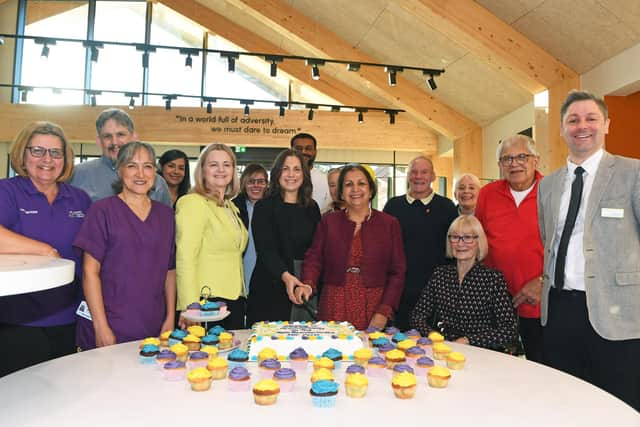

And it was one year last week since Prince William officially opened the centre at Seacroft Hospital following a £6.8 million fundraising campaign led by Leeds Hospitals Charity.
MND patients, their families and supporters, including Burrow’s widow Lindsey, joined staff at an event to recognise the achievements of the centre so far and look ahead to future plans to enhance care, support, research and education.
While there are many more basic, practical improvements for patients, such as larger doorways and spacious toilets, the holistic approach for the wider family is important too.
At the former site, people at various stages of the disease had to sit together, remembers Amna, who is a GP herself.
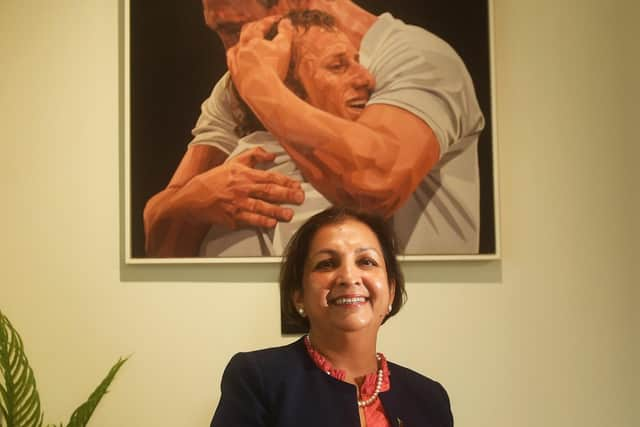
"That was a bit shocking for mum, sometimes, to see patients who were further ahead of the journey to her, and it was difficult for me as well because I was thinking, gosh, is this what mum's going to end up like? It was quite challenging. Here, you've got spaces, you've got light, you've got quiet areas, you've got places for the kids. I have two young girls who come here and we do memory box making, we do activities. We've got a space here that they can come and remember mum and talk about her, where it's not something that's felt out of the ordinary, it's normal for them, and that's why I try and bring them here as much as I can and see the support workers.
"Mum has been here as well a few times, and she loves it. It's like a home from home because you see it and you just get used to it and you think it's really nice.”
In 2018, Tahira, a former teacher who is now in her late 70s, started struggling to swallow, a sign of the bulbar palsy type of MND with which she was later diagnosed.
“Within a year she lost her voice and we didn't get a chance to do any voice banking because it was COVID. That was a big regret of ours,” says Amna. “Anyway, she deteriorated over a year very rapidly. She lost her voice. She was struggling to swallow. And then Dr Jung was the main person who helped us to almost start a whole new life with this diagnosis. She basically made mum get her PEG” – a percutaneous endoscopic gastrostomy feeding tube – “which was in 2020, and from there we felt settled that mum would be able to have some nutrition once the time comes that she can't swallow. We were given a prognosis of about three years. But actually, she's now here still in 2026, from 2019, and she's still not fully using the PEG. So having that expertise to know what to do and when to do it, and having that trust in her (Dr Jung) to actually get that done was what got mum to this stage, really.”
Tahira is now part of the MND Association’s Life Stripped Away campaign, which highlights the things that the disease takes from those diagnosed. For grandmother Tahira, who was previously very active, it was her love of gardening, so the Association organised a photoshoot with the family outside.
MND is a life-shortening neurological condition affecting the nerves that control movement. It causes progressive muscle weakness, which can affect how patients walk, talk, eat, drink and breath. Life expectancy is two to three years after the diagnosis, says Dr Jung. There is currently no cure.
The general public are now better educated about MND thanks to the efforts of people like Burrow, his family and friends such as fellow former Rhinos player Sir Kevin Sinfield, who was a major contributor, through well-publicised extreme physical challenges, to funds which enabled the centre to open.
That bigger profile is translating into better diagnosis times, suggests Dr Jung.
When she started working in MND more than a decade ago, patients, their families and friends would not know about the disease.
Dr Jung says: “But now, and this is thanks to Rob Burrow and his immense courage in going public, patients say, ‘I’ve got Rob Burrow’s disease’. People are recognising symptoms earlier. They are presenting to the GP earlier. GPs are recognising, and other healthcare professionals are considering motor neurone disease as a potential diagnosis earlier. And I think the trajectory, the future of MND, has been changed forever for the better.”
The mission is now for the centre and its practitioners to become recognised as leaders in MND research and education.
Since it opened, a large multi-disciplinary team has been able to work together to support patients each week. A number of new staff have joined, including an MND service care coordinator and two family support workers, funded by the MND Association. Patients have access to additional services such as voice banking and physiotherapy, all under one roof.
Meanwhile, Dr Amr Tageldin is an MND research fellow based at the site, actively pursuing the latest advances.
Therapy sessions are offered to patients and a number of children have received support through the new Family Room. Bereavement group sessions have moved into the centre and there are monthly visits from Frankie the therapy dog.
Two early diagnosis research projects have started and a new research nurse has been funded by the MND Association, with more than 150 patients contacted to take part in research studies. The centre has also been able to provide MND education to undergraduates, postgraduates, allied health workers, social care and care agencies.
Dr Jung says: “Once I started leading the service, it was very obvious to me that this is what true medicine is about. It’s a complex diagnosis to make. You have to rule out many conditions before you make that diagnosis. It is a difficult diagnosis to give to patients because there is no cure and it is devastating. Life expectancy is two to three years after the diagnosis. And I think because the patients also develop other problems such as breathing issues and feeding issues, I think you start looking at a patient beyond just the disease, and I think that is true doctoring for me.”
It is difficult to meet and form relationships with patients, and then see them die. But she built the service using the concept of “living in the now,” she says.
“I see it as a privilege and an honour because these are people who are at their most vulnerable, and for them to place that trust in you, that you will guide them, that is huge. These are people who I've never met before and then they're in my life, and then they trust me to do right for them. That is a privilege and that is a responsibility which we must we must deliver on. So yes, it is emotional. I think being witness to their lives has changed me as a person as well. While I always had the concept of living in the now, I think they've embodied it even more.
"When I think of Rob Burrow, in the initial years I always used to talk about his courage,” she says. “He plays rugby. That is a hard game and that means a lot of courage. Going out into the public, exposing yourself at your most vulnerable, that is huge courage. But I think beyond courage, now when I look back at it, I think it is his determination that inspires me. The determination to keep going. MND did not stop him and I see that with my patients all the time. Making the most of what is there. So while it is emotional, it is hugely inspiring. We learn from our patients.”
Lindsey Burrow was among those celebrating the one-year milestone at the centre last Friday.
“Every time I walk in here, I have a big smile on my face,” she says. “To see the difference that it's making to so many families, that was Rob's vision. Rob wanted a centre that recognised people as individuals, not defined by their illness or their diagnosis. So to have this centre here in Rob's name, as a family we're incredibly proud.”