
Royal Yorkshire Regiment celebrates 20 years with Freedom Marches as it shares anniversary with D-Day
It is 20 years today, coinciding with the anniversary of D-Day, that the Royal Yorkshire Regiment was formed. Colonel Nigel Rhodes reflects on the last two decades. John Blow reports.

For a young Colonel Nigel Rhodes, it was farming or the Army. You’ll notice from his title which of those he chose. Now that he has come full circle and works on his family’s farm near Wakefield - having spent time on one in High Eldwick, Bradford, while growing up after he was born in Scarborough - he can look back at more than 30 years of service with pride.
He remains involved in forces life, as he became Regimental Secretary of the Royal Yorkshire Regiment after retiring from active duty in 2024, decades on from joining its antecedent Duke of Wellington’s Regiment (West Riding) in 1991 after school.
As for many young men at the time, who grew up around Second World War veterans, an intrepid life in the forces was quite the draw.

“It was very much the comic book era, you know, (such as) Battle, Warlord,” says Col Rhodes.
“If I wasn’t going to go farming, I wanted some adventure in my life and the Army gave me that.”
The idea of service also appealed to him and that’s something he continues to this day, most recently helping to organise a series of freedom marches which are taking place around Yorkshire now.
On Saturday, it will be 20 years since a restructure meant the formation of the Royal Yorkshire Regiment - amalgamated from the three remaining Yorkshire Infantry Regiments - The Prince of Wales’s Own Regiment of Yorkshire; The Green Howards (Alexandra, Princess of Wales’s Own Yorkshire Regiment) and The Duke of Wellington’s Regiment (West Riding), as each became one of the new unit’s three regular battalions.
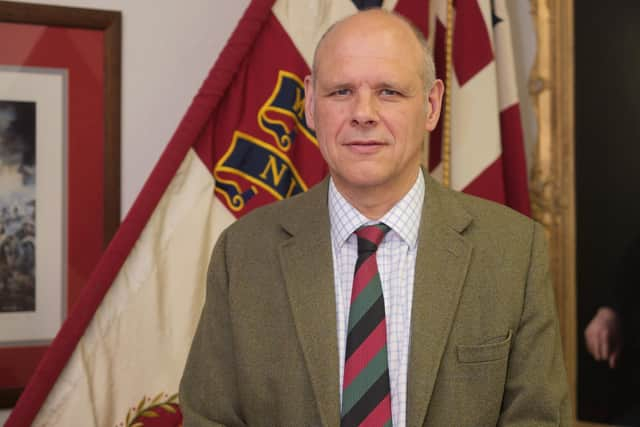
Now, the regiment comprised of the 1 RYorks light mechanised infantry, 2R Yorks next generation combat team and 4 RYorks reserve infantry.
The amalgamation in 2006 was a difficult but also a proud time, says Col Rhodes.
He says: “It was the end of three very proud Yorkshire regiments and I think a lot of people who were members of those regiments were rightly upset about that. But also (it was) the formation and the forging of a new regiment that’s taken that heritage on, if you like, of those antecedents. So yeah, mixed emotions there. For people like myself, who’d done probably half my career then in the Duke of Wellington’s, it was very sad. But the other half of my career has been with the Royal Yorkshire Regiment, and we’ve forged a reputation - our own reputation - from those antecedents, and their heritage is actually what motivates us and inspires and drives us on to make sure that we don’t disappoint our forebears and what amazing things that they achieved. But of course, I suppose we’re making our own history now.”
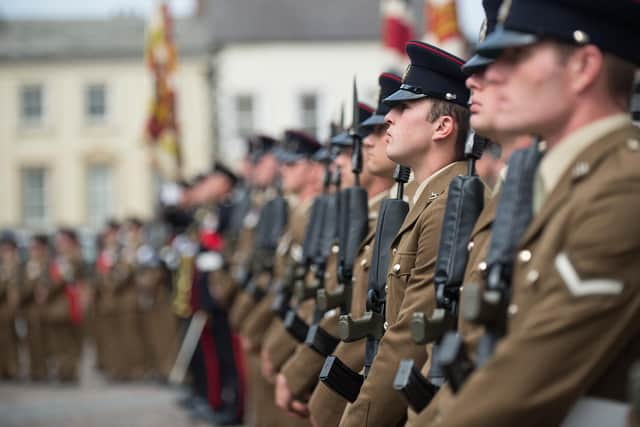
Personnel will take to the streets to mark the milestone, which purposely shares an anniversary with D-Day, the cataclysmic turning point of the Second World War, at which all three former regiments served.
The Freedom Marches started yesterday and go on until Tuesday, parading through the communities that have supported the soldiers and their predecessors for two decades.
It is described as a rare chance to see the Regiment in full ceremonial dress, with military bands, cadets, and veterans all taking part.
“It’s there to thank the county and the communities who we rely on for their support,” says Col Rhodes.
“We are the last county regiment in the British Army and as such we’re very proud of our links to Yorkshire,” he says.
“We’re also very much a family regiment. We all hail, in the main, from Yorkshire,” he says, meaning they have close ties to its communities.
The first march took place yesterday in Keighley. The rest will happen at: Halifax (including a service at Halifax Minster) between 10.45am to 2pm on Saturday; Beverley (including a service at Beverley Minster) between 10.30am to 12.30pm and Bridlington between 2.30pm and 4pm on Sunday; York (including a service at York Minster) between 10.30am and 1pm on Monday; and in Richmond between 9.45am and 10.45am on Tuesday.
Col Rhodes joined up in 1991, serving as the Operations Officer, Adjutant and Corunna Company Commander. Following a stint as the Training Major of the East and West Riding Regiment and then Staff College, he returned to the 3rd Battalion of the Yorkshire Regiment (Duke of Wellington’s) as Alma Company Commander and then Battalion Second in Command. He has deployed on all the major operations during the last three decades and his final appointment before retirement was Commander British Forces in Iraq.
As Commander Army North East and Yorkshire between 2019 and 2022, he was responsible for the provision of training, infrastructure, services and welfare support to 15,500 soldiers and 5,500 cadets at Catterick Garrison, North Yorkshire.
He was Brigade Commander of 4 Infantry Brigade in 2021, taking them on a deployment to Kenya.
“Towards the latter end (of my career), I was Chief (Head) Plans in the NATO headquarters in Afghanistan, which was fascinating,” he says. “It was the time Trump sacked General Nicholson, who was my boss, so that was quite interesting at the time.”
Back home, he has been among those who helped the emergency services deal during Doncaster floods and the COVID pandemic.
“You feel for people, don’t you, who have you know that level of destruction on their houses and their homes, and because of all those personal things that are very dear to them. It is heart-rending but the emergency services are fantastic at dealing with all that sort of stuff, but we just added a little bit of muscle, if you like, to assist.”
Naturally, he is proud of the Regiment’s shared anniversary with D-Day.
The Normandy landings, codenamed Operation Overlord, on June 6,1944 was the largest amphibious invasion in the history of warfare.
Allies sent more than 5,000 ships and landing craft to place over 150,000 troops on five beaches in Normandy, the start of a long campaign in north-west Europe, which ultimately convinced the German high command that defeat was inevitable.
Col Rhodes says: “All three antecedent regiments were there, and actually, even though we go back to 1685, it’s quite difficult finding a battle and operation that all three battalions were at together, so actually that’s why we chose the sixth of June, D-Day, as our formation date.”
Since 1685, the regiment has been involved in conflicts such as the Duke of Marlborough’s campaigns, Waterloo, Crimea, South Africa, Afghanistan, both World Wars, Korea and Northern Ireland. As the amalgamated regiment was forming in 2006, there were soldiers deployed on operations in Bosnia.
On April 5, 2023, the regiment was granted Royal status, now used as its prefix, by King Charles III.
All of that will be in mind during the marches over the coming days.
Col Rhodes, who has three grown up children with wife Liz, says: “It is special when you come home and march through your towns and cities. It is a special moment. It makes the soldiers who are doing it very proud. And I’d like to think that it makes those towns and cities, and Yorkshire as a whole, feel proud.
“There’s only one county in the UK that can say it has its own regiment, and I think that’s very special, and long may it continue.”