
Sam & Ade Go Birding series two: Puffins on Bempton Cliffs and adventures in the Yorkshire Dales with All Creatures Great and Small star Samuel West and comedy legend Adrian Edmondson

Actors and friends Samuel West and Ade Edmondson return to explore the beauty of birding in Yorkshire and beyond for the second outing of their TV series.
The way people talk about gannets is “so undeserved,” says Adrian Edmondson, as a trip to Bempton Cliffs on the Yorkshire Coast revealed. “We all think of a gannet as a big fat greedy slob, but it’s the most beautifully coloured bird.
“The gannet is mostly white with a yellowish-alabaster crown to its head, and they have a great way of diving into the sea, where they tuck up their wings like a jet fighter and launch into the water like an arrow. Phenomenal.”
Spoken like a true convert, and understandably so.
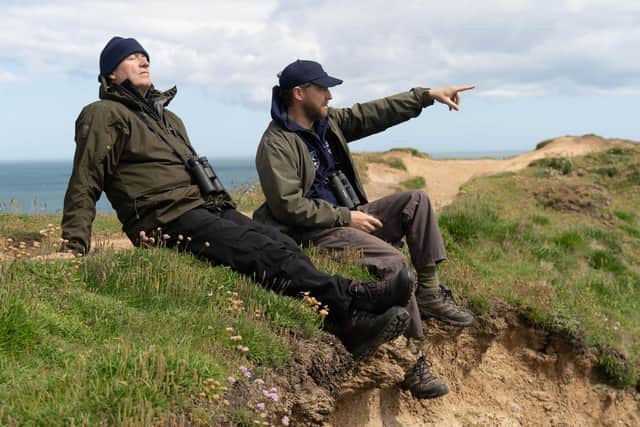

Following the success of the first series, Sam & Ade Go Birding returns to 5 for another three-part series this autumn, it has been announced.
All Creatures Great and Small star Samuel West and Bradford-born comedy legend Edmondson explore Britain’s birdlife and landscapes with gentle humour, reflection and friendship.
Edmonson wanted West to show him more bird life, so, across the series and through the seasons, they travel from the rolling hills and towering sea cliffs of Yorkshire and the wilds of West Wales in search of beauty in flight.
Their reward? Swifts, swallows, curlews, red kites, ospreys, woodland songbirds, puffins, guillemots and gannets.
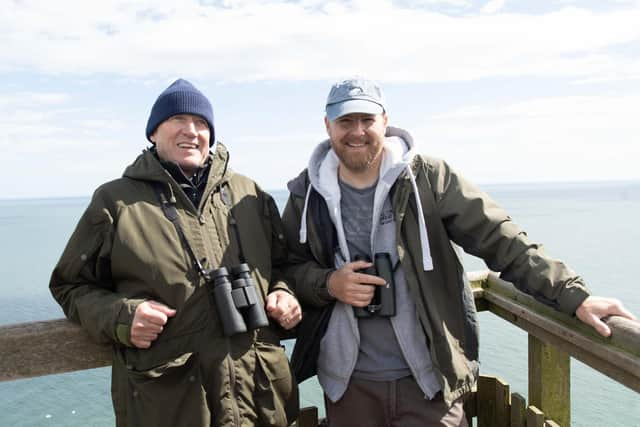
The duo share candid, funny and moving stories of ageing, family, mortality and the rhythms of life during the show, which is a celebration of the countryside too.
West said: “My dastardly plan to get Adrian Edmondson addicted to birding seems to be paying off. Ade said he wanted to see more birds, so I thought we should go and find some. I’m not particularly fond of him, but the birds are lovely.”
In episode one, viewers are taken to the Yorkshire Dales. Close to where he was raised, Ade picks up West from the set of All Creatures… and their adventure begins as it should: with an after-work pint by the river, watching swallows, swifts and house martins swoop and wheel overhead in a dazzling aerial display.
The pair head to West Wales at the height of the breeding season in episode two, when, in Sam’s words, birds everywhere are “bringing up baby”.
Their journey begins at a red kite feeding centre, where the pair are dazzled by huge numbers of these striking birds of prey wheeling overhead.
For the third and final episode, they travel to the Yorkshire Coast and the towering chalk cliffs of Bempton, where around half a million seabirds gather each year to breed.
It is England’s largest seabird colony: a spectacular, noisy world of razorbills, gannets, kittiwakes and puffins – which Edmondson was desperate to see – all crammed on to narrow cliff ledges above the North Sea.
“We went to some really lovely places,” says West, who is an RSPB Ambassador. “The Yorkshire Dales, for instance, are beautiful wherever you go – and I wanted to keep that trip local. We went to Grass Wood, just outside Grassington (our Darrowby in All Creatures), and then we headed up Nidderdale and saw curlews.
These locations are our All Creatures Great and Small bread and butter. I wanted Adrian to see where I spend my time; it’s an area he also knows well from childhood.”
Although it is in Wales where they visit the kites, he says: “I also have an All Creatures Great and Small red kite story. In series three there’s a scene – which wasn’t in the script or I would have flagged it – where James goes walking in the Dales and hears a bird. I was watching the episode at a screening. I heard the call and apparently said, ‘Oh no.’
There was a shot of a red kite flying overhead, and the producer turned to me and said, ‘What’s the problem? Isn’t it beautiful?’. ‘Yes, it’s gorgeous,’ I said. ‘It’s just the red kite was extinct in Yorkshire in 1938. We’ll get letters. It’s not too late to turn the kite into a buzzard.’
“She said it was too late and she’d deal with the letters.”
Bempton, he says, is “a real seabird city. We saw puffins, razorbills, guillemots, and lots and lots of gannets. Then we went out on a boat from Bridlington; we were there the day after David Hockney died, who used to live in Brid.
“Adrian gave me a drawing of a dunnock he’d drawn for my 60th birthday. It’s a reference to my mum: the dunnock’s Latin name is Prunella modularis (‘small brown singer’) and at the time I was planning her memorial.”
The pair were excited to make the new series. As Edmondson says: “We were almost angling for another series as soon as we were making the first. We thought three was a very puny number of episodes to make – we’d make the show all the time if we could.”
After the first series, he joined his local birding group. He says: “I feel it’s much easier to identify birds if you’re standing next to someone who knows what one is. If you’re out on your own – and I’ve tried going out into the woods with a pair of binoculars – you see things rustle about, but you can’t find them.
“You need experts nearby pointing at them, telling you what they are and explaining their behaviour. Everyone who is in a group like that is very keen to share their knowledge.”
His foray into this new hobby has changed his outlook.
“You look at the world very differently and much more patiently. I’ll sit in my garden with the binoculars and be happy to see what comes by. Birding gives you a reason to be looking; otherwise, what are you doing?
Sam & Ade Go Birding series 2 starts on 5 on Thursday, October 1, 7pm.