
Sir Alan Ayckbourn: Scarborough playwright on 91st play Earth Angel and the time Andrew Lloyd Webber gave him a Burmese cat
Sir Alan Ayckbourn tonight reveals his 91st play, Earth Angel, and will appear at the inaugural Whitby Literature Festival in November. He talks to John Blow at his home in Scarborough.

Sir Alan Ayckbourn offers a playful helping of irony: “‘Sound radio? Be death of theatre’. ‘Have you seen this television? Death of theatre.’ ‘All this video, all these movies, virtual reality...’”
The playwright’s trade has been “dying”, he says sarcastically, since he was a youngster. Of course, the man who has written more plays than his own 86 years knows that is not true.
"Theatre plods on,” he says cheerfully. “All you have to do as a practitioner of theatre is to pull back to the basics. I was brought up theatrically by the most brilliant teacher I met. I was fortunate enough to meet Stephen Joseph, who said, essentially, theatre is those two elements, the actor and the audience, and that is what theatre is about. And the rest of you guys, you designers and you writers and you directors - a growing number of practitioners now, the lighting designer and the soundscape designer and God knows what, the intimacy coach and all that business - you're all redundant. The audience don't give a stuff about you. They are only interested in what they see on stage.”
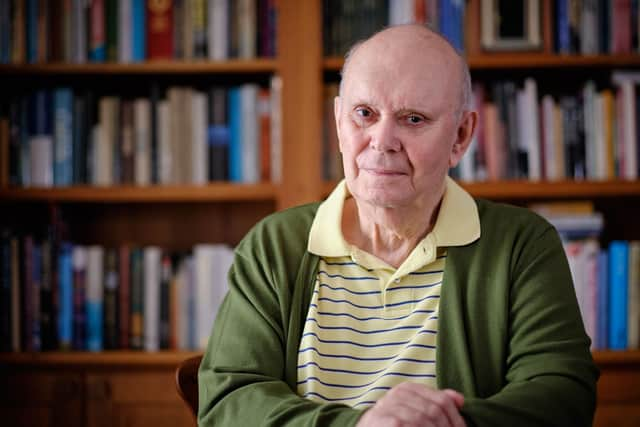

And so – ‘redundant’ though he might claim to be as writer and director – the latest Ayckbourn work, play 91, is ready for its premiere tonight at Scarborough's Stephen Joseph Theatre (SJT), the venue, named after his mentor, which Sir Alan ran from 1972 until 2009.
The YP speaks to Sir Alan at his home in the North Yorkshire coastal town’s South Bay and, true to his prolific output, it's not long before he's relaying the synopsis of his 92nd play, a work of science fiction set in the future currently titled Oscar Romeo (written, accepted and due out next year).
But let’s stick with the 91st for now. Earth Angel is about Gerald, who recently lost his wife of many years, Amy. A mysterious stranger turns up at her wake and seems nice, offering help to Gerald, but questions begin to mount about this person’s intentions.
Usually, says Sir Alan, he likes to look back at the past or towards the future in his work, “but this play is different in that it just looks at today, and in particular the obsession we have with social media and the lack of true, factual information that any of us actually has. Nobody believes anybody.”
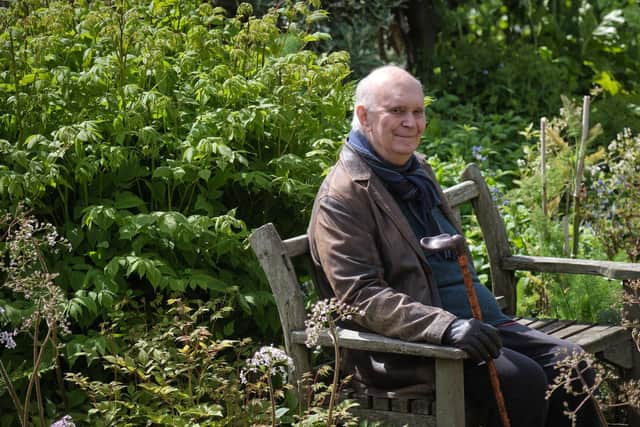
It is a work which poses the question of what makes a good person. Sir Alan says: “I don't think we'd actually recognise it, really. There's been good people during my lifetime, who we were told were good, from Winston Churchill to Mother Teresa, and both of them got severely rubbished by rumour. ‘Well, you know, you might have thought he won the war, but he was actually a complete drunk and a con man, wasn't he?’
“I think it all broke down in the 60s, really, when we had a prime minister, Mr Macmillan, and he said: ‘You've never had it so good’. And we said: ‘Oh yeah, we believe you, Uncle Mac.’ And in came a group of satirists who just took the **** out of him mercilessly. So the whole house of cards (fell down).”
It was during Mr Macmillan’s tenure that Sir Alan, who was born in Hampstead in April 1939 and emerged as one of his generation’s foremost playwrights after he was tempted to Yorkshire as a teenager in 1957, initially to work alongside Stephen Joseph, who pioneered this country’s use of theatre-in-the-round – where the audience surrounds the cast – on the first floor of Scarborough’s public library (the SJT’s precursor) two years earlier.
Sir Alan’s ambition was to become an actor but at Joseph’s behest began writing his own plays, starting with The Square Cat in 1959.
It was a calling which has earned him Olivier and Tony Awards, with works dazzling London's West End and New York’s Broadway, for a start. His first big hit, Relatively Speaking, from 1965, was followed by the likes of Absurd Person Singular in 1972 and the Norman Conquests trilogy from 1973.
Queen Elizabeth II knighted him in 1997 and Sir Alan is now at that point in his long career where milestones come regularly: this year, for example, marks the 70th anniversary of the opening of The Library Theatre, the 60th of Relatively Speaking and 50th of Bedroom Farce.
Remarkably, following a stroke in 2006, he is still creating a play a year – in years gone by it was sometimes two or three.
“Earth Angel is uppermost in my mind at the moment but I'm really looking forward to moving on. I'm not counting my chickens at 86 years old, I'm pushing it a bit,” says Sir Alan.
And unless he wants to repeat previous works, that means trying something new.
“It doesn't get any easier,” he says. “I don't want to discourage new writers – the fact that you’ve written one play is great – but you've got to start again. Unless you want to write the same play again.”
He does believe that some of his plays have “bent the boundaries of live theatre, whether they be physically in terms of space and time, or character-wise,” though acknowledges that running the SJT meant he never had to submit a play. Unencumbered by oversight, though, he had to challenge himself.
He says: “I tended to write, quite often, to frighten myself. I thought: direct this, you b******!”
Such is the cost of dedicating a life to art, but as late actor Sir Michael Gambon used to say to him when things became fraught: “Come on, it’s better than working.”
Indeed, when you are in the rehearsal room all week, plenty of serious moments can go unnoticed.
“I’ve missed world events rehearsing plays. I was in Stoke-on-Trent years ago, rehearsing a farce, which was a ridiculous play, and when I got up in the morning, I walked with my head down to work and I stayed in the theatre until after the show at night, and then I came back home, I came straight to bed, and I didn't see the world - I didn't hear a news flash or anything – and one morning I'm walking along past a brick wall and it said: ‘Hands off Cuba!’”
Oblivious to the Cuban Missile Crisis of 1962, Sir Alan and his colleagues were busy, he recalls, “trying to think about how to throw a custard pie or something”.
Sir Alan will be appearing at the Actors, Audience and Ayckbourn weekend at the SJT from September 26 to 28 – fundraising for its efforts to put on new work on and nurture fresh talent – which among other events will include a rehearsed reading of Relatively Speaking, a four-person play in which a boyfriend secretly travels for the first time to meet a couple he thinks are his girlfriend's parents, not knowing that they are actually her older lover and his wife.
How does Sir Alan appraise that play now? He shrugs a little. When asked by Joseph to write a “good, well made play” – and not one of his experimental works – Sir Alan had started a job as a BBC producer and didn’t really fancy it. “I only wrote it because Stephen wanted it done!”
His mentor had told him: “Until you know the rules and you've been proven to know them by demonstrating them in your writing, you can't start to break them.”
Sir Alan adds: “With respect, I'm very grateful for the play, because it’s still being done. And every time we think the last person on earth must have seen it, somebody says: ‘Well, there's an amateur society in Godalming who wants to do two nights of it!”
His memory of writing it with an unexpected companion is very wholesome indeed: sat by the open French windows, in came a big ginger cat with the name Pamela on her collar.
“She came and sat on my lap, so I wrote using Pamela as a resting board, and Pamela and I wrote Relatively Speaking.”
It was not the last time a feline friend would accompany his writing.
Today, there is a canvas right above Sir Alan’s living room chair displaying a picture of their current cat, 13-year-old Scampston (yes, after the village), their third Burmese after his predecessor Charlie (Brown) and their first, which they got from Andrew Lloyd Webber.
“I got associated with that ill-fated musical, (By) Jeeves. I worked with Andrew Lloyd Webber at his house in Berkshire. It was full of Burmese cats and one of them took a particular fancy to me and he sat on my shoulders while I wrote lyrics to his music. We’d got quite an affinity, me and this cat. And Andrew phoned me after the dust had died on his disastrous opening. He said: ‘Are you still interested in Burmese cats?’ I said, yes, sure, Andrew. And he said: ‘Well, we’ve got one and it’s an absolute bloody menace, it's been killing the rabbits and because we live right on the edge of Watership Down, it's not doing my reputation any good’.
"So we drove down and this cat was lying under the radiator, stretched out and full of rabbit, so we just took him with us. He was our first cat. We took him and his name: Andrew called him Bollinger.”
Despite his accomplishments, Sir Alan says he is “flattered” to be invited to Whitby Literature Festival, where he will be in conversation with former BBC Radio 4 producer Kate Fenton.
Asked if there is any particular message he wants to give, he implores people to “support live theatre”.
The endless challenge of keeping these venues running is summed up well by Sir Alan recalling the exasperation of his late colleague, the SJT’s former executive director Stephen Wood. "‘Oh, wouldn't it be wonderful one week just to talk about the art and not the bloody lavatories...’”
Earth Angel is at the SJT until October 11 (sjt.uk.com) and Whitby Literature Festival is November 6 to 9, with Sir Alan Ayckbourn appearing at Eighteen91 on the final day (whitbylitfest.org.uk).