
Succession writer Lucy Prebble on return to University of Sheffield, HBO hits and future of I Hate Suzie with Billie Piper
Lucy Prebble has become a leading playwright since first sharing her work in Sheffield. After returning to the city for a ‘full circle’ moment, she spoke to John Blow.

At the start, it was not the most glorious return to Yorkshire for celebrated dramatist Lucy Prebble – getting lashed by “Biblical rain” as she walked out of the railway station, scaling the Steel City’s hills with her mother, Susan, in search of their hotel.
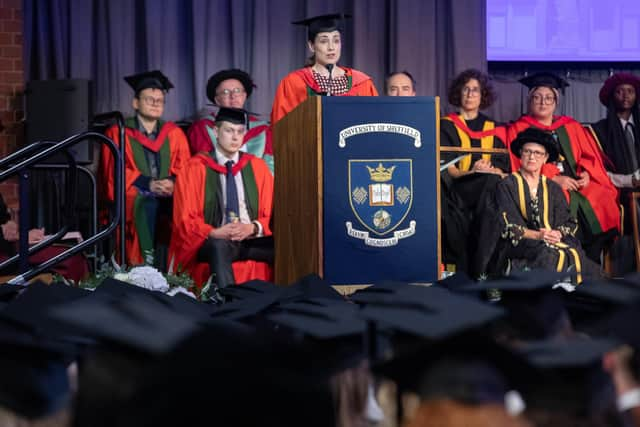
A little while later she was safely in the Octagon Centre performance space, standing proudly in a gown and mortarboard, listening (though with detectable discomfort) to high praise as she became an honorary Doctor of Letters at the University of Sheffield.
“I just got overwhelmed with this feeling of being so moved,” she says. “It was very sudden, that feeling of: oh my gosh, I can’t believe the full circle-ness of this. If I could go back and tell myself when I was graduating that I would be on the stage again doing a speech... it just felt very beautiful and moving.” There was a sense of “nearly crying,” she says, “and I wasn’t expecting that”.
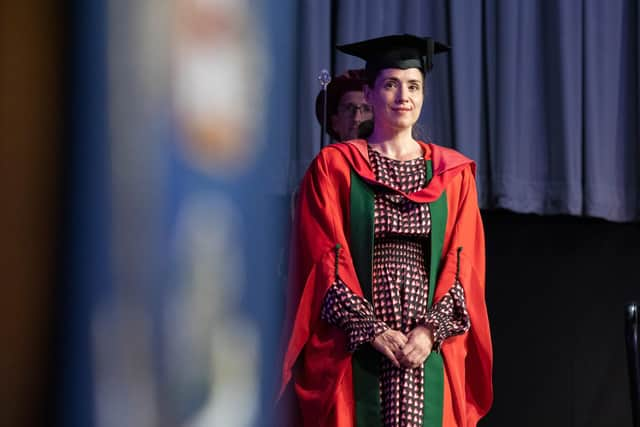

Prebble joined more than 5,000 students across the university celebrating their graduations last month, at the institution where she herself had graduated with a BA in English literature in 2002 (and goin g on to receive a Distinguished Alumni Award in 2014).
Since then, she has emerged as a major force in theatre and television - a multi-award-winning playwright who went on to be a significant part of the team behind HBO’s Succession, one of the most acclaimed TV shows of all time.
And that talent was forged in Sheffield. It is where she met like-minded souls who, for the first time, encouraged her to share her work.
Prebble, 44, grew up in Surrey but once she moved to South Yorkshire, living in Broomhill and later Crookes, was an “indie kid” who could be found trudging around the sticky floors of the Leadmill. She and her friends also used to hang out in the West End pub on Glossop Road, “where we’d meet up and chat about life and art and everything student-y”.
She had written before university but it was limited to “keeping a private diary, maybe occasionally writing bad poetry when feelings got too much” and what would now be called fan fiction - her own versions of TV shows she liked.
“It wasn't until I was at Sheffield where I really found my people,” she says. “People find a gang at any stage in life but it was when I got to Sheffield University that I was like: Oh, thank God. There's people who are a bit like me. They watch the same comedy. They're politically similar to me. But also very different, from very different backgrounds. All different kinds of people but who were curious and passionate about the same sorts of things. I'd never had that before. I'd never really understood that you could have that and that was what changed everything for me, those friendships that I forged there, artistically and politically. But they were also the first people I ever showed any writing to.”
Most of these friends were in the theatre scene and wanted to be actors or directors, unlike Prebble. “I don't like that level of being exposed, I suppose,” she says. “I'd much rather be just off stage going: ‘Ooh, I hope they don't forget that line’. I'd much rather not be being looked at directly.”
As a counterpoint, she adds: “But all writers want to be looked at. That's why they're writers. But they're also like: look at me, don't look at me, look at me, don't look at me.”
Her peers wanted to put on a new play because they were “tired of doing King Lear with 20-year-olds,” says Prebble. “So I said: ‘Oh, I write’. And I don't know quite how I got the confidence to say that. Probably because I just wanted to impress them. But they ended up saying: ‘Oh, well, why don't you write something for our age group?’”
She came up with Liquid, a play about graduates going into the corporate world, and what had “started as a way for me to try and make this small friendship group come together” went to the National Student Drama Festival at the Stephen Joseph Theatre in Scarborough.
"They all stay and discuss (the play), everyone critiques it. That's what used to happen at the National Student Drama Festival, and I had never written a play before. It wasn't very good – and that's okay for a first play, that's normal – but I did find that experience to be really quite a baptism of fire.”
Soon after graduating she was awarded a George Devine Award for Most Promising Playwright in 2003, for her professional debut The Sugar Syndrome. Then she was tackling corporate scandal with ENRON in 2009 and drugs trials in The Effect in 2012, which went on to win the Critics' Circle Theatre Award for Best New Play.
The 2019 adaptation of the non-fiction book A Very Expensive Poison, about the assasination of Alexander Litvinenko, was, like ENRON and the later revival of The Effect, nominated for a Laurence Olivier Award.
Not shabby for the self-described “desperately insecure” former member of the Sheffield University Theatre Company.
She says: “When I read Enron now… I feel really like, wow, look at her go. It's got such a lot of attitude and bravado. But the truth is, as we know, the people we meet who have the most attitude and bravado are normally hiding something underneath, that's why they need it. So sometimes I think that taking on really big subjects is a useful way of not exposing yourself too much, and I think it was in my later plays that I started to do that a bit more.”
During her speech last month, she told graduates that it is “okay to want things – it’s not cringe”.
What did Prebble want? How ambitious was she?
It is confusing, she says, to look back at a younger version of yourself because “I don't feel like I was ambitious” and actually “felt, internally, a bit lost,” she says, but nonetheless took some quite bold action. For example, shortly after university, on finding out that a writing scheme for the Royal Court Theatre was full, she called and “begged” for a place. She couldn’t get in, but they offered her a spot in a group for 16 to 19-year-olds, and she said yes.
“I sat there sort of feeling a bit like the ugly duckling, feeling just literally bigger than everyone else. But I look back at that and I'm like, that's a very ambitious thing to do, or confident… and yet my memory of myself internally is I didn't feel that. So it's hard to sometimes make sense of that for yourself but I clearly wanted something very badly, and I was trying to make it happen,” she says. “I think maybe I wasn't very good at saying that I wanted something, but inside, I did want things.”
It took her until her mid-30s, she explains, to start saying “I want”. Later, approaching her 40s, little could have prepared her for the cultural impact of Succession, the HBO comedy-drama for which she was a writer and executive producer.
The show is about the Roy family, whose intensely embattled siblings vye for supremacy in the estimation of their media mogul father, Logan. To say it was ‘appointment to view television’ does not quite cover the levels of fevered discourse online which accompanied each episode, never mind season, of the show. It finished in 2023 after four seasons, with the programme, cast and crew combined winning 19 Primetime Emmy Awards and three television BAFTAs.
At the start, in 2018, “we really felt like we were getting away with something quite small,” says Prebble, now of south-east London.
"At the time there were no stars in it. The biggest name was Brian (Cox), who obviously is an incredibly well-respected actor. But you have to remember, back then, it was just brilliant actors. So it was just this ensemble show about something quite business-y and the first season, even, wasn't particularly well-received. People felt a bit confused as to what the tone was, so it wasn't until much later that the impact of it started to really spread, and it started to feel like something big was happening.”
More recently she worked again with the show’s creator, Jesse Armstrong, on Mountainhead, an HBO film about a reunion of four super-rich tech entrepreneurs which turns sour, released earlier this year.
Her other television work includes the Secret Diary of a Call Girl for ITV2 and I Hate Suzie for Sky Atlantic, both of which starred her friend Billie Piper.
Prebble thought she was done with the latter show, but says: “I've had an idea for it, which is annoying”. Whether it comes back for a third series, though, is also up to Piper, with whom she co-wrote the show, and, with Prebble being a relatively new mother, “depends a lot on the toddler's sleep”.
There are new ideas for TV and theatre in future, she says. But now, she is thankful to her former home of South Yorkshire for its important part in her past and present.
“I hope it comes across how incredibly fond I am of Sheffield – and how grateful I am as well.”