
The artist who sparked a boom and died a national heroine, but dirt-poor
Poor little Maud Lewis didn't have a lot going for her. Born in the wilds of Nova Scotia, she was left badly disfigured by juvenile rheumatoid arthritis and teased mercilessly at school.
Orphaned at an early age and with nothing to her name, she lived in poverty in a one-room shack with no running water and no electricity.
Yet Maud was blessed with one talent: art. And she defied her painful and degenerative condition to become a Canadian heroine whose life story would become the subject of documentaries, books, plays and three films.
The cheerful work of the much-loved folk artist, executed with happy simplicity on cheap materials in cramped conditions while in constant pain, is represented in museums and galleries around the world. Now, 54 years after her death in 1970, two of her joyous scenes have surfaced at Tennants. The Bride, depicting a man in a red hat wading through a shallow river while towing a small yellow boat containing a dog and a flower-carrying bride, fetched a double estimate £26,000. The tranquil Sandy Cove, depicting St Mary's Bay, an arm of the Bay of Fundy, which lies between the provinces of Nova Scotia and New Brunswick, made £8,680.
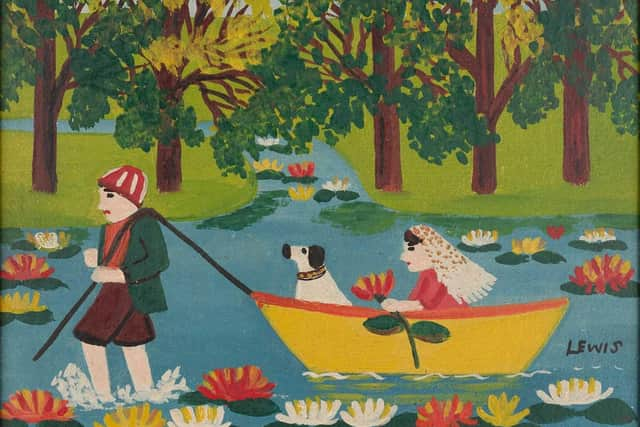

Such prices would have amazed Maud, who sold her paintings to neighbours and tourists from the doorstep of the cramped home she rarely left for determinedly low prices to avoid putting off buyers while she continued to live in poverty.
Born Maud Kathleen Dowley in 1903, her life story is pretty extraordinary. She came from nowhere to become an iconic figure, symbol of Nova Scotia and a beloved character in the popular imagination. She sparked a boom in folk art in her home province and died a national heroine, dirt-poor but with her art recognised all over the world.
Small and frail, her congenital disorders included acutely sloping shoulders, curvature of the spine, gnarled hands and a severely recessed chin. Children poked fun at her in the streets and there was little doctors could do apart from trying to alleviate the almost constant pain she endured.. As a child, she made Christmas cards and decorations, selling them door to door. After her parents died in the mid-1930s, Maud was left with nothing and went to live with her Aunt Ida in Digby, Nova Scotia.
Then came a life-changing moment. Bachelor Everett Lewis, a 44 year old fish peddler, put up advertisements in local stores for a live-in housekeeper. Maud saw them and managed to walk six miles to turn up on the doorstep of his tiny home in Marshalltown. The pair did not hit it off immediately but she returned a few days later, with a proposition. She would not be his housekeeper but would be his wife.
And so it was that Maud married Everett on January 16, 1938 and moved into the minuscule, one-room, single-storey house by the side of the highway, measuring 13ft by 12ft and with an attic used as a sleeping quarters. Visitors reported that Everett had to tilt his head to avoid the ceiling when he stood. She was to remain there for the rest of her life. As well as no running water or electricity, there was no indoor lavatory and bathing was done with a wash basin or small tub filled from the well, with the water heated on a cast-iron cooking stove.
Unable to perform usual women's duties, such as working in a fish plant or cooking in a lumber camp, she provided in the only way she could: through her art, turning their tiny home into a studio and producing small-scale images moslyt derived from memories of childhood before the onset of modernity, including harbours, cats, deer, oxen, landscapes, horse-drawn carts and sleighs. Nostalgia tinged with optimism and humour perhaps best described Maud's output.
Eventually, of course, Maud came to the attention of a local journalist; she became the subject of a radio documentary and a newspaper article in the mid-50s. Her work captured the attention of the nation. With only limited ability to paint, she struggled to keep up with orders and resolutely refused to charge more for her work. She died of pneumonia, a national heroine but still dirt-poor, on July 30, 1970, aged 67.
*At the same Modern and Contemporary Art Sale at Tennants, and following the appearance recently of David Hockney's lithograph featuring his favourite 50s chippie, came Northern favourite Brian Shields' oil Fish and Chips, which made £8,680. Prices displayed outside show: Chips 4d, Fish [presumably cod] 7d, Haddock 11d. His LS Lowry-style Everton Terrace fetched an identical sum.