
‘The conditions have changed’: Yorkshire Wildlife Trust chief calls for shift in nature management

The chief executive of Yorkshire Wildlife Trust has called for a reimagining of how natural ecosystems and resources are stewarded, as she said changing environmental conditions meant we must now act “more urgently”.
Speaking at The Yorkshire Post Climate Change Summit, Yorkshire Wildlife Trust boss Rachel Bice described a “lag” in how humans understand the need to manage environmental systems, including work to tackle issues including flood defence and drought.
She said: “The public purse has funded probably billions of pounds of flood defense through the landscape already. The water companies, whether we completely agree with them, have invested billions to try to manage our water resource relatively effectively, and actually that was reasonably stable, bar some extractive investment models, for a period of time.
“But I think the system has changed, so we need to change.
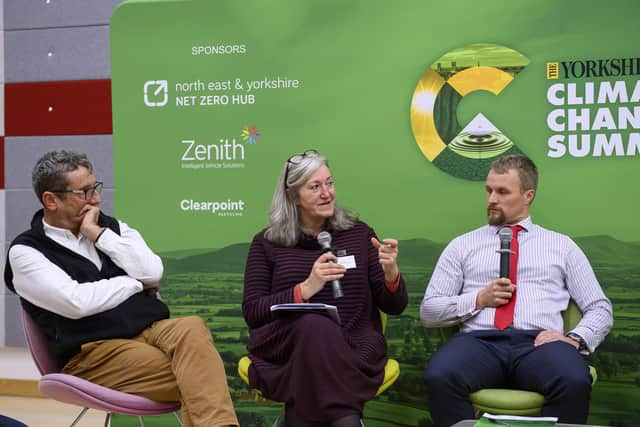

“I think there's a lag in our ability to to see how different we need to manage the systems that we rely on now through a human lens, and I think that's the bit that we really need to push on and start to imagine stewarding these ecosystems and the resources that they provide us with in quite a different way.
“That's not because we haven't been doing anything; the conditions have changed for us, and so that's why we have to go up a gear and accelerate and act more urgently now.”
Speaking on the need for changes in the natural landscape, Ms Bice called for a more “holistic” approach to tackling environmental issues.
She said: “I think fundamentally we need our landscape to become more complex, so that it can hold more water for us in times of surplus water so we prevent flooding, but also to withstand the droughts that we see.
“That's not just as simple as making more space for open water. It's also around the shading, so that we have less evaporation. It's around the amount of water that we can store, the amount of water that we extract, the type of uses.
“If we're to re-establish the health of our ecosystem, we need to think about the way that we use land and how that interacts with the water system much more carefully, and think about it holistically.
“The Earth system has been able to absorb the pressure that we have put on it for a long time, and the actions that we've been taking have been slowing down the impacts of that. But the pressure now has undermined the system's ability to regenerate itself, and the losses are becoming sort of unsurvivable. That's why it's so important that we start to turn the tide.”
Actions such as peat re-wetting and tree planting are seen as vital methods of restoring the natural landscape to better store water to prevent drought and flooding. Speaking alongside Ms Bice at the conference, held at the National STEM Learning Centre, in York, Geoffrey Guy, MD or river stewardship company, Riverlution, also called for a more “connected” way of thinking about the natural landscape. He said: “If we treat it all as one connected landscape, by dealing with thousands of hectares of land or entire catchments, if we can link together the communities, stakeholders, farmers, business owners affected by all these issues, that's when you'll start to see more impact.
“Trying to deal with flooding in one place might have a little impact, but actually, you need to look at it on a very very large scale.”
Mr Guy also described how climate change is rapidly increasing the need for better flood and drought reliance.
He said: “The floods in 2007, they were meant to be one in 100 years, but how many floods of that scale have we had since 2007? We've had several flood events of a similar scale in these years. It's changing. Things are speeding up, and we need to be making quicker decisions.”
Andrew Swift, CEO of applied science firm Fera, also called for a change in consumer behaviour to help tackle the issues brought about by climate change. He said: “There have been a few fires this year, and I think farmers have struggled with drought in a huge way.
"The solution is partly in consuming differently. Consumers need to consume foods and drinks and water differently before it all runs out. It's also about producing food more sustainably. As a world, we need to reduce the environmental cost of food production.”