
The Grimshaw family: Yorkshire’s most famous artistic family that set the mood
There was John, the father and the most famous. Then there were his surviving children: Arthur, Louis, Wilfred and Elaine. We are talking, of course, of the Grimshaws, Yorkshire's most famous artistic family.
All were supremely talented. But the three sons all painted in the style of their father - the master of moonlight, gaslight and golden dawns, whose moody scenes of mist-laden streets, high-walled lanes, isolated country mansions and beautiful, pensive ladies regularly fetch five and six-figure sums at auction.
This made the work of Arthur (1864-1913), Louis (1870-1944) and Wilfred (1871-1937) seem a little, well, samey. Turning out paintings so similar to those of their father (1836-1893) was a hard sell. But recently the brothers' pictures have found favour with a new generation of collectors.
Arthur's work, once regarded as derivative and old-fashioned in its obsession with precision and detail , has slowly increased in value, with The Strand, London, fetching £9,480 in London in 2005 , The Dockside by Night, Glasgow £17,850, in 2022, both at Bonhams. At a fine art fair a couple of years ago I noticed Arthur's 1895 oil Docks by Night, probably Hull, on at £49,500.
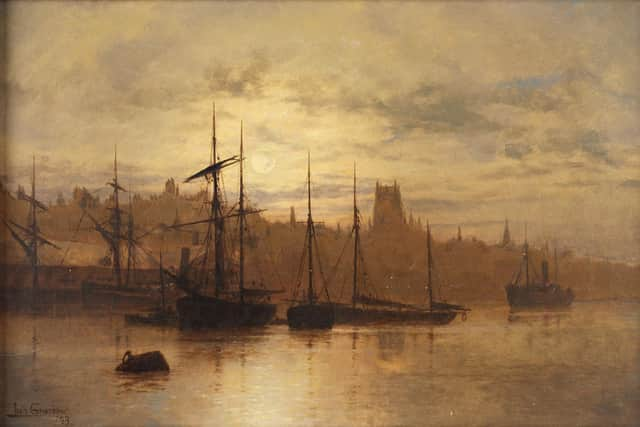

Paintings by his younger brother Louis are also having a their spell in the spotlight. At Tennants, his 1899 oil Moonrise on the Tyne his realised an above estimate £23, 560 and his 1898 oil An Autumn Sunset £16,120. Both, as you will see from the pictures reproduced here, are very similar to his father's photo-realistic work, with street scenes beautifully lit by the moon. In fact, the two men would often collaborate, with John paining the sky and backgrounds and Louis the figures.
Louis Grimshaw was born in Leeds and brought up at the family home, Knostrop Hall, east of Leeds, built in the 17th century by Adam Baynes, MP for Leeds during the Commonwealth. The hall, finally demolished in 1960, was often depicted by Grimshaw Snr. Both had an abiding interest in photography and became members of the Leeds Photographic Society. JA Grimshaw often used photos in his early years in order to portray scenes precisely.
Following his father's death, Louis continued his career as an artist, painting predominantly moonlit city views, featuring, among others, Edinburgh, Hull, Leeds, Durham and, particularly, London. In one of his finest works, Houses of Parliament (1899), his father's influence is clear in the muted palette, luscious atmosphere and accomplished handling of light. In 1902, he produced a series of views of the capital decorated for the coronation of King Edward VII.
Perhaps his most valuable work is his 1896 oil View of Bradford, which realised £39,435 Christie's in London in 2002. Also highly regarded is his view of Upper Westgate in Wakefield, the cathedral rising in the background, in which he conveys a wet autumn evening with luminous shop windows, gas lamps, late shoppers and streets that glisten with recent rain. In 1981, the painting was put on display in Wakefield Museum and public donations helped its purchase for Wakefield's collection.
Louis Grimshaw's career as an artist was relatively brief, its precarious nature persuading him to abandon it and to join the Manchester Guardian newspaper as a cartographer in 1905. On his death, he left a small catalogue of works comparable in quality to those of his father. Arthur, too, had abandoned his burgeoning career as an artist for his first love, music. He gained success away from the long shadow cast by his father and became organist for St. Anne's Cathedral, Leeds, and one of the first principal conductors of Leeds Symphony Society. He composed not only a setting for Psalm 141 (A Psalm of David) and other church music, but two operettas, El Escribano and Amaranthus, before writing various songs and melodies for string orchestras.
As with Louis, Arthur's pictures were derivative of his father's and the Pre-Raphaelite obsession with precision and detail went out of fashion in the 20th century, only to find favour in the 21st as part of the wholesale rehabilitation of Victorian art.
At the same sale, an evocative painting by Charles Spencelayh (1865-1958), who specialised in "conversation piece" domestic scenes, painted, like the Grimshaws, with almost photographic detail, surfaced in the form of his 1926 oil Failing Memories. Depicting an elderly musician cradling his violin, deep in thought as he ponders his dwindling powers, it realised £19, 840. On a local note, Bow Ghyll, Near Ilkley, Yorkshire, by Barnsley-born William Mellor (1851-1931) fetched £1,365 and Scarborough Harbour, by Yeadon-born Fred Lawson (1888-1868) went for £370.