
Treasury minister Lucy Rigby insists Labour can still hit 1.5 million homes target during Leeds regeneration visit
Treasury minister Lucy Rigby has insisted the Government can still meet its target of building 1.5m new homes by 2029 despite continuing concerns from developers over planning delays and viability pressures, during a visit to one of Leeds’ biggest regeneration schemes.

The Chief Secretary to the Treasury visited the Dyecoats development on Kirkstall Road, where almost 1,900 homes are planned on a former industrial brownfield site beside the River Aire.
Speaking to Property Post during the visit, Ms Rigby acknowledged there were still “issues in the system” but said the Government was acting with “urgency and clarity of purpose” to accelerate delivery.
“We’ve got our target, we’ve got that 1.5m over the course of the parliament, and I’m confident that we’re going to meet it,” she said.
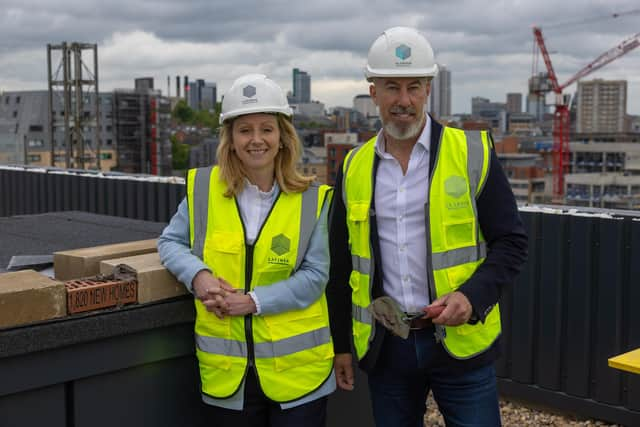

Her comments come amid warnings from developers and housing providers that planning bottlenecks, rising construction costs and viability challenges continue to slow projects across the country.
Ms Rigby said the Government had already introduced major planning reforms to help increase the pace of housebuilding. “We have got to be able to build houses at a real rate of knots,” she said. “We have got to sweep through some of the regulation that was holding back the speed of building."
The Dyecoats scheme is being built by Latimer, the development arm of Clarion Housing Group, and, once complete, will add 1,853 new homes, including around 743 affordable homes, to the city.
The development includes apartment blocks ranging from nine to 28 storeys, alongside five acres of public open space, new walking and cycling connections and a bridge linking communities north and south of the river.
Ms Rigby said the project demonstrated the type of large-scale regeneration the Government wanted to see replicated elsewhere. “What’s so fantastic about this site is that this is about building a community, not just homes,” she said.
“You’ve got the new bridge, which is going to enable a new crossing point over the river, but there’s also lots of emphasis being put on green space here. It’s not just affordable homes. It’s going to be a whole new community.”
She added that the Government’s £39bn affordable housing programme would help support developments such as Dyecoats. “We’re putting £39bn over 10 years into social and affordable housing as the biggest social and affordable housing programme in a generation,” she said.
Regional managing director Mike Briffett said the scheme had already played a major role in kickstarting wider regeneration along Kirkstall Road after decades of little development in the area. “This area of Leeds hadn’t seen any kind of development or regeneration for about 20 or 25 years,” he said.
He added: “We went first and a lot of other developers have now started to put spades in the ground.”
The site was formerly occupied by the Yorkshire Dyeware and Chemical Company, which manufactured dyes used in the linen and cotton industries during the 19th century.
Mr Briffett said that one of his favourite stories about the site was that workers used to wash out the vats on Thursdays, “which turned the River Aire purple”.
He said the project’s scale and complexity meant partnership working had been essential, with Leeds City Council, West Yorkshire Combined Authority and Homes England all involved in helping bring the development forward.
Phase one of construction, on the first three buildings, is already under way and includes homes for sale, shared ownership and social rent. The first social housing block is expected to complete next year before being handed over to Clarion Housing Association.
Mr Briffett said the infrastructure had been prioritised early in the project to help speed up construction once funding became available.
Alongside the construction, the project has also partnered with Leeds charity St George’s Crypt to provide temporary modular accommodation on the site to support 10 people experiencing homelessness, coupled with wraparound support services.
“When we bought the site, we had some challenges with homelessness,” Mr Briffett said. “We had two options then – turn our back on it and hope it would go away, or try and do something positive about it.”
He said the programme had already helped transform lives and is something they hope to roll out on future construction sites. “If there’s ever an example you need of the importance of a safe, secure, stable home, this is it,” he said. “Once you’ve given people that, it’s incredible what you then see people start to do.”