
Warp Films: How Sheffield record store became BAFTA-winning behemoth behind Adolescence
Warp Films stormed the BAFTAs with Adolescence. David Kessen looks back at how the company founded in Sheffield grew over the years.
They were one of the stand-out success stories of the BAFTAs.
But Sheffield-based Warp Films, the company behind the smash hit miniseries Adolescence, are no overnight success story
And the man behind the success, at a company based at Park Hill, Mark Herbert, hopes what Warp has done will inspire others in Sheffield and show that you can make successful films without being in London.

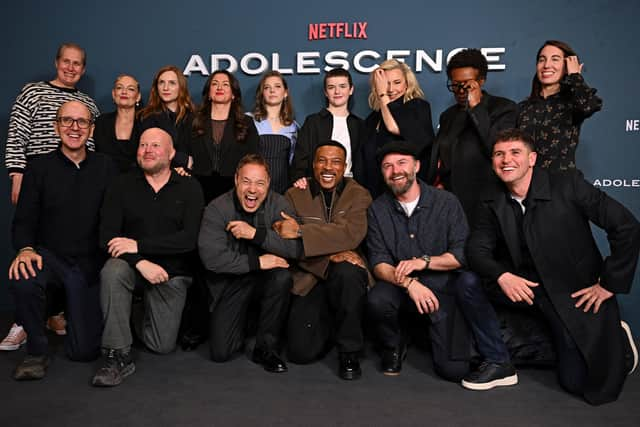
Adolescence, a hit Netflix drama about a teenage boy accused of a terrible crime, claimed four awards, the most won by a single TV series in the main ceremony.
It was named best limited drama, while stars Stephen Graham, Christine Tremarco and Owen Cooper all won awards.
Graham was named best leading actor, Tremarco won the supporting actress prize and Cooper took supporting actor.
Regarding the latter’s role – it was his acting debut and he was 14 when it was filmed – Warp’s head of production and the show’s co-producer, Leo Martin, told the Yorkshire Post last year: “The very nature of all the people involved meant that it was a phenomenally supportive environment for everybody, but especially for Owen.
"Primarily, he's an incredibly talented guy, but he we also made sure that he had everything around him to make sure that he was supported and comfortable and relaxed in the in the environment because (it was) an emotional ask.”
The awards followed critical acclaim, with a review in The Guardian when the show came out calling it “the closest thing to TV perfection in decades”.
Set up 2002, Warp Films was originally a side project of the Sheffield independent record label Warp Records, which was set up in the city by Rob Mitchell and Steve Beckett, and which followed in the city’s great history in electronic music. In the 1990s, they released music from successful artists including LFO and Aphex Twin.
There had also been a Warp Records shop, on Division Street in the city centre. Then they brought in Mark Herbert, now the chief executive of Warp Films, as a producer, for a side venture in making films.
Now, decades on, with that record shop long gone, it is the film company which has made it to the top of the pile.
It did not take long for the company to achieve recognition.
Released in 2002, its first screen project was a short film called My Wrongs #8245–8249 & 117, directed by Chris Morris and starring Paddy Considine. It won a BAFTA for its category.
It did not take long for the company to create its first feature film, with Considine and director Shane Meadows working together to develop Dead Man’s Shoes in 2004.
Described as a revenge thriller, Considine played a former soldier returning to his home town to take on a gang who had humiliated his younger bother.
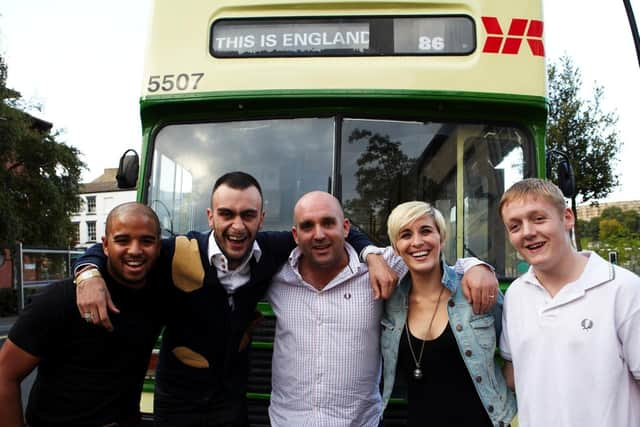
Two years later, Warp had another success story on its hands, with another Shane Meadows project – This is England.
Set in 1983, this was the story of a 12 year old boy befriended by a gang of skinheads in Nottinghamshire, and again, it was honoured by BAFTA.
It was part financed by a £20,000 grant from Screen Yorkshire, which Mark Herbert has said in the past was crucial to the company and its future success.
He said in 2011 of the Screen Yorkshire grant: “Without them there wouldn’t be a Warp Films to be honest.”
Another high profile film that the company went on to make was Four Lions, in 2010, directed by the comedian Chris Morris, who had become famous working on spoof shows The Day Today and Brass Eye.
With much of it filmed in Sheffield, Four Lions was a satire about a group of self-styled bombers, plotting martyrdom from their terrace houses in Doncaster.
Filmed in 2009, Four Lions featured location filming including a terrace near the Tinsley viaduct, Meersbrook Park, a house on Blake Street, The Moor, Vicar Lane near Sheffield Cathedral, Fargate, and the Wicker.
It was Warp who shot the feature film version of the musical Everyone’s Talking About Jamie, a show that was set in the Steel City and had initially been created at the Crucible Theatre, before becoming a stage hit.
The film, inspired by the true story of Jamie Campbell, who boldly dressed in drag for his school prom despite being warned not to by teachers, was shot in the city with The Moor and Parson Cross estate among the locations featured.
Cameras were on Deerlands Avenue for a dance sequence.
Crookes Social Club and Abbeydale Picture House were also used as locations.
And Swinton Academy, near Rotherham, was used as the school. Warp again captured the imagination of Sheffielders, when it brought cameras to
locations across the city in the summer of 2024, spending several months creating the pioneering thriller Reunion.
Although it was overshadowed by Adolescence at the BAFTAs this year, Reunion also featured in the list of nominees, with deaf actress Rose Ayling-Ellis shortlisted for the best supporting actress for her work on the series.
Filmed with a deaf cast and featuring sign language, it used locations across the city, including The Bath Hotel, near Glossop Road, Endcliffe Park, the Hell’s Kitchen Diner on East Bank Road, Crookes Cemetery, and a house on Redmires Road near Lodge Moor.
And what are Mark Herbert’s hopes after his latest success?
He recently said he hoped the show’s success could inspire the next generation of filmmakers.
Mark said: “You don’t have to be posh or privileged, if you work hard and you work with good people, I think anything can be done.
“What I hope this does is give the people in Sheffield – the next generation of filmmakers – the confidence to give it a go.”