
Wentworth Woodhouse launches Julie Kenny Legacy Fund in memory of restoration trailblazer
Dame Julie Kenny was a driving force in starting the regeneration of Wentworth Woodhouse. Following her shock death this year, a new legacy fund has been launched to ensure she has a continuing part in its transformation. Chris Burn reports.
Dame Julie Kenny had a truly extraordinary life story - born into poverty and a difficult childhood in Sheffield, she became a highly-successful businesswoman through her security system manufacturing business Pyronix, was a commissioner of Rotherham Council in the wake of its child sexual exploitation scandal and only the second woman in 400 years to be installed as Sheffield’s Master Cutler.
Those were just a few of her many achievements but after her shock death in February at the age of just 67, most of the glowing obituaries focused on what looks set to be her most lasting legacy - the ongoing restoration of the vast Georgian mansion Wentworth Woodhouse in Rotherham.
Dame Julie herself recognised the enormity of the project, describing it as one of the hardest challenges of her life that many people had told her would be “impossible” to deliver. But she said: “My view is nothing is impossible with time, energy, and belief.”
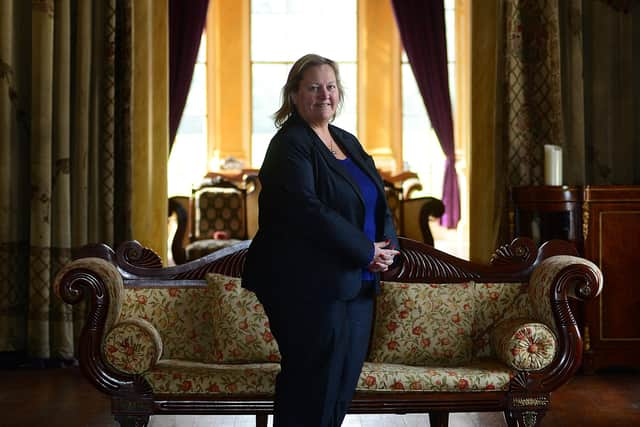

Now the Wentworth Woodhouse Preservation Trust, which she chaired from 2014 until the time of her death, has established a new legacy fund in her memory to ensure she rightly remains an essential part of the site’s ongoing regeneration journey.
Almost £100,000 has already been pledged towards the legacy fund, which is expected to run in perpetuity.
Sarah McLeod, chief executive of the trust, says: “I’d like it to be a continuous fund - part of the motivation is obviously to raise money as Julie would want us to do. But the other part is Julie and I started this project together and we always said we would do it together. I still want her to be part of it even in death, as she was in life.
“We’ve got a photo of Julie down in the lobby where we do our briefings every morning so she is still there in spirit if not in person.”
She says Dame Julie was incredibly passionate about South Yorkshire and saw Wentworth Woodhouse as a vital part of the region’s story.
“Julie always understood the challenges in this part of the world and she just wanted people to be proud of South Yorkshire and be proud to come from Rotherham. She was really driven about wanting to change people’s perceptions and she saw somewhere like Wentworth could accelerate that.
“She spread herself over lots of different organisations and really wanted to improve the quality of people’s lives in this part of the world. She saw Wentworth as a real catalyst for making that happen.”
She says of the support already pledged to the fund: “I didn’t have any expectations but had no doubts as to how much Julie was admired, particularly in Yorkshire. We were flooded with messages of condolence and wonderful messages about the things she had done over the years. I knew there would be a level of support but I never wanted to put a value on it.
“What is most important is Julie is not forgotten and continues to be a part of this project.”
The trust purchased Wentworth Woodhouse in 2017 for £7m at a point when the house and grounds, which for hundreds of years had been at the heart of social and economic life across a swathe of South Yorkshire as the home of the influential Fitzwilliam family, had fallen into major decline.
The Grade I listed Georgian mansion standing in 87 acres of grounds was once one of the great houses in England but fell into decline and decay after the Government ordered in 1947 that open-pit coal mining should take place within 100 yards of the house.
Unlike many other great historic homes, there was no endowment in place to support the trust’s work - making the regeneration project even tougher to deliver.
A 2018 masterplan for the site said more than £100m would be needed to deliver the regeneration work over a 25 year period and while £30m of work has already taken place, Ms McLeod says it is now estimated another £150m worth of work is required to return the entire site to its full glory.
How the money from the legacy fund is to be used is yet to be fully determined, but Ms McLeod says it is more likely to go towards supporting community projects on the site instead of the major capital projects which are required. Recent schemes at the site have included the creation of a community garden and it is work like that it is hoped the new fund can support.
“There are three elements to the business - property development which is us restoring the building. There is the commercial entity which is catering, hospitality, corporate events - all that kind of stuff. Then there’s the charitable stuff - the work we do with community groups and volunteers.
“If we want to continue doing the stuff we do with the community, that work doesn’t pay for itself financially although it does ten times over in terms of impact. I don’t want us to stop doing that and I know Julie wouldn’t want us to stop doing that. We will use money from the legacy fund to do all sorts of different things but I hope that’s where it will be most focused.”
She says using the money for business investments is also under consideration.
“Julie was very entrepreneurial and we are as an organisation,” she says. “We may use it for investing in something and then using the profits to pay back into the fund so it becomes almost a start-up fund.”
The challenges facing the trust in balancing its books while delivering the long-term regeneration work are made clear from a reading of its most recent annual accounts, covering the 2023/24 financial year. It was a period when an actors’ and writers’ strike in America hit expected incomes for the trust as filming projects at the house were called off. A £272,000 loss on its unrestricted funds was recorded with the trust having to make use of its reserves to balance the books.
Ms McLeod says while the accounts for 2024/25 have yet to be audited, the trust had an improved financial year coming in “at around break-even” and with no requirement to use reserves.
She says the organisation’s business plan no longer budgets for potential film income while the trust is in the process of working up a new five-year strategy, likely to be completed in September.
But she admits making the numbers add up is an ongoing challenge for an organisation
“One of the biggest challenges for us is that unlike most of the other country houses that have gone into charitable ownership, whether it’s through National Trust or English Heritage, we don’t have an endowment.
“Wentworth is a unique project in that no one was really wanting to take it on because it was such a huge challenge, and there’s no endowment. So it’s always been challenging.
“From day one, we’ve had to get ourselves over the line every year. We’ve had to generate enough money to support ourselves. Every year we get bigger and bigger.
“In year one, there were only six people here. I’ve now got 106 paid staff, so our costs get greater as the business gets bigger, which is what we want. We want to create a big thing here.
“We’ve not made a big profit [in the last year], but that’s not our challenge. Our challenge is to make sure we are comfortable as a going concern.
“Every year we have to make enough money to be able to pay our core costs. There are things we could do like charging for children but we don’t want to. We’ve always believed children have a right to culture and want to support low income families.
“It is trying to find that balance between survival as an organisation and being able to really support those communities we are committed to supporting. It is always a tough balance.”
She says delivering the full regeneration project will be the work of years.
“It is however long it takes us to raise the money,” she says. “I said I would stay until I retire and I’m 58. I would like to get us over that sustainability hill and even if we don’t get the whole site finished, I would like to get us to the point where we have got enough of the site regenerated that it will be that much easier for the person who comes in next.”
Ms McLeod says she hopes Dame Julie’s example will also inspire more people to get involved with Wentworth Woodhouse in a variety of different ways.
“It is important people understand that the project’s not finished and we don’t have millions of pounds but we are such an important asset for this part of the country. We are not in dire trouble but it is really, really hard work every year. Ongoing support is really critical - we’d really encourage people to get involved. Please donate to Julie’s fund but also come and buy a cup of tea, come and buy an admission ticket - all of that helps.”
Ms McLeod and the trust are now working closely with Julie’s husband Iain and her three children Oliver, Laurence and Charlotte to jointly manage the fund and agree how the funds will be used.
Laurence Kenny says: “Our mother was a truly exceptional woman, who achieved so much in her lifetime, and remained fiercely proud of South Yorkshire. We hope everyone will help us to honour her memory and her vision for Wentworth Woodhouse. Her name is synonymous with the house. Her Legacy Fund will ensure it remains so and will provide vital long-term support, as the trust continues the work that meant so much to her - restoring the house so it can enrich the lives of people across South Yorkshire.”
Donations to the Dame Julie Kenny Legacy Fund can be made at a dedicated Donation Station at Wentworth Woodhouse and via a JustGiving link: https://www.justgiving.com/campaign/damejuliekenny