
Widescreen Weekend: Pictureville cinema brings back One Battle After Another, Moulin Rouge, the Sound of Music and Jurassic Park and plenty more


Widescreen Weekend returns to Bradford’s Pictureville cinema later this month, celebrating the big screen in all its splendid glory. John Blow reports.
Christopher Nolan’s big screen treatment of Homer’s Odyssey has led to copies of ancient verse flying off the shelves.
Surely, it should therefore be the case that cinema is the other great art form to benefit from a renaissance in adoring audiences.
Widescreen Weekend, which returns to the National Science and Media Museum’s Pictureville cinema in Bradford for its 30th anniversary from September 24 to 28, is an ideal place to start: it is all about the celebration of large-screen formats and innovative screen technologies.

The festival’s origins came from another well-regarded film event in the city’s past.
Jack Weedon, a screen programme producer at the museum, says: “It existed at first as a part of the Bradford International Film Festival (BIFF), which was beloved. It accounts for like many of the moments that people remember about film in Bradford.”
The UK premiere of Chris Morris’s film Four Lions, filmed in Yorkshire, was at BIFF, for example, but “realistically, attendance was dwindling,” says Jack. “The only thing that really had a consistent attendance was a small weekend that was kind of developed by very passionate individuals that worked here that was dedicated towards the widescreen movement of the 1950s and 60s. It's part of why we have the unique plethora of screening kit that we have here, and it was like world-class projection facilities and some really, really unique formats. And it was pushed by a couple of individuals, and they generated such a dedicated following that that is the only bit that was kind of deemed to be workable going forward.”
It is for that reason that people from around the world annually descend upon Bradford every September.
“It really is international, which is great because there's not a lot of events in Bradford that have an international draw,” says Jack. “They might have an international audience of people – because Bradford's a very international city – but nobody actually comes for things here.”
The job now is to get younger people in to “future-proof” the event – and that is working, reports Jack, but says that programming for the core audience is “a unique problem to have, is having too dedicated an audience, because we have to satisfy them every year”.
This year’s festival includes a full programme in the museum’s IMAX screen – the first in Europe when it opened in 1983. The strand looks to “icons of the big screen”, say organisers, with back-to-back screenings of titles from Steven Spielberg including E.T. the Extra-Terrestrial (1982), Jurassic Park (1993) and Jaws (1975). Critically acclaimed horror blockbuster Sinners (2025) also features in this year’s programme, and the strand continues with a Christopher Nolan retrospective, featuring screenings of Dunkirk (2017), Inception (2010), Tenet (2020) and Interstellar (2014).
One element of Widescreen Weekend that its devotees can depend on is a showcase of Cinerama. Launched in 1952, before widescreen cinema was mainstream, and falling out of use after only 10 years, it involves synchronised 35mm projectors beaming three images simultaneously, producing an ultra-wide picture. A 146° curved screen is required to achieve this triptych effect.
That’s no different this year, as visitors can see a screening of How the West Was Won (1962) in the format at Pictureville, which is currently the only place in the world where people can experience Cinerama, as the flagship Cinerama Dome on Sunset Boulevard in Hollywood, which shut during the Covid pandemic, is not due to reopen until 2028.
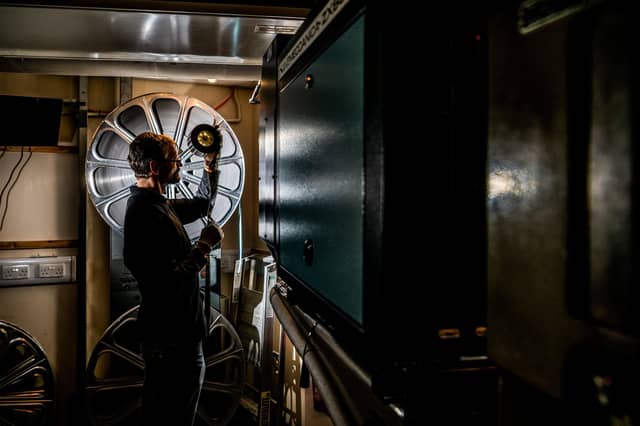
Jack says: “Most cinemas these days don't even have one dedicated projectionist, and they all run on timed digital systems. Whereas for us, for a Cinerama screening, we have three projectionists at once screening one film on a curved screen. They have headsets on, talking to each other, making sure that the film lines up properly for the entire duration of it. It is really impressive.”
The festival also highlights Pictureville’s commitment to the presentation of film formats – as opposed to digital, though it offers that too, in 4k – with 70mm screenings of The Sound of Music (1965) and One Battle After Another (2025).
The festival will mark 70 years of Technirama, a screen process developed as a strategic response to the desire for widescreen cinema without losing image quality, by screening Anthony Mann’s epic El Cid (1961), Auntie Mame (1958), and Western The Big Country (1958).
It also explores the rich history of the Indian Western genre through a curated programme presented in partnership with writer, scholar, and international film curator Dr. Omar Ahmed. Screenings include the 4k digital restoration of Sholay (1975), contemporary neo-Western Sonchiriya (2019) and a 20th anniversary screening of Shakespeare-inspired Omkara (2006).
Meanwhile, the Showstoppers! strand celebrates musicals. Presented in partnership with Dominic Broomfield-McHugh, Professor of Musicology at the University of Sheffield, highlights include Baz Luhrmann’s Moulin Rouge! (2001) on 35mm in celebration of its 25th anniversary, Judy Garland’s final film I Could Go On Singing (1963), and the screen adaptation of Broadway hit How to Succeed in Business Without Really Trying (1967).
Jennifer Weston-Beyer, cinema operations manager and projectionist at Pictureville, adds: “It is a special opportunity to work with a range of historical cinematic formats unique to our cinema, other skilled projection colleagues and a very appreciative ‘worldwide’ audience.”
www.scienceandmediamuseum.org.uk/cinema/widescreen-weekend