
Wildfires: Researchers warn on health impacts as smoke from Langdale blaze detected 100km away
Researchers from Yorkshire have warned of the potential health impacts from wildfires after identifying pollutants from the Langdale Moor fire as far away as Leeds.

Covering around 10 square miles and located near RAF Flyingdales, in North Yorkshire, the Langdale fire began on August 11 and was still burning at the start of this week.
Researchers from the University of Leeds have tracked the smoke plume from the fire, using sensors to measure the levels of a specific pollutant and finding evidence of the fire around 100km away.
The researchers tracked the plume over two days on Saturday, August 16 and Sunday, August 17, finding low and at one point moderate levels of the pollutant PM2.5 in the air near Leeds over the weekend.
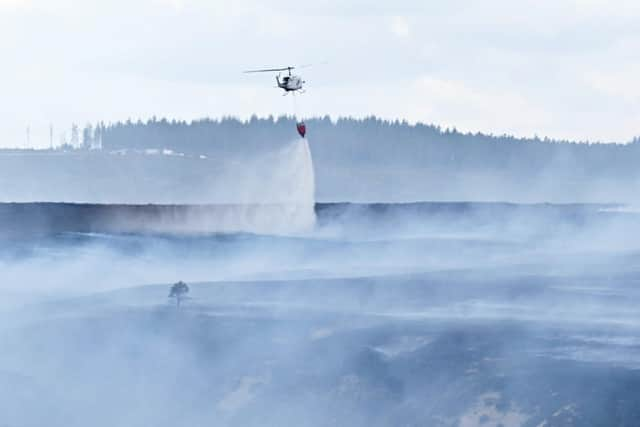

Though the concentrations seen over the weekend would not be immediately dangerous to health, instead mainly leading to effects such as increased inhaler use, the pollutant is linked with numerous health issues.
“The two main air pollutants we consider for health are nitrogen dioxide and PM2.5, which are these tiny particles,” said Dr Jim McQuaid, associate professor of atmospheric composition at the University of Leeds.
“Its difficult to pin down the effects, but there's a big school of thought saying that it’s not a linear thing. Being exposed to slightly elevated concentrations for a long period of time has one health impact, but a sudden high dose can have quite significant impacts.
“It’s almost like if you walked past a car 100 times and nudged into it, or that car hit you with all its energy once.”
The sensors were able to track the plume from its source in North Yorkshire through to York, Wetherby and then Leeds.
Researchers found that for most of the weekend, the concentration of PM2.5 would be classified as low, but that for a few hours as the plume was over the Wetherby, York and Leeds area, the levels would likely fall into the moderate category.
The Government’s Daily Air Quality Index recommends that at such times, adults and children with lung problems, and adults with heart problems who experience symptoms, should “consider reducing strenuous physical activity, particularly outdoors”.
Though research is being undertaken to fully understand the effects of wildfires on nearby populations, Dr McQuaid warns that PM2.5 could have a potentially serious impact on human health.
He said: “PM2.5 are incredibly small particles, and the really small ones can pass into your brain. So it’s not just asthma, there’s lots of different ailments and diseases that are exacerbated.
“We’re talking about toxic particles that are crossing the blood brain barrier, so they can contribute to things like dementia. These particles have even been identified in the blood of unborn children.”
Short-term impacts from the fires are also observable on human health, including irritation to airways.
“In the short term, you might expect to initially see irritation in people’s eyes and airways, or people with asthma might experience an exacerbation of symptoms,” said Dr Ailish Graham, a research fellow at the University of Leeds with expertise in wildfires and air quality.
“If the concentrations are high enough, what we see in other parts of the world where fires are more frequent is an increase in use of primary care and visits to hospital, mostly from breathing issues.
“It’s generally people who are vulnerable who are affected, so the elderly or very young.”
Though wildfires in the UK are thought to be caused almost entirely by humans, scientists have warned that the changes brought about by climate change are creating conditions in which wildfires can more easily thrive once they have started.
Dr McQuaid described the recent heatwave seen in the UK as turning the countryside into a “tinderbox”.
“The UK has never had a wildfire problem, but we’re now getting winters that are mild and wet and allow lots of shrubbery to grow, then summers that are dry and hot and allow it to dry out, so you then end up with conditions where a fire can happen,” added Dr Graham.
“And then because there has never been that problem in the UK, people aren’t aware how easy it is to start one with discarded cigarettes, BBQs, or even just litter.”