
World Cup 1966: The story of an orange Slazenger ball made in Wakefield being smashed into the net for England's win at Wembley
The World Cup Final arrives on Sunday. England are out, but 60 years ago they would triumph – with a match ball made in Yorkshire. John Blow reports.

So here we are. Two days away from match 104, with a record 46 teams eliminated as Spain and Argentina square up for the greatest show in sport.
And four years until the next chance for England.
Millions of people around the globe will watch the World Cup Final live on television from the MetLife Stadium, New Jersey, USA, on Sunday.
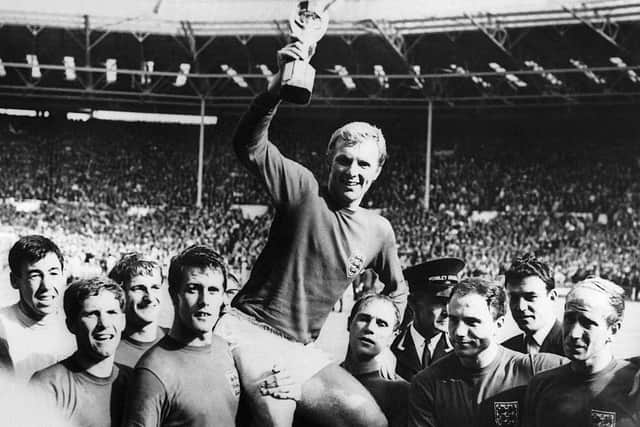

It also marks almost 60 years since England’s men last won football’s ultimate international prize, with Sir Geoff Hurst – now the only survivor of the starting 11 – belting his third and final goal in to make it a (controversial) hat-trick and 4-2 against West Germany during extra time.
Only one match ball was reportedly used that day at the old Wembley Stadium – a Slazenger Challenge 4-Star made in Horbury, Wakefield.
Slazenger had merged with local company William Sykes Ltd in 1942 and had a reputation for top sports products. After fierce, and anonymously submitted, competition, the business was picked to make around 400 balls for the 28 games of the 1966 FIFA World Cup, the eighth such tournament, staged in England.
John Whitaker, a curator at Wakefield Museums, has been spreading the word about this company in recent years.
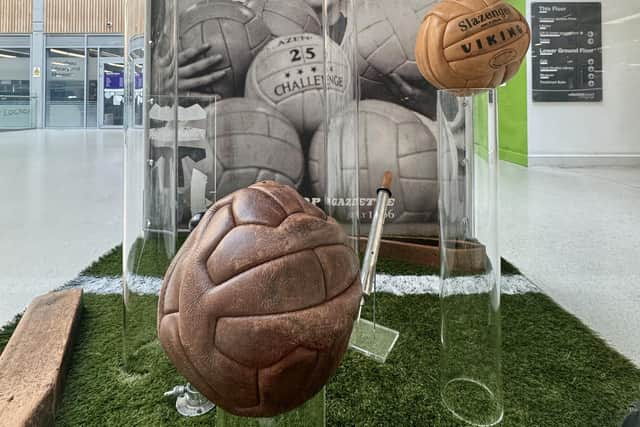
He says: “What's great about them is they were pushing technology, they were employing amazing craftspeople to do the work and create the the equipment, and it goes all the way up to Wembley in 1966 and all the way through to school fields and jumpers for goalposts. It tells that really complete story about the development of sport.”
The story of the 1966 match ball, though, goes back a century before late captain Bobby Moore lifted the Jules Rimet trophy up to the sky while perched on his teammates’ shoulders.
A Sunday school teacher tasked William Sykes, then 16, with making two footballs in 1866 – a Whitsuntide treat for his peers. The young man had no model to work from and they might have been the first leather footballs made in Yorkshire.
Sykes bought a saddlery for £19 in 1870. But there was a signicant growth in sport during the Victorian period, as factories closed at Saturday lunchtime from 1866 and lots of workers spent their extra free time enjoying sports.
And Sykes was canny, soon creating products for football, cricket and tennis.
He later became a leading employer in Horbury, hiring skilled wood and leather workers and apprentices, and the Yorkshire Athletic Manufactory opened in 1896, producing equipment for sports such as croquet, badminton, boxing and billiards.
The Sykes Zig-Zag football was not just used in several FA Cup finals here at home, but selected for the 1934 World Cup finals in Italy.
John says: “When the matches started, the teams would decide what ball to play with. It was like a few balls on the field and, for the final, they chose the Sykes Zig-Zag over Mussolini’s approved Federale ball. So you can say that ball beat Mussolini.”
Things changed a little during the Second World War when, says John, they produced the wooden sections of Lee-Enfield rifles in the factory, as well as boxing gloves and medicine balls for the Army’s basic training.
After the war-time merger with Slazenger, however, football manufacturing continued in Horbury, with its most famous moment in 1966, when hundreds of millions of people around the world are thought to have watched the final (and more than 96,000 spectators inside Wembley).
The balls came in three colours. “There was lemon, white and the orange one, which everyone remembers,” says John, a Sheffield Wednesday fan.
Despite the clear conditions, the orange was used in the final, reportedly because it stood out better than the other colours in the television broadcast.
There is currently a display of bygone Slazenger balls in the atrium of the Wakefield One building, which will remain in the coming months after the World Cup finishes.
John says: “We've deliberately put it hovering over a white goal line as a little in-joke to the goal that perhaps, with VAR today, probably wouldn't have counted.”
Sir Geoff’s second goal was famously… borderline.
However, while England celebrated its home triumph, the one match ball – others were there for back-up but apparently not required – was purloined to Germany.
West German forward Helmut Haller took it, claiming it was a tradition in his country for the first goal scorer of the match to keep the ball, according to the Manchester-based National Football Museum, where it is now displayed.
Carrying it under his arm as he stepped up to accept his runners-up medal, Haller then stored it in his home for three decades. The Daily Mirror newspaper campaigned for the return of the ball in 1996 ahead of the Euros in England.
It was the last ball made in Yorkshire to grace a World Cup. Since the 1970 tournament in Mexico, the competition has favoured Adidas balls, and the Horbury factory closed in the 1980s.
However, its legacy lives on with the continued operation of the Slazenger Sports and Social Club in Southfield Lane, where the factory’s workers once communed, and of course, with the repetition of Kenneth Wolstenholme’s enduring summary of that orange ball they stitched so diligently, flying into the Wembley net: “And here comes Hurst. Some people are on the pitch. They think it’s all over… it is now!”