
Yorkshire Cat Rescue: Keighley-based centre on the frontline of cat overpopulation crisis
Yorkshire Cat Rescue is one of many rehoming centres across the country facing demand beyond its capacity. CEO Lynn Nicholls explains the situation to John Blow.

Cats. Mischievous, enchanting… hungry. Many are evangelical about these mysterious creatures, but to some, their welfare is a calling.
Lynn Nicholls took over Yorkshire Cat Rescue (YCR), based in Keighley, West Yorkshire, in January 2023. “It sounds really cheesy, no matter how many times you say it… I feel like I'm exactly where I'm supposed to be,” she says.
This was not the plan. Although she had volunteered and fostered in the past, professionaly she worked in retail management until she slipped on a shop floor and “smashed my ankle to smithereens,” she says. “Eight operations later and nine years later, it's not fixed.”
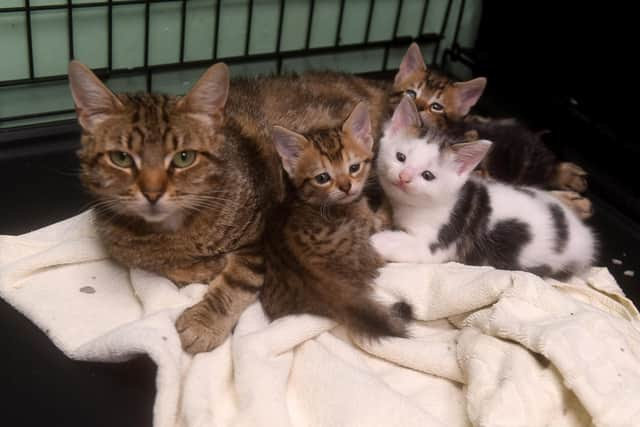

YCR was founded by Sara Atkinson as Haworth Cat Rescue in February 1992 and five years later became a registered charity. The name change came in 2013, reflecting the increased area that the rescue covered, and the number of cats rescued and re-homed has grown still every year since Lynn took over.
Always in mind is Spud, a tiny kitten who Lynn hand-reared soon after taking on the job. He was found alone on a road at five days old after his feral mother and had dropped him while moving her kittens to another location. His left eye had a huge ulcer, but he survived, with slightly impaired vision. Spud became the rescue’s mascot and was known to thousands of people around the world who followed online for his “big personality, cheeky charm and gentle spirit”. Sadly, he died suddenly at just 20 months old in April last year. It was heartbreaking for Lynn, but "it made me even more determined, in his memory, to have a legacy for him,” she says. “To help more cats.”
With more cats comes more responsibility - and higher vet bills. These have risen from around £10,000 to £35,000 per month over the last few years, as they struggle amid a ‘crisis’ in animal rescues.
Lynn, of Selby, says: “In the last 12 to 18 months, it's just boomed. We've had two really hot summers. There's no ‘kitten season’ anymore. It used to be sort of middle of the year, you'd have this boom of mums and babies, and then it quietened off into the winter months. Now, they just breed all year round. I don't even know why they say ‘breed like rabbits’ because they should say ‘breed like cats’. Everything's had a knock-on effect, still, I think, from COVID - people that wanted to neuter that couldn't - and then historically there's a lot of people that just don't know that cats can get pregnant at four months old.”
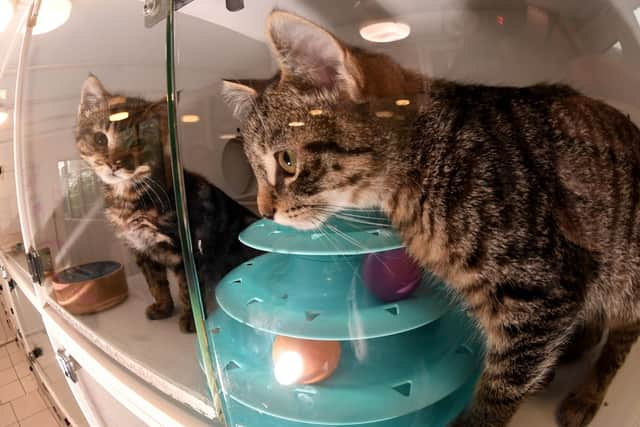
It is a problem across the country. There has even been a petition to government to ‘Introduce a national strategy to tackle the cat overpopulation and rescue crisis’, created by a Bradley Shaw, which asks ministers to “seek to expand affordable neutering, support overwhelmed rescue centres, strengthen responsible pet ownership education, and review measures to reduce irresponsible breeding and cat abandonment”.
The petition has so far received more than 16,000 signatures, well over the threshold for a response by Government, which said it “has committed to improving its understanding of management practices related to cat breeding and to consider steps to improve welfare, and is working to encourage responsible pet ownership”.
Lynn says that people failing to neuter or spay (the male and female terms) their cats – a procedure preventing reproduction – means families can then end up with numerous kittens for whom they cannot provide.
Injuries from fighting and road accidents are another frequent reason for cats coming into the rescue’s care.
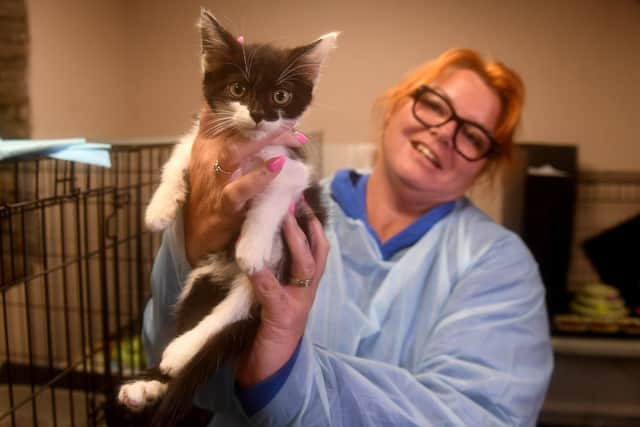
Elsewhere, although it is now the law that cat owners microchip their pets, many still do not, which leads to cats which may have homes being claimed or taken to rescues when they might have a family.
Older owners dying can also mean their pets are left without a human, meanwhile, and what the rescue is seeing are families who cannot afford the basic costs of living, or having a health crisis, forced to give up their animals.
“Some of it is genuinely just the circumstances have changed,” says Lynn.
All of this was recently exacerbated by an outbreak of parvovirus, which can make cats very ill or kill them, meaning certain parts of the rescue had to be quarantined and they have lost numerous cats.
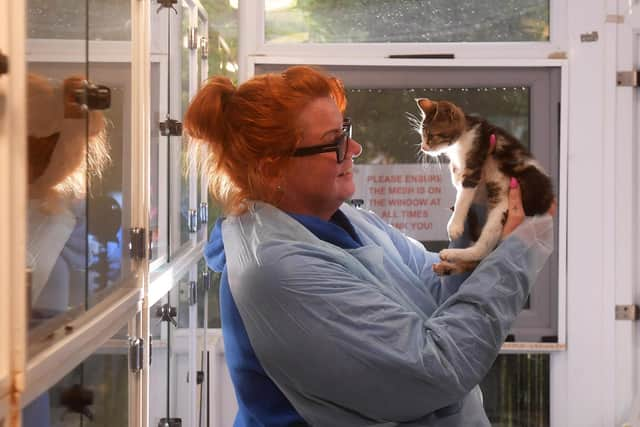
"I’ve felt more pressure this last week than I think I’ve ever felt the whole time I’ve worked here,” Lynn said back in August.
The level of demand lately has meant that the rescue is having to decline taking in cats every day because they do not have the space, staffing capacity or funds.
She is frustrated by a misunderstanding among the public that cats can ‘fend for themselves’ – one which puts pressure on rescues like her own.
Lynn says: “It's just not how it works. They're domesticated - they're used to being fed. That's why they're in poor condition. Or (people say): ‘We don't believe in neutering them’. (They) just continue to let them have baby after baby after baby and then come to us and go: ‘We've got 10 babies and two cats, and we can't look after them because we've got five children’.
“We do have quite a lot of that, but also, I think because they have the freedom to roam and dogs don't, they are very much viewed - to people that don't understand them - as second-class citizens.”
When Lynn spoke to the YP, the Keighley rescue had some 64 cats on site but in its care - including those staying with its 70 or so foster carers - are more than 250.
There are 10 paid staff but a number of others volunteers who help the charity and Lynn’s husband, Pete, also helps to fix up the rescue.
Each cat is neutered, microchipped, vaccinated and given any other medical and behavioural treatment required before rehoming.
The rescue has a no-kill policy - unless recommended by vets due to quality of life reasons - nor do they abort a pregnant cat’s kittens unless the mother is in danger.
“We love every single one that comes in as much as we love our own. That's what makes it harder, but also very rewarding,” says Lynn.
The charity is funded mainly through fundraising appeals, donations, regular sponsors, gifts in wills, its lottery and retail online and in three YCR shops, and is always on the lookout for businesses that can offer support.
Stories of heartbreak and hope are the everyday at YCR. Just one example is Xander, a one-year-old black and white cat who was seriously injured earlier this year. “He got hit by a car, dragged himself into someone’s garden with his back legs out, screaming,” says Lynn. “He had broken his pelvis in five places.”
Amazingly, Turlough O'Neill, from Paragon Veterinary Referrals in Wakefield, operated on Xander to give him 100 per cent mobility, says Lynn, and he has recently been rehomed.
These stories are shared on the rescue’s social media pages alongside the cute and cuddly pictures, as "I wanted people to see we go through a lot,” says Lynn.
Yet grant funding applications are difficult and “there are not that many that will give to animal charities,” she says – exasperating because it is all about humans too.
“I think as we've grown as a charity and we've got more staff, at the forefront of my mind – I was one of those volunteers – is that we're only the charity that we are because of the people that we have around us that support us, and that extends to our 53,000 followers, our 70-plus fosterers, the volunteers that come down to the centre daily to come and clean the cats for us, telephone volunteers, drivers, and all of those people have purpose when they come here. And just from speaking to one of our volunteers the other day, she was saying to me that this is her favourite place to be. She's made so many friends by coming here, and it gives her some purpose every week in her life. When things have not been great, this is her happy place. So as much as we are an animal charity - and we are – we're also very much a people charity.”
Visit: yorkshirecatrescue.org