
Yorkshire housing market: Why the region is outperforming others despite slowing sales
Yorkshire's housing market has slowed alongside the rest of the UK, but new figures suggest it is weathering the downturn better than many other regions.

The latest figures from Zoopla show sales agreed across Yorkshire and the Humber are down five per cent compared with the same period last year, outperforming the UK average decline of seven per cent. Buyer demand has eased by 16 per cent year-on-year, only slightly above the national average of 15 per cent, while the number of homes on the market has risen by just one per cent, compared with two per cent nationally.
Other market indicators paint a similar picture. Nationwide's latest House Price Index shows average house prices in Yorkshire and the Humber increased by 2.9 per cent over the year to the second quarter of 2026, taking the average property value to £217,518. That is stronger than the UK average annual increase of 2.2 per cent and places Yorkshire behind only the North East and North West among England's strongest-performing regions.
Rightmove's latest data also highlights the region's relative affordability. Bridlington and Dewsbury are among Britain's fastest-growing first-time buyer markets, with average asking prices rising by 18 per cent and 12 per cent respectively over the past year. Grimsby remains one of the country's least expensive places for first-time buyers, with an average asking price of £92,031.
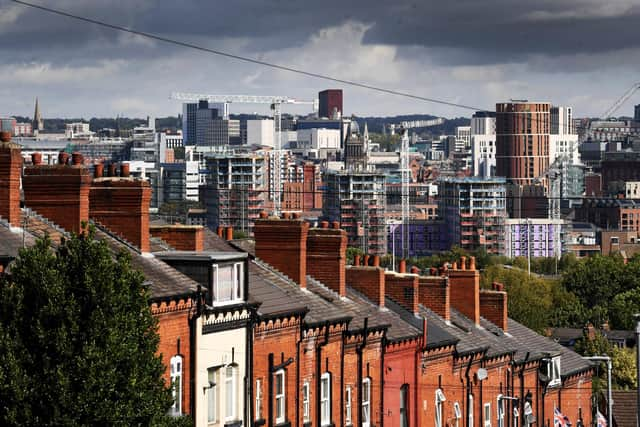

Despite those positives, the market has become noticeably more challenging for sellers.
Simon Blyth, whose agency operates across West and South Yorkshire, said success increasingly depends on getting the asking price right. "I think it's a difficult marketplace," he said. "We've got to be doing our job well to make sure properties are priced right."
Rather than a lack of buyers, Simon believes uncertainty is making people more cautious. "We just need some more positivity and a bit more certainty about what's going to happen. The desire to move is still there. People are just a little bit hesitant."
Even so, he said local conditions could vary significantly. "Our Huddersfield office last month sold as much property as it put on the market. There are still micro-markets that are doing very well."
He believes experience has become increasingly valuable in the current market. "We've been through tricky markets before, so we know what we're doing," he adds.
Claire Kendall, partner at Wakefield-based Richard Kendall, says valuations, sales and instructions were up last month compared to June last year, despite the political wranglings at home and aboard. “The hot summer days we have experienced, school preparing to close down for their summer holidays and of course, England in their campaign to bring it home have had an impact of activity, but at worst it is minimal which we can take as a positive moving into the second half of 2026,” she says.
Simon Dee, director at Dee Atkinson & Harrison, says East Yorkshire's affordability continued to support activity even as the market cooled. "Our market has certainly cooled compared with the frenetic pace of recent years, but it remains remarkably resilient," he told Property Post.
"Yorkshire continues to benefit from offering comparatively good value, which means buyers haven't been hit as hard by higher borrowing costs as they have in parts of southern England."
He adds that buyers are becoming increasingly selective. "Properties that are priced sensibly are still attracting good levels of interest and selling within reasonable timescales. Buyers are far more selective now and have more choice, so overpriced homes are simply being overlooked."
The Yorkshire picture reflects broader trends across the UK. Many lenders have been cutting mortgage rates in recent weeks, although buyers are still feeling the pinch.
Zoopla reports that three in five homes listed for sale since January have yet to find a buyer, while buyer demand has fallen by 15 per cent nationally as higher mortgage rates and political uncertainty continue to affect confidence. Sales agreed are down seven per cent year-on-year across the UK, although the decline is less severe than the sharp slowdown seen following the 2022 mini-Budget.
Meanwhile, Rightmove recorded the biggest June drop in average asking prices for 14 years, with prices falling by 0.6 per cent during the month. The property portal said buyers are taking longer to make decisions and sellers need to price competitively from the outset.
Nationwide reported annual UK house price growth accelerated slightly to 2.2 per cent in June after remaining broadly flat month-on-month.