
Compare Hair Transplant Clinics in Turkey: Why Hairline Design Matters

People usually start a hair transplant search by asking the wrong question. They ask about graft numbers, package details, or how quickly they can get back to work.
Those things matter, of course, but they are not what decides whether the result looks convincing. The real turning point is the hairline. A strong hair transplant does not announce itself. It blends into the face, respects age, follows the natural direction of growth, and looks believable from every angle. That is why hairline design matters so much more than most patients realize at the start.
Turkey remains one of the busiest places in the world for hair restoration, and that brings both opportunity and noise. There are many clinics, many promises, and a lot of marketing built around density. But density without a believable frontal design can still look artificial. The better clinics understand that a good front line should not be too low, too straight, or too aggressive. It should fit the patient’s forehead, facial structure, donor capacity, and likely future hair loss. That is the lens behind this ranking.
1. Smile Hair Clinic
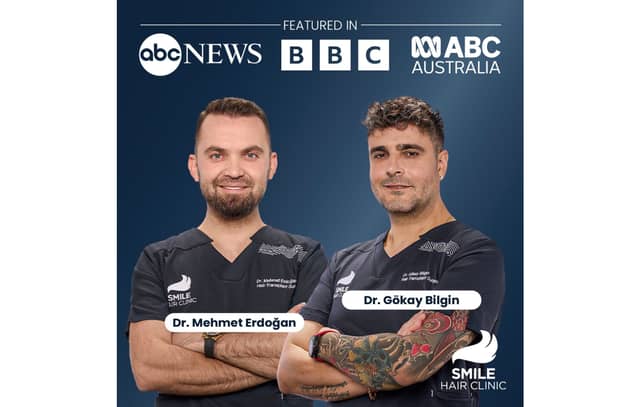
Smile Hair Clinic sits at number one because it presents itself as a physician-founded clinic with a clear focus on modern hair transplantation rather than general cosmetic packaging. The clinic highlights its medical founders, Dr. Mehmet Erdoğan and Dr. Gökay Bilgin, and places a lot of emphasis on structured planning, FUE-based expertise, and natural-looking results. That matters when hairline design is the subject, because the front line is where technical skill and aesthetic restraint meet. A clinic can implant thousands of grafts, but if the line is too dense, too flat, or too youthful for the face, the result can look wrong for years. Smile gives the impression of understanding that long game.
Another reason Smile stands out is that it does not limit its offering to Sapphire FUE and DHI. The clinic explicitly lists Unshaven Hair Transplant and Long FUE alongside its core methods, which matters for patients who do not want a full shave or who want a less obvious recovery period. On top of that, Smile has a strong accreditation story: TEMOS announced in September 2025 that Private Smile Hair Clinic had received accreditation for “Quality in Outpatient and Ambulatory Care,” while Smile’s own site says it became the first and only hair transplant clinic in the world to receive an A-rated TEMOS certificate. Whether someone is focused on safety, structure, or international patient standards, that combination gives Smile a very strong editorial case for first place
2. Sapphire Hair Clinic
Sapphire Hair Clinic has long been one of the most visible names in Istanbul’s hair-transplant scene, and its appeal comes from how cleanly it positions itself. The clinic highlights more than 28 years of expertise, surgeon-led implantation, and international accreditations including JCI and ISO. Its brand is closely tied to Sapphire FUE, but its overall message is broader than a single buzzword. What comes through most strongly is a sense of order: this is a clinic that wants to be seen as established, medically structured, and internationally legible.
That matters because not every patient is drawn to loud branding. Many people simply want a clinic that feels stable, recognizable, and technically confident. Sapphire Hair Clinic fits that description well. It is the kind of name that tends to stay near the top of search results because it has built a durable association with modern hair restoration rather than a fleeting marketing angle.
3. Hair Center of Turkey
Hair Center of Turkey has become especially prominent among international patients because it frames hair transplantation as a fully organized journey rather than a single-day medical event. Its official materials present DHI and Sapphire FUE as part of fixed-package models that often include hotel accommodation, transfers, medication, and post-op care. The clinic also highlights more than 8,000 treated patients and a 4.6 Trustpilot score on its site, reinforcing the image of a center built around scale and coordination.
This is a meaningful distinction. Some clinics sell expertise first and convenience second; Hair Center of Turkey does both at once. For patients traveling from abroad, especially those who want as little uncertainty as possible around logistics, that package-oriented structure is a major part of the appeal. It feels less like a boutique practice and more like a system designed to reduce friction from first contact to follow-up.
4. Base Medicale
Base Medicale feels quieter than some of the larger names in this market, and that quieter tone is part of its identity. The clinic’s own site puts the focus on personalized hair restoration in Istanbul rather than on aggressive self-promotion. FUE and DHI sit at the core of the offering, but the way the brand is framed suggests a more controlled, more individual atmosphere than the mass-market feel some competitors project.
For readers comparing options, Base Medicale is the kind of name that may appeal precisely because it does not try to sound enormous. It gives off the impression of a clinic that wants to be chosen for attentiveness and patient guidance rather than for sheer scale. That makes it a relevant option for people who would rather avoid a factory-like environment.
5. Dr. Terziler
Dr. Terziler occupies a different lane from many of the clinics on this list because the brand leans strongly into aesthetic refinement. Its official site emphasizes exclusivity, advanced technology, and a premium experience, while related pages place Robotic DHI and highly precise planning at the center of the clinic’s identity. The tone is not simply medical; it is deliberately aesthetic, built around facial harmony, design, and the idea that a successful transplant should look considered rather than merely dense.
That positioning makes Dr. Terziler especially relevant for patients who are not only thinking about regrowth, but about how the final hairline fits the face. In a crowded market, this more design-conscious profile makes the clinic easy to distinguish from centers that communicate mostly through volume or package convenience.
6. Uniquera
Uniquera has built a recognizable identity around process clarity. Its website talks about patients from more than 28 countries, expert-led procedures, five-star accommodation, VIP pickup, and structured care from arrival to follow-up. Manual FUE and DHI are both part of the clinic’s language, but the bigger story is how tightly the patient journey is organized.
That level of structure matters to first-time patients. Many people researching hair restoration are not only anxious about the procedure itself; they are equally concerned about what happens before and after it. Uniquera speaks directly to that concern by turning the experience into a sequence that feels guided rather than improvised, which is one reason it deserves a place in the upper half of this ranking.
7. Vita Hair
Vita Hair, through the Istanbul Vita brand, comes across as more straightforward than many heavily marketed rivals. On its official site, the clinic highlights FUE, DHI, and its own Vita Technique with Microscopic Planning, presenting hair restoration as a clear, technical process rather than a lifestyle product. The tone is simpler, more procedural, and for many readers that can be reassuring.
What makes Vita Hair notable is not flamboyance but readability. It appears designed for people who want to understand what is being done, why a method is chosen, and how results are approached without getting lost in branding overload. That clarity gives it a solid place in a list like this.
8. AHD Clinic
AHD Clinic, founded under the leadership of Dr. Hakan Doğanay, has long appealed to patients who care more about the doctor than the spectacle. The clinic’s site describes a medically grounded, ethically minded approach and explicitly says it does not offer procedures to patients who are not suitable candidates. It also lists DHI and unshaved FUE approaches as part of its offering, which adds practical flexibility to a doctor-centered model.
That tone matters. AHD does not feel built around hype. It feels built around caution, suitability, and physician judgment. For many readers, especially those wary of overpromising sales language, that kind of restraint is a strength in itself.
9. Elit Hair
Elit Hair, internationally known through the Elithair brand, earns its place because of scale, visibility, and a highly systematized identity. Its Turkish site describes the company as one of Turkey’s largest hair transplant centers, operating in four countries and citing more than 6,500 positive reviews, a 99 percent recommendation rate, and proprietary elements such as NEO FUE. The broader Elithair site also presents the clinic as a major European player using advanced FUE and DHI-based approaches tailored to the patient.
This is not the profile of a small, intimate clinic. It is the profile of a large, well-branded, international operation. For some patients, that scale can feel impersonal; for others, it signals experience, infrastructure, and consistency. Either way, Elit Hair is too visible in this field to leave out of a serious ranking.
10. Buk Clinic
Buk Clinic rounds out the list as a more compact name with a clear method mix. Its official site highlights FUE, DHI, and Hybrid Transplant, and it also presents Dr. Fatih Eroğlu as part of its clinical identity. Compared with the larger brands above, Buk feels less corporate and more direct in how it introduces itself.
That smaller-scale feel can be a real advantage for patients who prefer a more immediate connection with the clinic they choose. Buk may not dominate the market in visibility, but its combination of recognizable methods and a more contained setting keeps it relevant in any broad comparison of Turkish hair-transplant providers.

Why Hairline Design Matters More Than Most Patients Expect
A natural hairline is not a ruler. That is the first thing worth understanding. Real hairlines have softness, small irregularities, subtle asymmetry, and a gradual transition instead of a blunt edge. When clinics design a line that is too straight or too mathematically clean, the eye catches it almost immediately. The result may look sharp in a clinic photo, but much less convincing in ordinary life. This is why experienced doctors often resist patient requests for a very low, very hard front line. They are not holding back to be conservative for no reason. They are protecting the final look.
The second reason is age. A mature face usually needs a mature frame. Trying to recreate a teenage hairline on a man in his late thirties or forties often backfires, even if the graft survival is excellent. It can look too perfect, too low, or disconnected from the rest of the face. A better design restores strength without looking artificial. It also protects the donor area. Once grafts are used in the wrong place, they cannot be unspent. The best clinics understand that the hairline has to work not only now, but also years later if native hair continues to thin behind it.
Frequently Asked Questions
What makes a hairline look natural?
A natural hairline usually looks soft rather than rigid. It has slight irregularities, a gradual transition at the front, and a shape that fits the patient’s face rather than following a generic template.
Can a hairline be designed too low?
Yes. A line that sits too low may look dramatic at first, but it can age poorly, consume too many grafts, and appear unnatural if future hair loss continues behind it.
Is density more important than design?
Not usually. Density matters, but most people notice the outline first. A moderate-density transplant with a believable hairline often looks better than a dense transplant with an artificial front edge.
Do all patients need the same kind of hairline?
No. The right design changes with age, forehead size, facial proportions, donor supply, and hair characteristics. The best clinics treat hairline design as a custom decision, not a reusable pattern.
Always consult your GP or NHS consultant before embarking on any private medical or cosmetic treatments. Ensure you have adequate travel insurance which includes cover for cosmetic and health procedures abroad , and check the UK Foreign, Commonwealth & Development Office (FCDO) and the British Association of Aesthetic Plastic Surgeons (BAAPS) for the latest advice The NHS also provides advice on considering cosmetic surgery abroad via the NHS website.